


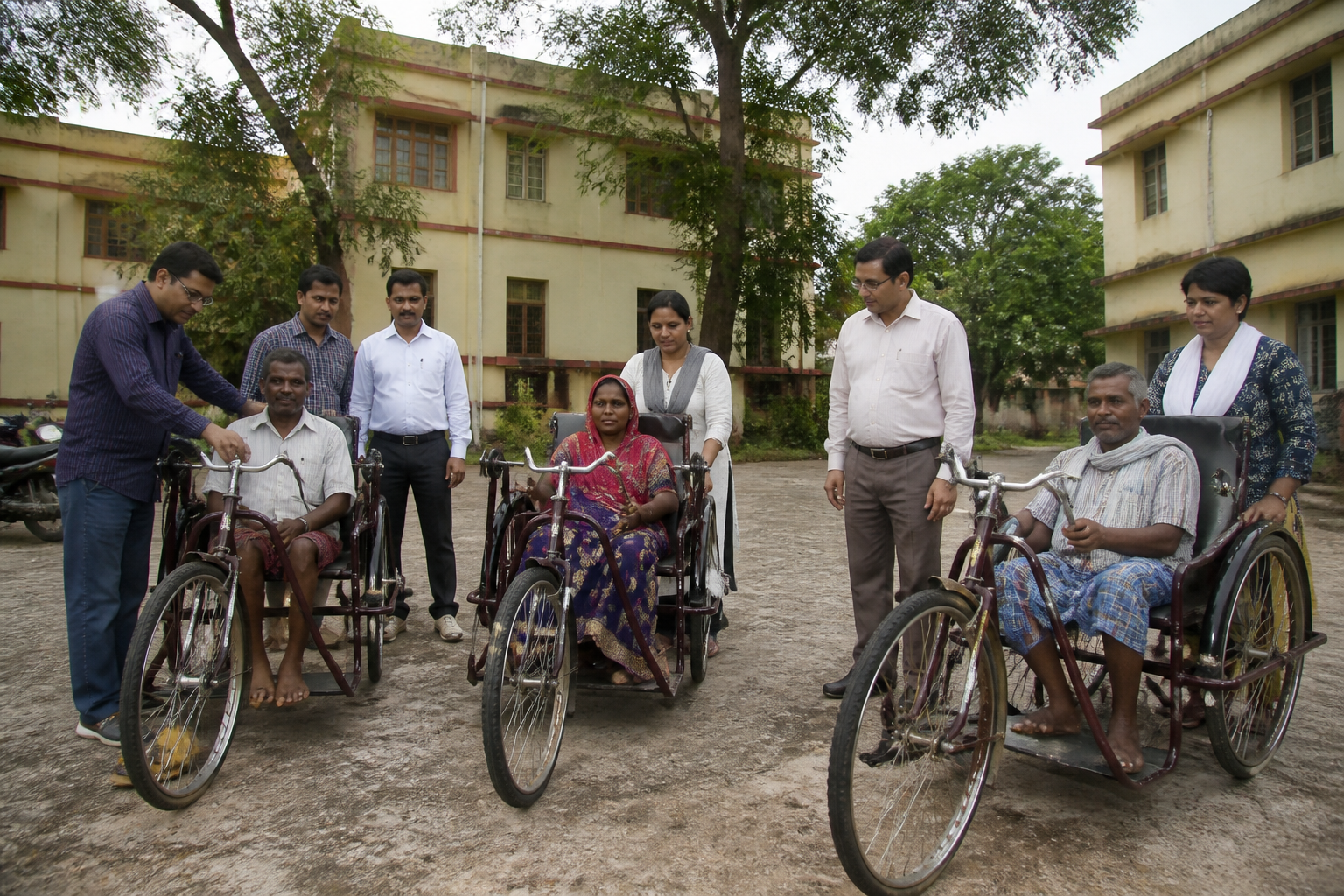
The distribution of tricycles to four people with advanced filariasis in Latehar is a small administrative intervention with a much larger public-health significance: it shows how a disease-control programme must extend beyond medicines to the basic ability to move, reach a toilet, visit a hospital and participate in daily life. District officials say Latehar has more than 1,180 active filariasis patients, making mobility support an issue of local governance rather than an isolated act of assistance.
The four recipients—Usan Bhuiyan, Amrawati Devi, Manti Devi and Pushpa Devi—are all from Sadar block and were identified after Latehar deputy commissioner Sandip Kumar directed social welfare officials to find patients with acute and severe mobility restrictions. The tricycles were distributed at the block-cum-anchal office of Sadar Latehar late on Saturday.
The administrative chain matters. The support did not emerge only from a health facility or a charitable initiative. It followed an instruction from the district administration, identification by social welfare officials and coordination involving local health authorities. That combination points to the institutional complexity of managing a chronic disease whose consequences are medical, social and infrastructural at the same time.
District programme manager for health, N K Das, said all four recipients have grade VII filariasis. He described the condition as one in which swelling is irreversible, skin folds become deep and the skin becomes leathery. The description explains why a conventional health intervention may not be enough for people living with advanced disease. Where mobility is severely compromised, access to public services depends on whether the person has a practical means of transport.
A World Health Organisation note cited in the report describes the everyday consequences in stark terms: mobility becomes a luxury, walking becomes a difficult choice and even going to the washroom can become a major task for a patient with lymphatic filariasis. These are not only clinical outcomes. They determine whether a person can reach a hospital, attend a government office, collect medicines or remain connected to family and community life.
That distinction is important in understanding the Latehar intervention. A tricycle does not reverse the swelling or treat the underlying infection. It addresses one consequence of the disease: the loss of independent movement. In administrative terms, this places the intervention between healthcare, social welfare and disability support. The district’s response therefore raises a broader question about whether disease programmes are designed around the full daily experience of patients or mainly around diagnosis, treatment and prevention.
The scale of the district’s caseload makes that question more urgent. Das said Latehar has a little over 1,180 active filariasis patients. Of these, 813 are cases of filarial hydrocele, while the remaining cases include lymphatic filariasis. The figures indicate that the district’s burden is not concentrated in one form of the disease and that patient support cannot be based on a single clinical pathway.
The report does not provide a complete breakdown of the 1,180 patients by block, age, gender, income, disability level or access to transport. It also does not state how many people require mobility aids, how many have received them previously or whether a formal district-wide assessment has been completed. Those gaps prevent a precise estimate of unmet mobility needs. But the available figures establish that the four tricycles form part of a much larger patient-support challenge.
The disease itself also requires a response that operates at more than one level. Civil surgeon Palamu, Dr Anil Kumar Srivastava, said the morbidity is caused by the Wuchereria bancrofti parasite. He urged residents to participate actively in the mass drug administration drive against filariasis without hesitation. That appeal places prevention and community participation alongside individual support for people already living with severe disease.
Mass drug administration and mobility assistance serve different purposes. The former is intended to address transmission and prevent further illness, while the latter responds to disability and loss of function among existing patients. Treating them as substitutes would leave a gap in policy. A district can pursue drug administration while patients with advanced disease remain unable to travel independently. Conversely, providing mobility aids without sustained prevention would not address the conditions that allow the disease burden to persist.
The Latehar case also shows why the language used to describe filariasis matters for public administration. The official account focuses on severe mobility restrictions, irreversible swelling and the need for transport. That framing moves the patient away from being seen only as a case in a disease register. It recognises that the disease has consequences for access, dignity and participation, even though the supplied information does not quantify those effects.
The responsibility is spread across institutions. The health department tracks patients and supports prevention efforts. The social welfare department was directed to identify people needing tricycles. The district administration coordinated the intervention. Sadar hospital, meanwhile, is expected to receive a medical facelift, including modular operation theatres for dentistry and ophthalmology, according to the deputy commissioner. The report does not establish whether these hospital upgrades are directly linked to filariasis treatment, but they form part of the district’s stated plan to improve local healthcare capacity.
This institutional spread can be useful because the problem itself crosses departmental boundaries. It can also create the risk of fragmented support if patient identification, medical care, rehabilitation and mobility assistance are not connected. The available account records the order to identify severely affected patients, but it does not specify the criteria used, the budget for the tricycles, the number of applicants or the mechanism for monitoring whether the aids remain usable.
Those implementation details are not minor. A mobility aid has value only when it is appropriate to the user’s condition and environment. The source does not describe the design of the tricycles, the distances recipients must travel, road conditions around their homes or whether maintenance and replacement support will be available. It would therefore be premature to judge the intervention’s long-term effectiveness. What can be established is that the administration recognised a mobility problem and responded with a physical access measure.
The numbers also reveal the limits of viewing filariasis only as a campaign issue. The district’s mass drug administration drive depends on residents participating, but the people already living with advanced disease may require a continuing service relationship with the state. Their needs may include clinical assessment, mobility support and access to facilities. The supplied report confirms only some of these interventions; it does not document a comprehensive patient-support system.
For cities and towns, the lesson extends beyond Latehar. Urban and rural health systems are often evaluated through facilities, medicine availability and programme coverage. Yet patients experience those systems through journeys: whether they can leave home, reach a clinic, use a toilet and return safely. When mobility is severely restricted, the distance between a patient and a public service becomes an administrative barrier. In that sense, transport is part of health access.
Latehar’s tricycle distribution offers a visible example of a more grounded approach to public health. The intervention is modest, but it is directed at a practical constraint identified by officials. Its significance will depend on whether it remains a one-time response for four patients or becomes part of a systematic process for identifying and supporting the wider population of active cases.
The evidence currently confirms three points. Latehar has more than 1,180 active filariasis patients; 813 of those cases are reported as filarial hydrocele; and four grade VII patients from Sadar block have received tricycles after the district administration ordered an assessment of people with severe mobility limitations. The larger questions—how many other patients need assistance, how support will be funded and maintained, and how health and social welfare departments will coordinate—remain unanswered in the supplied material. Those questions will determine whether the intervention becomes a durable part of district governance or remains a limited act of relief.
