


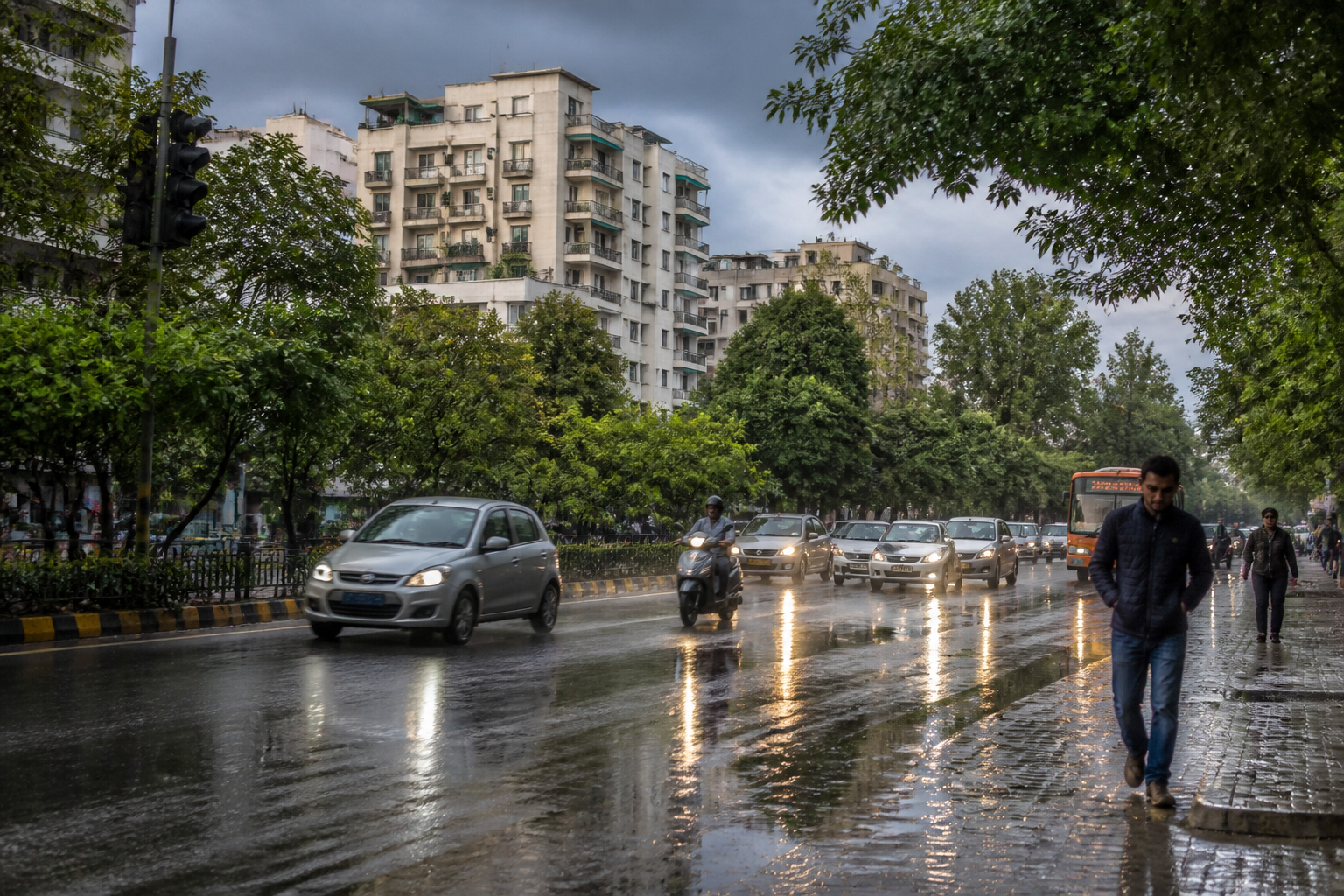
Delhi recorded its second-lowest September night temperature in 25 years on Sunday, as the Safdarjung Observatory reported a minimum of 21 degrees Celsius following rainfall, cloud cover and strong north-northeasterly winds across the Capital region.
The reading was three notches below the seasonal normal and marked Delhi’s coldest September night in two years, according to the India Meteorological Department. The last time Safdarjung recorded a lower September minimum was in 2008, when the temperature fell to 20.8 degrees Celsius. In 2024, the minimum had dropped to 21.1 degrees, the third-lowest September reading recorded since 2001.
The temperature variation was sharper at several other observatories. Palam recorded 19.2 degrees Celsius, 4.7 degrees below normal, while Mayur Vihar reported 19.5 degrees. The Delhi Ridge station was the coolest location, recording 16.8 degrees Celsius — a seven-notch departure from normal that the IMD categorised as “markedly below normal”. Lodhi Road and Ayanagar recorded minimum temperatures of 21 and 21.2 degrees Celsius, respectively.
Daytime temperatures also remained unusually low. The maximum temperature at Safdarjung was 29.2 degrees Celsius, five notches below normal, limiting the usual daytime warming experienced in the city. The combination of lower daytime heating and cooler overnight conditions produced a sharp fall across both urban and peripheral monitoring stations.
An IMD official attributed the drop to the interaction of a low-pressure area over central Uttar Pradesh and an active Western Disturbance over North India. “The low-pressure area over central Uttar Pradesh was drawing moisture into the region, while a Western Disturbance was also active over North India. This led to increased cloud cover and rainfall over Delhi-NCR. The cloud cover reduced day-time heating, while the wet ground and strong North-Northeasterly winds triggered increased cooling,” the official said.
Delhi received rainfall on Saturday, with Safdarjung recording 4.9 mm and the Ridge station recording 6.8 mm. Parts of Noida received 26.5 mm. The IMD also reported gusts of up to 33 kmph at Palam, while north-northeasterly winds reached speeds of 20-25 kmph during the day.
The weather conditions affected the wider Delhi-NCR region unevenly, with the largest departures from normal recorded at exposed or greener locations such as the Ridge and at stations receiving stronger winds. The station-wise readings also show how temperature conditions can differ significantly within the same metropolitan area, depending on local rainfall, land cover and exposure.
According to the IMD’s seven-day forecast, Delhi is expected to see partly cloudy skies on Monday, followed by mainly clear conditions for the rest of the week. Day temperatures are likely to rise to around 35 degrees Celsius, while night temperatures are expected to remain near 25 degrees Celsius.
