


India’s carbon market is being built under pressure from a trade system in which emissions are becoming a direct cost of exporting. The European Union’s Carbon Border Adjustment Mechanism, which entered its definitive phase in January 2026, requires importers to account for the carbon embedded in selected goods. For Indian steel, aluminium, cement and fertiliser producers, the issue is no longer only how much they manufacture or sell, but how much carbon is associated with every unit reaching a foreign market.
That shift changes the meaning of industrial competitiveness. An Indian factory can comply with conventional export requirements and still face a commercial disadvantage if its production is more carbon-intensive than that of competitors. The EU importer pays the border charge, but the cost can travel back through lower margins, higher prices or reduced demand for Indian goods. The United Kingdom is preparing a similar mechanism for January 2027, widening the number of markets in which carbon intensity could influence export economics.
India’s response is centred on the Carbon Credit Trading Scheme, or CCTS, and on efforts to make domestic carbon pricing part of a broader industrial transition. The policy objective is twofold: retain some carbon-related economic value within India and reduce the emissions that generate charges abroad. The second objective is harder. A domestic market can allocate a price to emissions, but it cannot by itself provide the clean electricity, transmission, storage and production technologies required to lower emissions at scale.
The size of the exposure makes this more than a climate-policy question. India’s merchandise exports reached $441.78 billion in FY26, according to the supplied report, while metals remained a major export category. The European mechanism currently covers iron and steel, aluminium, cement, fertilisers, electricity and hydrogen. These sectors are closely tied to heavy industry, energy consumption and the infrastructure of industrial production.
NITI Aayog’s Trade Watch Quarterly, as cited in the report, puts India’s annual metals exports at about $34.8 billion in 2025. Iron, steel and aluminium accounted for roughly 78% of that trade. The EU represented approximately 22% of India’s combined steel and aluminium exports, while the EU exposure for iron and steel stood at 39.3%. That means the European market is not a marginal destination for Indian metal producers. For steel exporters in particular, changes in the cost of carbon can affect a substantial part of their external market.
The export numbers also show why the timing matters. India exported 6.94 lakh tonnes of finished steel worth ₹5,541.2 crore in August 2026, according to the report, with volume up 31.3% and value up 41.5% from August 2025. Between April and August, finished-steel exports reached 29.86 lakh tonnes worth ₹23,646.6 crore, representing increases of 34.1% in volume and 32% in value. Strong export growth can increase exposure to carbon-related trade costs if production systems remain emissions-intensive.
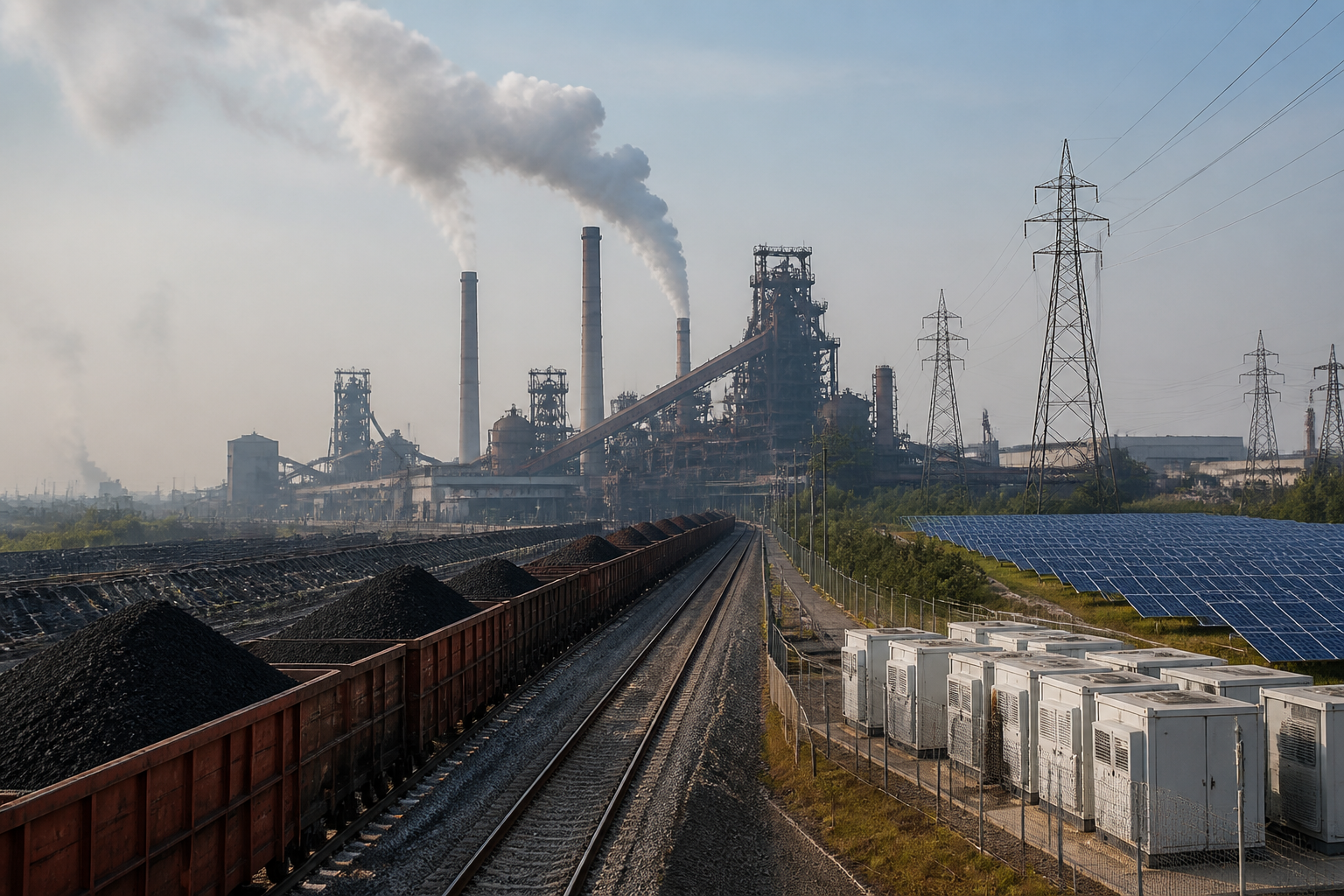
The structural difficulty lies in how Indian metals are produced. NITI Aayog’s Trade Watch Quarterly for April-June, or Q1 FY27, said Indian metals have notably higher carbon intensity than the global average. The report attributed this largely to the continued importance of coal-based Blast Furnace–Basic Oxygen Furnace routes in primary steelmaking and coal-fired Direct Reduced Iron processes, rather than cleaner gas-based or Electric Arc Furnace routes.
This production profile means the carbon problem cannot be solved through documentation alone. Indian exporters need to measure and verify embedded emissions, but lower paperwork does not equal lower emissions. The trade system may reward accurate reporting in the short term, yet the lasting competitive advantage will come from changing the energy and technology used in factories.
A June 2026 working paper by the Indian Council for Research on International Economic Relations estimated that India’s steel exports to the EU could fall by 24% under CBAM. The estimate is based on simulations using the ICRIER Samriddhi Model, a GTAP-E-based general-equilibrium model. It is therefore a modelled scenario rather than an observed fall in exports, but it illustrates the scale of the risk facing a sector with significant European exposure.
India has begun building the administrative architecture needed to respond. The Central government notified the CCTS in June 2023 under the Energy Conservation (Amendment) Act. The scheme is overseen by the Bureau of Energy Efficiency and uses emissions-intensity targets rather than an absolute production cap. Targets become stricter each year and operate in two-year compliance cycles beginning in FY 2025-26.
According to a Press Information Bureau release cited in the report, the system covers more than 700 industrial units across seven emissions-intensive sectors, including steel, aluminium and refining. Companies that perform better than their assigned targets can earn tradeable Carbon Credit Certificates, with each certificate representing one tonne of carbon dioxide equivalent reduction. Companies that fail to meet their targets can face penalties. The framework has also expanded to include sectors such as petroleum refining, petrochemicals, textiles and secondary aluminium.
The design reflects an attempt to connect industrial performance with market incentives. Yet the value of that incentive will depend on the strength of the market and the price attached to each reduction. Ajay Srivastava, founder of the Global Trade Research Initiative, said the EU carbon price was about €75 per tonne of carbon dioxide, compared with roughly $10 in China, while India’s emissions-trading system would take time to become fully operational. His assessment was that recognition of India’s system overseas would not necessarily remove the border charge because a substantial price gap could remain.
That price gap is central to the limits of the domestic-carbon-revenue strategy. The United Kingdom has agreed to recognise India’s CCTS, allowing qualifying carbon payments made in India to be taken into account under the UK’s CBAM. This reduces the risk of exporters paying twice, but it does not eliminate the underlying liability. The relief depends on the carbon price actually paid in India. If the domestic price is lower than the foreign benchmark, exporters can still face a balance at the border.
The policy question is therefore not simply whether India should price carbon. It is how the proceeds and compliance system can support a credible industrial transition. Trishant Dev, a climate, trade and green industrial policy expert at the Centre for Science and Environment, said carbon revenues should help create the infrastructure needed for decarbonisation. In his assessment, cleaner steelmaking depends on affordable clean power, making transmission, energy storage and renewable generation as important to the carbon strategy as the market mechanism itself.
This brings the carbon market into the domain of urban and industrial infrastructure. Electricity networks determine whether factories can access reliable renewable power. Storage affects whether cleaner power is available when industrial demand is high. Transmission capacity determines whether renewable generation can reach manufacturing clusters. Without those systems, emissions-intensity targets can become a compliance burden without creating a practical pathway for factories to change their production methods.
The transition also has a regional dimension. Dev said a share of carbon revenues could support coal and steel regions most affected by the shift. That concern matters because industrial decarbonisation changes not only factory technology but also the economic geography around mines, plants, transport networks and worker communities. The supplied evidence does not establish how India will allocate future carbon revenues, but it identifies reinvestment as a critical design question.
India’s international position adds another layer to the policy challenge. New Delhi has argued in climate negotiations that developing countries should not carry the same obligations as wealthier economies with higher historical emissions. This position is associated with the principle of Common But Differentiated Responsibilities and Respective Capabilities under the United Nations Framework Convention on Climate Change. India has reiterated it in United Nations negotiations, official statements, Nationally Determined Contributions and other multilateral forums.
Dr S Faizi, an international environment policy expert and former UN environmental negotiator, described CBAM as protectionist and argued that India should pursue the dispute-settlement route at the World Trade Organization. India has raised concerns about CBAM and other unilateral environmental trade measures in WTO discussions, while continuing consultations and trade negotiations with the EU. The report does not indicate that India has initiated a WTO dispute over CBAM.
Faizi also drew a distinction between carbon credits and direct emissions reductions. His position was that credits should not obscure the need to cut greenhouse-gas emissions, particularly because India is highly exposed to climate risks. That distinction is important for evaluating the CCTS. A certificate-based system may help establish a market signal and create a mechanism for compliance, but the export advantage will ultimately depend on whether production becomes less carbon-intensive.
The emerging strategy can therefore be understood as a two-part shield. The first part is domestic carbon pricing and verification, which may allow India to retain some economic value and demonstrate the emissions performance of exported goods. The second is industrial decarbonisation, which reduces the carbon content that foreign markets can charge. The first can be established through rules and registries. The second requires capital, cleaner energy, new production routes and sustained implementation.
India has already created a Committee on Export Preparedness for EU CBAM, while independent accredited Indian verifiers empanelled under the Bureau of Energy Efficiency are aligning plant-auditing protocols with the EU’s carbon registry. The first annual CBAM declarations for emissions embedded in 2026 exports are due by September 2027. These administrative milestones will test whether companies, verifiers and government agencies can produce emissions data that foreign systems accept.
The evidence confirms that carbon is becoming part of the infrastructure of trade. India’s export growth, especially in steel, is occurring alongside stricter carbon requirements in important markets. The country has a domestic carbon-market framework and is expanding its institutional response, but the supplied evidence also points to a continuing price gap and high emissions intensity in key industries. The developments to monitor are the operation of the CCTS, the treatment of Indian carbon payments by foreign mechanisms, the quality of emissions verification and the flow of investment into clean power and industrial technology. Those factors will determine whether India’s carbon market becomes primarily a compliance system or a platform for lowering the cost of manufacturing in a carbon-constrained global economy.
