


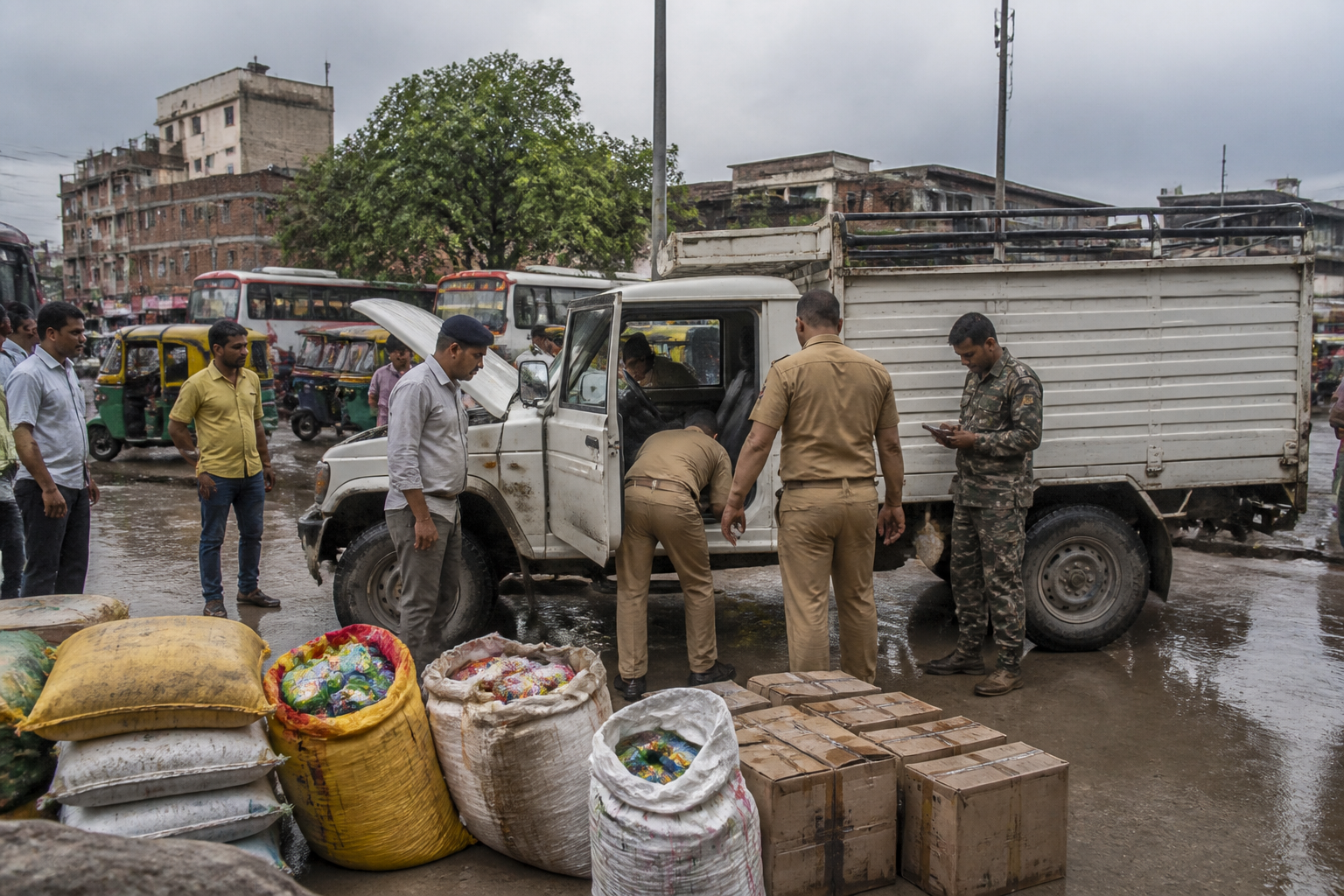
Bihar liquor smuggling is no longer only a matter of stopping vehicles carrying visible bottles. Seizures described by enforcement officials and investigators show a more adaptive system in which consignments are disguised as snacks, school notebooks, homeopathic medicines, clothing and gas-cylinder loads, while deliveries move through roads, concealed vehicle compartments and even the Gandak river. The result is a governance challenge: enforcement agencies are being pushed to identify networks, not merely intercept packages.
The state’s prohibition regime has created a market that operates through concealment. According to the report, smugglers have changed both the physical routes used to move liquor and the language used to discuss it. Ordinary names such as “Rocky Singh” and “Ravi Lal” are allegedly used as substitutes for liquor brands. Terms such as “food”, “groceries”, “milk”, “oil”, “silk/sari” and “parcel” may refer to consignments or their movement, while delivery workers use shortened brand names or terms such as “frooti” for a 180ml tetra pack.
Saharsa SP Vikram Sihag said different groups do not follow one universal code. Instead, networks create their own expressions and change them when they suspect their conversations are being monitored. That makes enforcement dependent on context. A word has little meaning in isolation; its significance emerges only when investigators connect phone conversations with callers, vehicles, locations, payments and seized material.
This is an important shift in the administrative problem. A conventional enforcement model looks for a prohibited product, an identifiable carrier and a route between a supplier and a buyer. The cases reported from across Bihar suggest that each part of that chain can be deliberately fragmented. One person may arrange transport, another may create a concealed compartment, another may finance the consignment and another may receive it. The final delivery may bear little visible connection to the original supplier.
A seizure in Muzaffarpur illustrates how physical evidence and coded communication can intersect. Excise officials allegedly intercepted around 180 litres of spirit in bottles resembling homeopathic medicine containers near Patahi airport ground in the Ahiyapur police station area. The consignment reportedly included 20 cartons labelled “Whizz Dilution Sepia-6” and “Whizz Dilution Justicia Adhatoda 30C”. A code number found on the detained suspect became a link in the investigation, which led officials to a poultry farm in Mohammadpur Khaje village under Karja police station. There, investigators allegedly found an illegal liquor manufacturing unit and detained two people.
The case shows why seizure volumes alone do not fully describe the enforcement task. The reported recovery was significant, but the investigation became more consequential because officials attempted to identify the delivery point and the people operating the production facility. The code was not treated merely as a label on a package; it was used as a possible connection between the carrier, intended recipient and alleged manufacturing operation.
Other seizures show the range of logistical adaptations. In Barh’s Panchmahla area, officials allegedly found around 1,200 litres of foreign liquor beneath sacks of Kurkure in a pickup vehicle. The consignment was suspected to have travelled from Dhanbad towards Begusarai, indicating that the network crossed district and state-linked transport routes rather than remaining confined to a single locality. Two suspected smugglers were arrested in that case.
In Gopalganj’s Phulwaria area, an apparently almost empty SUV drew suspicion. A detailed search allegedly found hidden compartments in the engine area, body, chassis and Stepney, with liquor suspected to have been transported from Uttar Pradesh. In Motihari, bundles of school notebooks allegedly concealed 286 bottles of foreign liquor, amounting to around 51 litres. The police linked the arrested suspect to an earlier liquor-related case in 2024 and suspected that a concealed space had been prepared inside the notebook bundles before their movement by bus.
The reported methods also extend beyond ordinary road traffic. Excise personnel in Katihar allegedly recovered around 52 litres from a concealed compartment fitted into an e-rickshaw. In Gopalganj, around 574 litres were reportedly transported by boat through the Gandak river. Other seizures involved 27 cartons hidden in a gas-cylinder truck and around 2,208 litres concealed among bundles of clothes.
Taken together, these cases reveal three characteristics of the enforcement environment. First, concealment is being integrated into ordinary urban and regional logistics. Snacks, stationery, medicine containers, clothing, passenger vehicles and small commercial transport all become possible covers. Second, the network uses multiple transport modes, including buses, pickup vehicles, SUVs, e-rickshaws, trucks and boats. Third, the routes connect different districts and states, requiring coordination between local police, excise officials and investigators.
The institutional division of responsibility makes this harder. Excise authorities may intercept consignments and investigate violations of prohibition rules, while police stations handle arrests, criminal cases and local intelligence. Transport corridors, bus stands, river routes, roadside markets and commercial vehicles fall within different operational environments. A successful investigation therefore depends on the ability to combine information across agencies and locations rather than treating each seizure as an isolated incident.
The report quotes an unnamed SP-rank police officer saying that investigators are increasingly examining who arranges vehicles, creates concealed compartments, finances consignments, receives the goods and distributes them to final customers. This describes a move from object-based enforcement to network-based enforcement. The central question is no longer only what was seized, but how the consignment was financed, assembled, transported and delivered.
The reported price differences also point to a distribution system organised around product categories and customer demand. A delivery worker in Patna said 180ml tetra packs cost Rs 250 each, while liquor in plastic PET bottles ranged from Rs 300 to Rs 700 depending on the brand. The same source said “Royal Challenge” was shortened to “RC”, “Blenders Pride” to “BP”, “100 Pipers” to “Pipe” and “Teachers” to “Masterji”. These details are not a measure of the total illegal market, but they show how informal retail language can help separate product identification from open communication.
What the evidence does not establish is the overall scale of Bihar’s illicit liquor economy, the proportion of consignments detected or whether seizures are increasing or decreasing over time. The supplied report provides case-level figures from different districts, but it does not present a consolidated statewide dataset, conviction rate, interdiction rate or comparison with earlier years. Those gaps matter because seizure data can demonstrate enforcement activity without revealing the full size of the underlying market.
The evidence does, however, establish the operational diversity confronting enforcement agencies. A network able to shift between coded calls, modified vehicles, disguised packages and river transport can adapt whenever one method becomes vulnerable. Every adaptation also creates new investigative possibilities. A concealed compartment, repeated route, phone number, financial transaction or connection between a transporter and supplier can become a point of entry for investigators.
For urban governance, the larger issue is the use of legitimate mobility and commerce as cover for prohibited trade. Bus stands, roads, small vehicles, commercial consignments and river crossings are not designed only for illicit activity; they are part of the everyday infrastructure of movement. Enforcement must therefore distinguish suspicious patterns without treating ordinary transport or informal commerce as inherently criminal. The cases show the difficulty of performing that task across a wide geography with multiple agencies.
Bihar’s prohibition regime is consequently being tested at the level of systems and intelligence, not only patrols and checkpoints. The reported seizures demonstrate that smugglers are experimenting with language, packaging, vehicle design and routes. They also show that enforcement agencies are responding by tracing relationships between people, places, vehicles and consignments. What remains to be established through official statewide records is how these individual operations fit into broader trends in seizures, arrests, prosecutions and convictions.
Until that evidence is made available, the clearest conclusion is limited but significant: liquor smuggling in Bihar is operating through flexible logistics rather than a single fixed route or concealment method. The enforcement challenge is therefore likely to remain a continuing contest between adaptation and detection, with the effectiveness of the prohibition system depending on how well agencies can connect isolated seizures to the networks behind them.
