


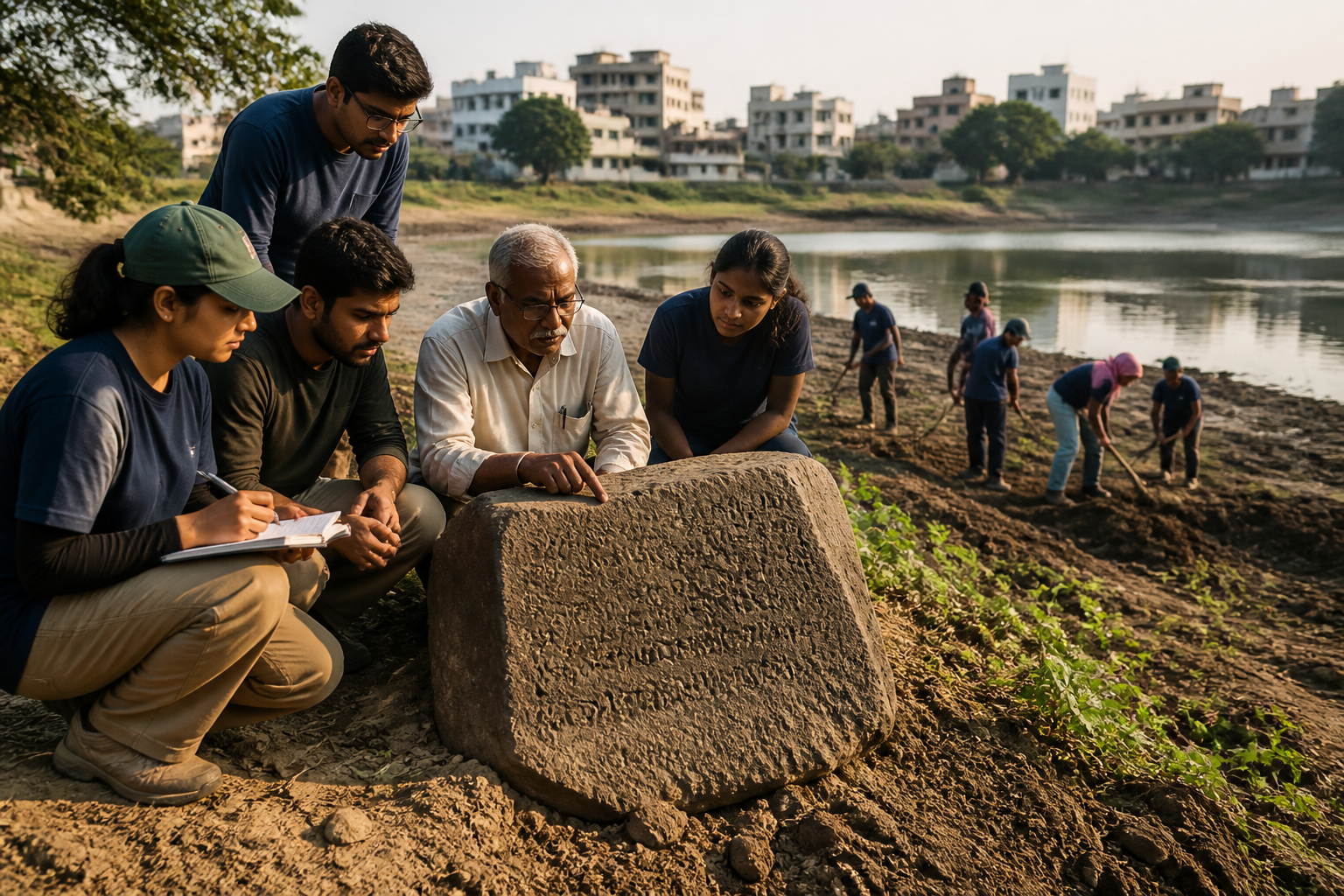
A 13th-century inscription discovered during desilting work at Medavakkam tank has revealed details of a sluice built in 1268 CE for irrigation, offering new evidence of the historic water-management network around present-day Chennai.
The inscription was found by volunteers involved in the restoration of the Medavakkam tank. Senior epigraphist S Rajavelu, who deciphered the inscription, said it records the construction of the sluice during the 20th regnal year of the Telugu Chola king Sri Vijaya Kanda Gopalan.
According to Rajavelu, the sluice was built by a merchant in 1268 CE to support irrigation. He said the inscription was evidence of an ancient water-management system and showed that the area had organised infrastructure for controlling and distributing water several centuries ago.
The inscription refers to Monavakkam lake, which is known today as Medavakkam. Rajavelu said the discovery indicated that Chennai’s surrounding areas once contained several lakes serving both drinking-water and irrigation needs. He also called for the protection of lakes with historic significance.
The discovery was made by N Arjun Shankar of Pasumai Kaval Naduvam during restoration work at the tank. The finding adds a historical dimension to the desilting exercise, which has exposed evidence of how water bodies in the region were constructed and managed in the past.
Local heritage advocate M Poongundran of Pavaleru Thamizh Kalam in Medavakkam said the ancient Medavakkam lake might once have been much larger but is now restricted to a small area. His observation places the inscription within a wider change in the physical extent of the water body and its surrounding landscape.
The inscription also provides a link between the present-day tank and the wider lake-building traditions of historic Tamil Nadu. The Pallavas, Cholas and Vijayanagara kings were focused on creating several hundred lakes in the ancient Thondai Mandalam region, which corresponds to present-day north Tamil Nadu, according to the report.
For the restoration effort, the find means that desilting is not only revealing the physical condition of the tank but also uncovering records of its earlier role. The inscription’s reference to irrigation identifies the sluice as part of a functional water system rather than an isolated construction.
The discovery comes as calls grow for historic lakes and associated structures to be documented and protected. Rajavelu’s appeal specifically includes lakes with heritage value, while the restoration team’s account highlights the reduced area of the Medavakkam water body.
The next steps will involve continued restoration work and the protection of the inscription and other historically significant features associated with the tank. The report did not specify whether the inscription would be formally conserved or whether the lake’s historic boundaries would be documented by an authority.
