


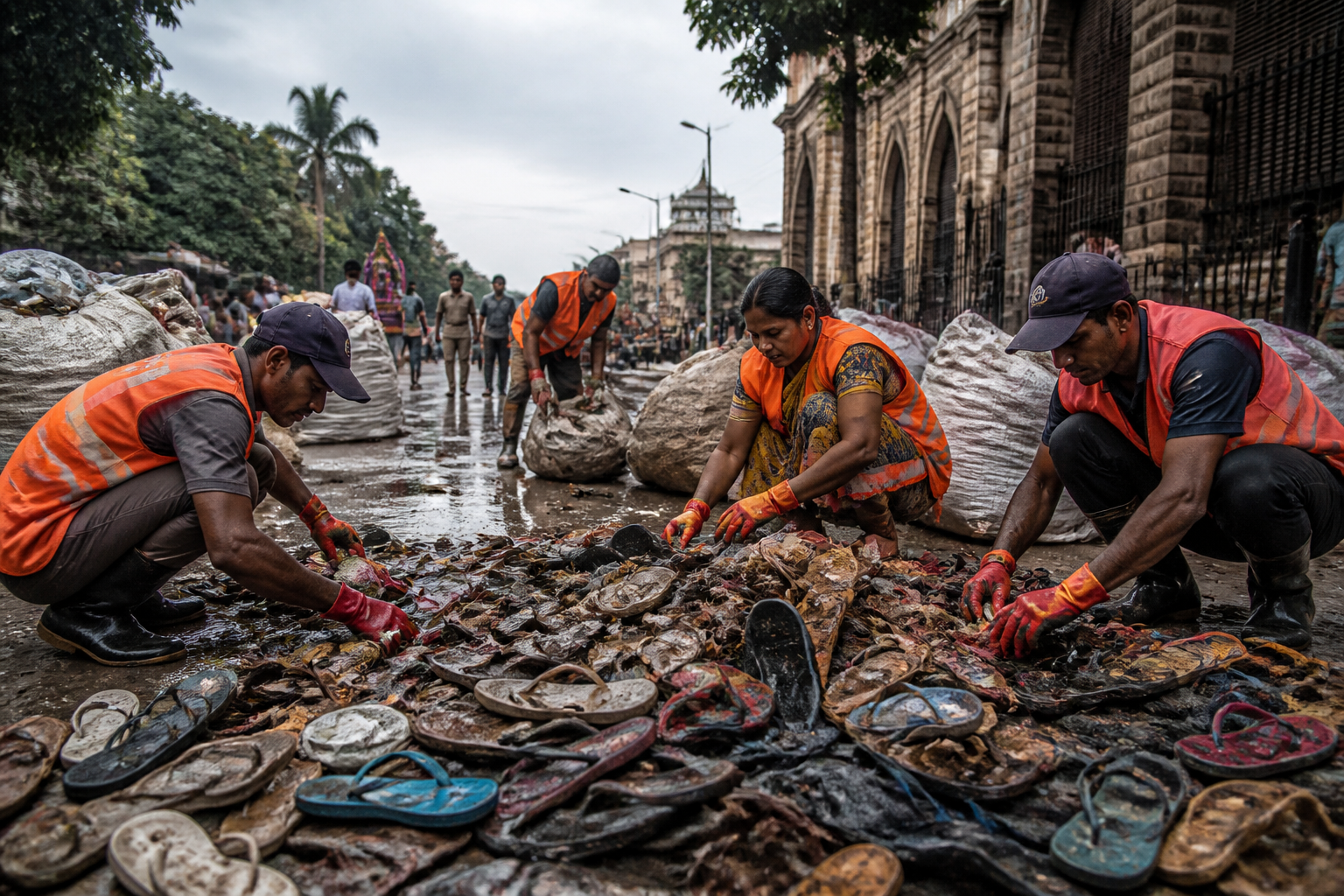
Nearly eight tonnes of footwear collected after Mumbai’s Ganeshotsav are being diverted from landfills for cleaning, refurbishment and material recovery. The initiative, involving the Brihanmumbai Municipal Corporation (BMC) and GreenSole Foundation, offers a detailed example of how a difficult waste stream can be handled through collection, sorting and redistribution rather than disposal alone.
The scale of the collection is linked to the way the city’s largest public festivals occupy streets beyond the boundaries of formal venues. Footwear was found abandoned around pandals and along crowded procession routes after devotees moved through the city. BMC waste management and sanitation teams collected shoes, sandals and slippers from several locations, including nearly four tonnes after Ganesh idol arrival processions on August 29.
The first major collection followed the Chinchpokli Cha Chintamani Ganpati aagman procession. Sanitation workers gathered footwear from Bharatmata Junction, Jijabai Lane and the area near Chinchpokli railway station. The material was initially stored at a vacant plot at Saibaba Municipal School in Parel before being moved to GreenSole’s processing facility in Bhiwandi.
This chain is important because it shows that diversion from landfill begins before recycling technology is involved. Waste must first be identified, collected separately, stored, transported and delivered in a quantity that makes processing viable. In this case, the BMC’s sanitation network created a concentrated stream of discarded footwear, while GreenSole supplied the sorting and refurbishment process.
Vrushali Ingule, Assistant Municipal Commissioner of BMC’s F South ward, said much of the footwear would otherwise eventually be dumped in landfills. She said the initiative could allow the material to be upcycled and distributed to underprivileged children while reducing waste. Her comments place the project within a familiar municipal challenge: public events generate temporary but concentrated waste, and the response often depends on whether materials can be separated quickly enough after the event.
At GreenSole’s Bhiwandi facility, the footwear is manually sorted, washed and sanitised. Uppers, soles, laces and other components are separated and assessed for possible reuse. Usable soles are cut to size and reassembled with recovered uppers to produce refurbished footwear. The components are put together using a repurposed heater machine and pressure-sealed before the edges are cleaned and straps are attached.
The process demonstrates why footwear cannot be treated as a single, uniform material. A discarded shoe may contain a sole, upper, lace, strap and other components with different conditions and reuse potential. The value of collection therefore depends not only on the quantity gathered, but also on the condition and composition of what reaches the processing facility.
Material recovery does not end with making another pair of shoes or slippers. Components that cannot be reused for footwear can be converted into products such as school bags and sitting mats. Thermoplastic rubber and thermoplastic polyurethane recovered from discarded soles are ground into granules and sold to the automotive and furniture industries and waste management agencies.
GreenSole estimates that around 15 per cent of the collected material becomes residual waste or offcuts. That figure is a reminder that upcycling is not the same as eliminating waste. Even a process designed to extend material life produces a residue that needs another disposal or recovery route. The environmental value of the initiative therefore depends on the proportion successfully reused, the distance involved in collection and processing, and the destination of the remaining material.
The logistics of collection also affect the project’s environmental performance. GreenSole co-founder Ramesh Dhami said the organisation did not want to expend unnecessary fuel while trying to reduce carbon emissions through upcycling. He said concentrated collections were important because the organisation’s Thane facility receives between 500 and 3,000 pairs of acceptable footwear at a time.
That operational detail points to a wider condition of urban recycling: recovery systems must be designed around material density and transport efficiency. Small, scattered collections may be difficult to process economically or environmentally, while large event-linked collections can create a more practical supply stream. Mumbai’s festival calendar, in this case, becomes a source of concentrated material rather than a series of isolated household donations.
GreenSole says it has worked on footwear upcycling for more than a decade and processed more than one million pairs. Its collections include corporate drives, individual donations and surplus inventory from manufacturers. The organisation also estimates that its broader upcycling work since 2016 has helped reduce nearly 4,374 tonnes of carbon dioxide emissions. These figures are estimates provided by GreenSole and describe its wider operations, not only the footwear collected during Ganeshotsav.
The distribution plan gives the municipal initiative a second dimension. Refurbished footwear from the collection is to be distributed through schools and non-governmental organisations to children from Classes I to VIII, including students in BMC schools and children in Maharashtra’s tribal belt. The same waste stream is therefore being connected to both municipal sanitation and material access.
That connection also explains why the project cannot be assessed only by the number of tonnes diverted. Its stated outcome includes several linked stages: removing footwear from public spaces, avoiding at least part of the landfill route, recovering usable components, producing refurbished goods, and distributing them through institutions and NGOs. A failure at any stage could reduce the overall value of the intervention.
The BMC’s role is primarily visible at the front end of this chain. Its sanitation teams identified and collected the material and arranged temporary storage before transfer. GreenSole’s role begins with processing, but the two functions are interdependent. Without timely municipal collection, footwear could be mixed with other waste or lost to ordinary disposal. Without a specialised processor, the BMC would have limited options beyond sending the material to a landfill or another conventional waste stream.
The arrangement also raises a practical governance question about festival waste: whether temporary waste generated by large public gatherings should be managed entirely as a post-event cleanup exercise or planned as a separate recovery programme. The reported collection suggests that at least some festival waste can be mapped by location and event phase. The August 29 processions produced a particularly large stream, and workers were able to identify specific junctions and roads where footwear had accumulated.
The evidence supplied does not establish whether the collection will become a permanent annual system, how much footwear is usually abandoned during Ganeshotsav, or what proportion of the eight tonnes will ultimately be converted into usable products. It also does not provide a comparative assessment of the emissions from transporting the footwear to Bhiwandi against the emissions avoided through reuse and material recovery.
Those gaps matter because circular-economy projects require more than a visible diversion figure. Their performance depends on collection coverage, contamination, processing yield, transport distance, residual waste and the durability of the final products. The 15 per cent residual estimate offers one measure, but a complete assessment would also need the final quantity refurbished, the quantity converted into other products and the quantity sold as recovered material.
Still, the initiative confirms a useful institutional principle. Municipal waste systems do not have to treat every discarded object as undifferentiated refuse if collection is organised around the characteristics of the material. Footwear requires manual sorting and component-level assessment, but its soles, uppers and other parts can move into different recovery routes. That makes the system more complex than routine sweeping and disposal, but also creates more than one opportunity for reuse.
Mumbai’s discarded festival footwear thus provides a narrow but revealing view of urban waste governance. The city’s sanitation workers supply the collection capacity, a specialised organisation supplies processing expertise, schools and NGOs provide distribution channels, and industrial users absorb some recovered material. The immediate result is a diversion programme for nearly eight tonnes of footwear. The larger question is whether such coordinated, material-specific systems can be measured, repeated and integrated into the city’s management of other temporary waste streams.
