


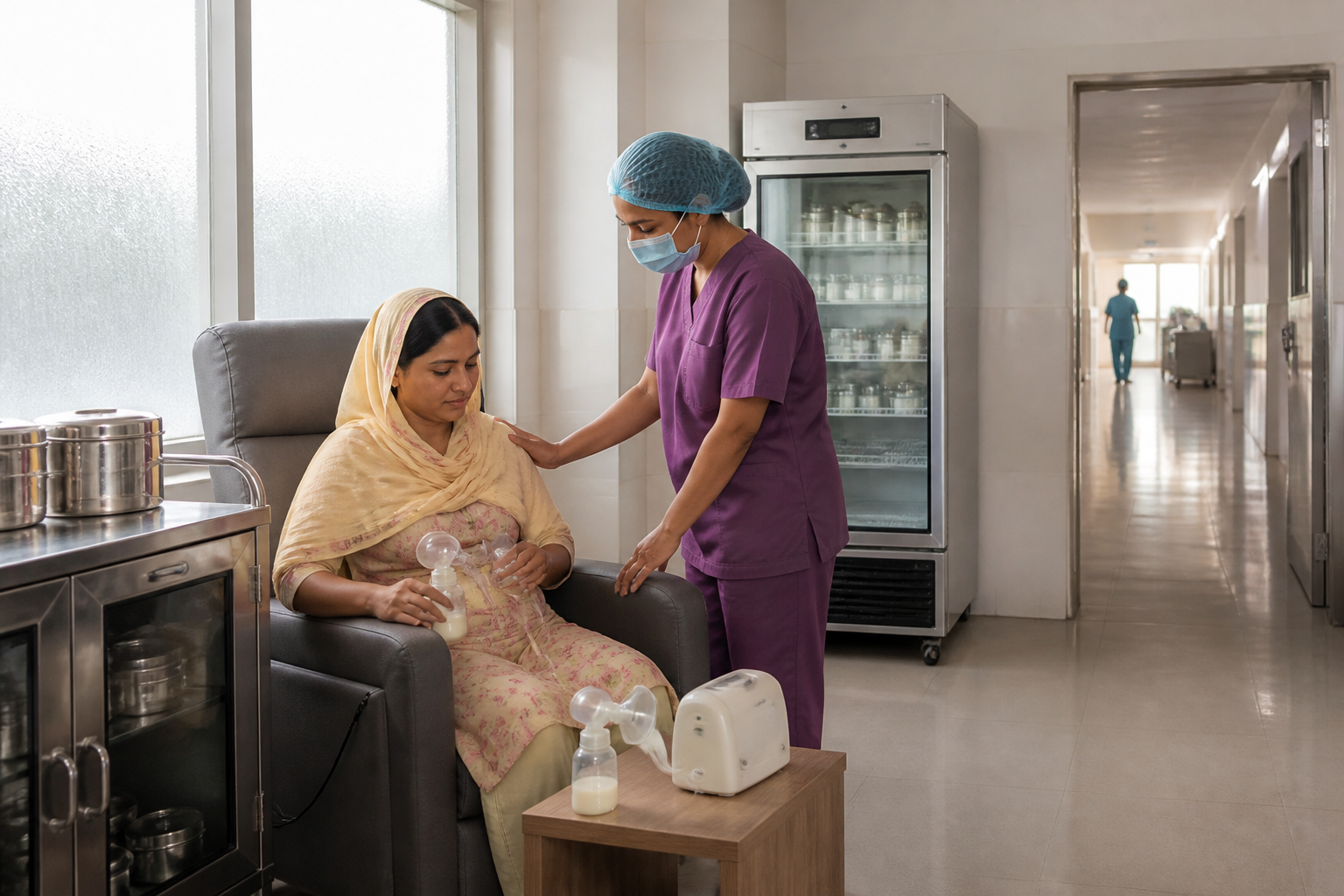
Gujarat’s human milk banks have grown into a public care network that connects neonatal intensive care, hospital infrastructure and community participation. Across six public-sector facilities, 17,025 litres of donated human milk have been collected from more than 52,000 donors over 18 years, benefiting 47,579 babies, according to figures reported by the Times of India.
The numbers describe more than a medical service. They show how a hospital system can respond to a specific vulnerability in neonatal care: babies who need breast milk when their own mothers cannot immediately provide it. The network depends on equipment and clinical protocols, but also on something less visible—women willing to express surplus milk, hospitals able to receive and process it, and community organisations capable of making donation socially familiar.
That combination has developed gradually. In Ahmedabad, Surat and Vadodara, the milk banks described in the report have become part of the support system around premature and critically ill infants. Their work sits within hospitals, but its reach extends into the experience of families spending weeks beside neonatal and paediatric wards.
For Nidhi Soni, a resident of Godhra, the system became visible when her son was born at 30 weeks and spent nearly a month in a neonatal intensive care unit. During the first two or three days, before she could feed him herself, another mother’s milk was used. Soni later began donating at the Ahmedabad hospital where her son was treated and at Parul Sevashram Hospital in Vadodara. Between January and May, she donated about 25 litres.
Her decision also highlights an important distinction in access. Soni stopped donating through a Bengaluru-based agency after learning that recipients were charged. She said families who needed donated milk might not be able to afford it. The public-sector model described in Gujarat therefore matters not only because it makes donor milk available, but because it places the service within hospitals that are already caring for high-risk infants and families with limited choices.
At Ahmedabad Civil Hospital’s Ma Vatsalya milk bank, mothers can express milk in a private room while staff remain available around the clock. The bank has collected 3,236 litres and benefited 5,102 babies, according to hospital figures cited in the report. It receives around 100 lactating mothers a day, Dr Sucheta Munshi, associate professor of paediatrics and the bank’s in-charge, said.
These figures also reveal the operational scale of the service. A milk bank is not simply a collection point. It requires a defined space for expressing milk, staff support, storage, testing and pasteurisation before the milk reaches infants. The report states that the milk provided through Gujarat’s public banks is tested and pasteurised. That makes the banks a form of clinical infrastructure rather than an informal exchange between individuals.
The hospital setting also shapes who becomes a donor. Many women at Ma Vatsalya are already spending long periods in the ward with their own children. Rajal, a 25-year-old from Banaskantha, had been at the hospital for nearly three months while her child underwent surgery and remained under observation for a brain-related condition. After doctors suggested that she express milk because her child could not be breastfed, she began donating the surplus to other babies.
Her experience shows how donor networks can form within institutions. Mothers who remain in wards for weeks or months may encounter other families facing similar difficulties. Dr Jolly Vaishnav, head of paediatrics, said these women sometimes form informal support groups and strong bonds. In that setting, donation becomes part of a wider exchange of information, emotional support and practical solidarity.
The system also carries the memory of loss. Staff at Ma Vatsalya recalled a mother who continued donating after one of her twins died from congenital complications. The report says she found some solace among other mothers and their babies. Another donor, Pooja Patel, spent 44 days at the hospital after delivering a baby weighing 815 grams. Her child required CPAP for 12 days and later stayed with her in the Kangaroo Mother Care unit. By discharge, when the baby weighed 1.25kg, Patel had become a regular donor.
These accounts are not a substitute for clinical evidence, but they explain how public health infrastructure is sustained in practice. The service depends on people whose own contact with medical vulnerability changes their understanding of what can be shared. The hospital provides the institutional setting; the donors provide the supply; and paediatricians and support staff connect the two.
The clinical reason for donor milk is strongest among premature and medically fragile babies. Dr Shwetal Bhatt, professor of paediatrics and nodal officer of SSG Hospital’s Comprehensive Lactation Management Clinic, described a mother’s own milk as “like a live vaccine” and said donor milk is a substitute when the mother’s milk is unavailable. Dr Rakesh Joshi, medical superintendent at Ahmedabad Civil Hospital, said the benefits are particularly important for premature babies, including weight gain, brain development and immunity.
Hospital officials also said their data indicated lower infection rates among admitted infants since the initiative began. The supplied report does not provide the underlying dataset or a comparison methodology, so the claim should be understood as an official hospital statement rather than an independently assessed finding. Still, it points to the way milk banks are evaluated within neonatal care: not only by litres collected, but by their relationship to infant feeding, recovery and hospital outcomes.
Surat’s experience demonstrates that the network required social as well as medical infrastructure. Organised work on human milk donation began there nearly two decades ago, and a milk bank opened at SMIMER Hospital in 2008. Doctors and community groups held donation camps to familiarise families with expressing, storing and sharing breast milk.
The early challenge was not only capacity. It was comprehension. Damyanti Bhavani, immediate past president of Kutch Kadva Patidar Samaj Surat, recalled that many members initially did not understand the idea of donating milk and storing it for later use. The community later began encouraging lactating mothers to participate. Dr Ketan Bharadva and the Amrutam Foundation helped build the programme, while women’s groups supported its expansion through Project Yashoda.
This history matters because services such as milk banks cannot be scaled by hospital infrastructure alone. A new facility can provide equipment and staff, but regular supply depends on trust, awareness and a clear understanding of who benefits. Surat’s model, as described in the report, developed through repeated donation camps and relationships between paediatricians, community groups and families.
The state-level figures suggest that this approach has produced a substantial public resource. More than 52,000 donors have contributed 17,025 litres over 18 years, with 47,579 babies benefiting. The average volumes conceal different kinds of participation: some women donate once, some contribute while their children are hospitalised, and others continue after discharge. The reported stories show that donation is not tied to one social profile or one emotional circumstance.
At the same time, the figures also clarify what remains unknown from the available evidence. The report does not provide a district-wise comparison of the six banks, the number of infants turned away, the total demand for donor milk, the operating costs of the facilities, or the staffing and equipment required at each centre. It also does not establish whether every eligible premature infant in the state has access to a milk bank. Those gaps do not diminish the achievement recorded, but they limit what can be concluded about coverage and unmet need.
The institutional question is therefore larger than whether Gujarat has milk banks. It is whether public hospitals can make such services consistently available to families at the point when they need them. The answer depends on the relationship between neonatal units, lactation-management services, milk-bank operations and referral systems. It also depends on whether hospitals can provide donors with privacy, counselling and round-the-clock support, as Ma Vatsalya does according to the report.
There is a further equity dimension. Donor milk becomes most valuable when a mother’s own milk is temporarily unavailable, when a baby is too premature or unwell to breastfeed, or when the mother is separated from the infant’s care process. These circumstances are concentrated in hospitals serving vulnerable families. A public system that provides tested and pasteurised milk without shifting the burden to families can reduce one part of the inequality surrounding neonatal treatment.
The Gujarat experience also shows why community participation should not be treated as a replacement for public provision. The donors and community groups are central to the network, but the safety and continuity of the service depend on hospitals, trained staff and clinical oversight. The public value emerges from the combination. Informal goodwill becomes a reliable service only when it is absorbed into accountable institutions.
The evidence available in the report confirms three developments: Gujarat has built a sizeable public human milk-bank network; the network has supported tens of thousands of babies; and its growth has relied on both hospital systems and community-led awareness. What it does not yet establish is the network’s full coverage, capacity against demand or long-term health outcomes. Those are the measures that would show whether the state’s milk banks have moved from successful individual facilities to a fully integrated neonatal-care system.
