


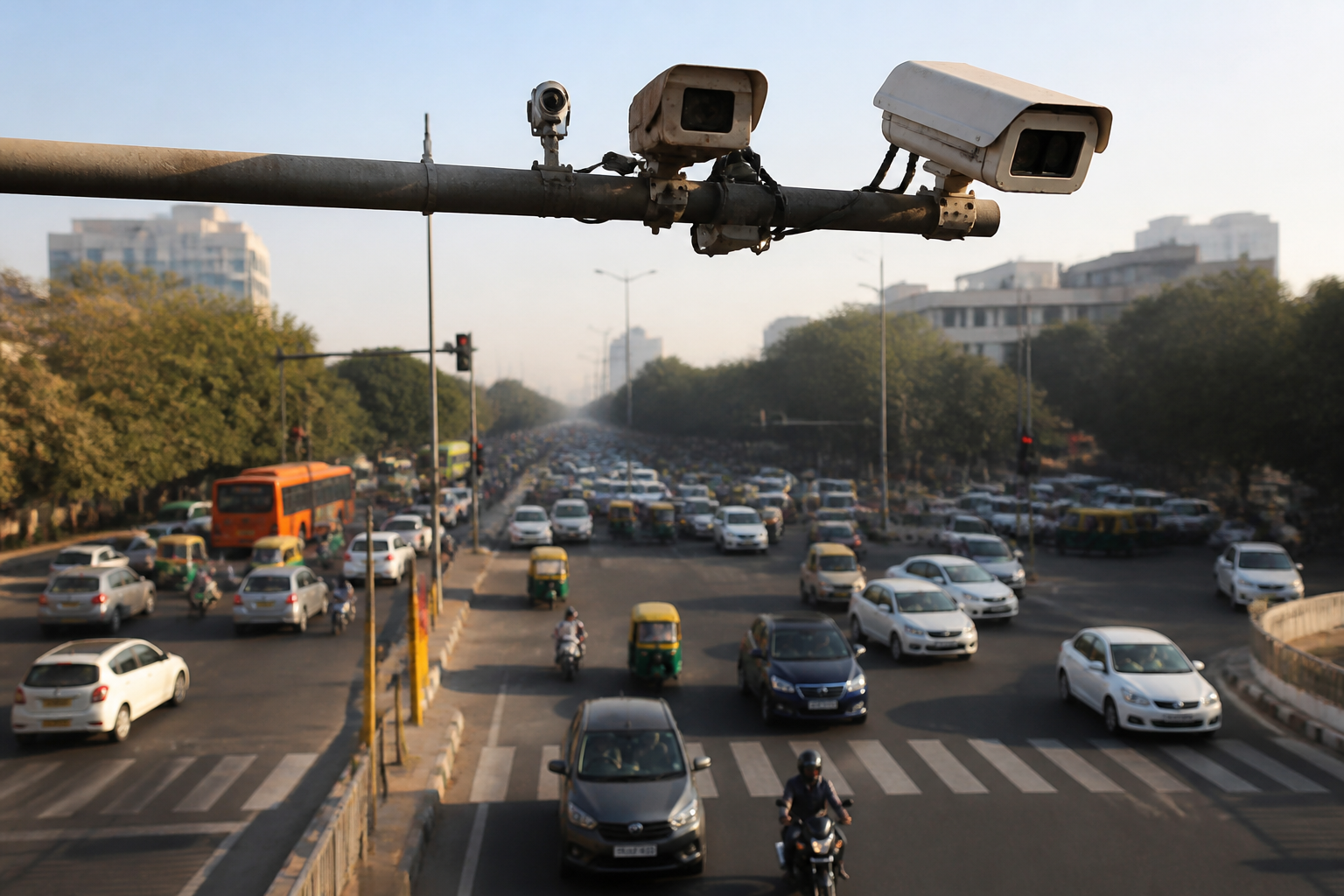
Delhi traffic challans issued through cameras rose to 38,95,591 by 20 September 2026, with car drivers accounting for the largest share as the capital expands automated enforcement across roads, junctions and sensitive locations.
According to traffic police data reported by Jagran – New Delhi, 17,56,160 camera-generated challans were issued to car drivers during the period. Two-wheeler riders followed with 12,42,653 challans. Taxis accounted for 5,22,668 challans, while light goods vehicles and three-wheelers recorded 1,34,856 and 80,097 challans respectively.
The total represents an increase of 1,60,918 challans compared with the same period last year. Traffic police had issued 37,34,673 camera-based challans by 20 September in the previous year. The figures indicate that enforcement is reaching more vehicles without requiring police personnel to be physically present at every location.
Delhi traffic authorities are using the Integrated Traffic Management System, Automatic Number Plate Recognition cameras, artificial intelligence-based smart cameras, Over Speed Violation Detection systems and Red Light Violation Detection cameras. These systems identify vehicles and record violations for the issuance of challans.
The enforcement data also shows a parallel focus on dangerous driving behaviour. The New Delhi range traffic police conducted a week-long operation against vehicles travelling in the wrong direction across 11 traffic circles in New Delhi and South-West districts. The drive resulted in 915 challans, with FIRs also registered under the applicable law.
In total, 33,005 challans and 417 FIRs have been recorded this year for wrong-side driving, according to the report. The enforcement action covers a violation that can create direct collision risks, particularly on busy urban roads and at junctions where traffic flows are concentrated.
The southern range traffic police, working with local police, also conducted anti-encroachment and parking enforcement drives on 19 and 20 September. Officials issued 829 challans for illegal parking. Of these, 266 were e-challans and 563 were issued through the official Delhi Traffic Police mobile application.
The same operation removed 98 roadside stalls and towed eight vehicles using cranes. These actions link camera-based enforcement with physical management of road space, where illegal parking and roadside occupation can reduce carriageway capacity and obstruct movement.
The figures show that automated enforcement is becoming a larger part of Delhi’s traffic administration, while police drives continue to address wrong-side driving, illegal parking and encroachment. The latest camera-based challan total and enforcement actions were reported with figures available up to 20 September 2026.
