


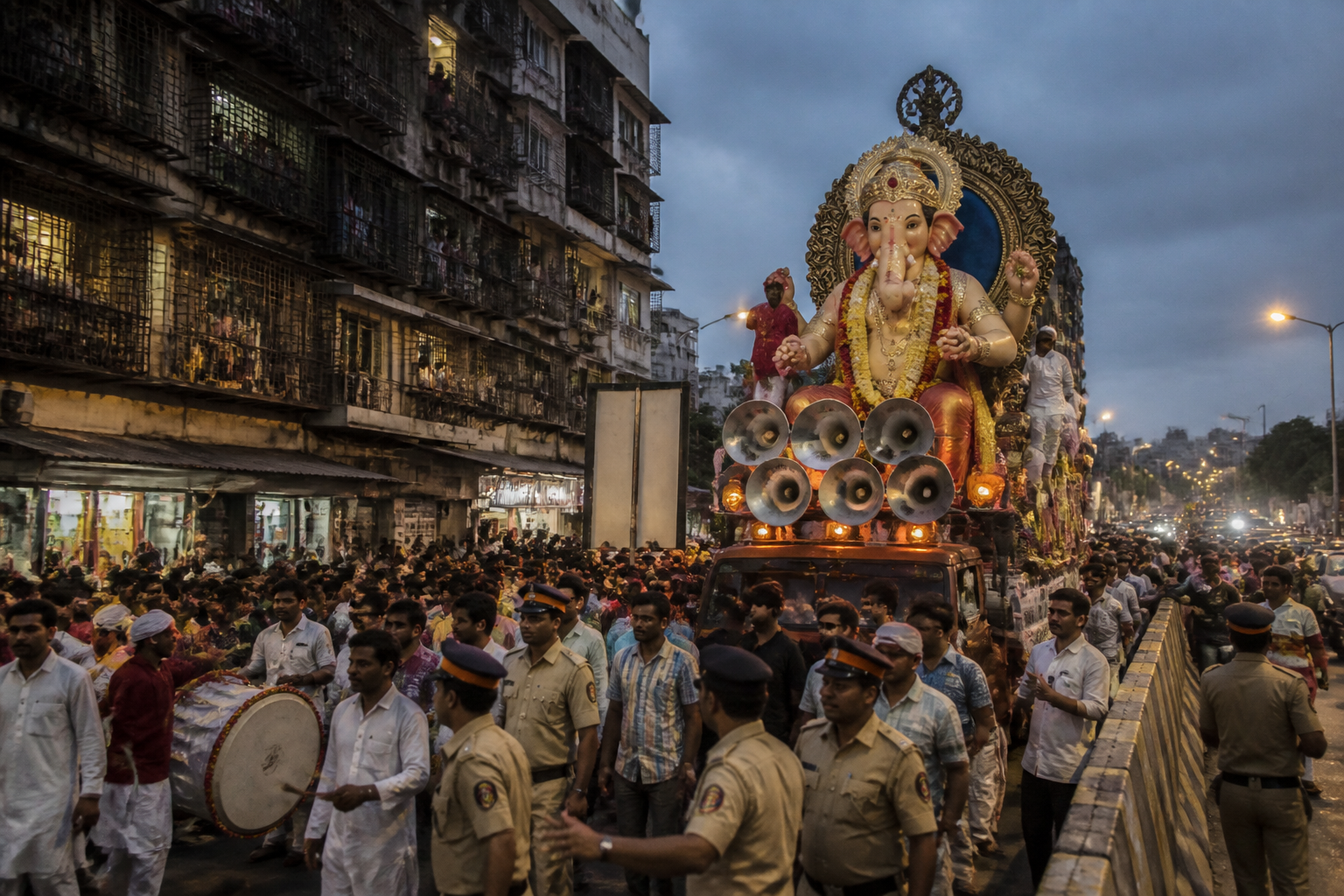
Mumbai’s Ganesh visarjan noise pollution problem has returned to the same institutional question: why do court directions and existing rules fail to control sound levels during large public processions? A report by the Awaaz Foundation, cited by Loksatta, recorded the highest sound levels in Bandra and Worli during this year’s immersion processions, even as the Bombay High Court had issued directions relating to noise and air pollution.
The immediate picture was familiar. Musical instruments, loudspeakers and firecrackers were used along several immersion routes, while the report said many public Ganesh mandals did not follow the applicable noise-pollution rules. At a political party facility near Girgaum Chowpatty, the sound level reportedly reached 103 decibels. The Awaaz Foundation also said loudspeakers continued to be used until 12.30 am, which it described as a violation of noise-pollution rules.
These observations matter because Mumbai’s immersion processions are not confined to a single venue or a short, controlled event. They move through public roads, residential neighbourhoods and major coastal immersion points, bringing together processions, traffic management, temporary structures, public-address systems and crowds. The result is an urban management challenge in which the right to conduct a public cultural event intersects with the rights of residents to health, rest and a regulated public environment.
The supplied report does not provide a complete table of readings for every location, nor does it identify the exact times and measurement methods for the highest levels recorded in Bandra and Worli. It does, however, identify a clear pattern: despite prior judicial directions and longstanding rules, enforcement remained uneven across immersion routes. That distinction is important. The problem is not simply that one procession exceeded a permitted level. It is that the administrative system appears unable to ensure consistent compliance across a dispersed, high-volume event.
The Awaaz Foundation’s role is central to the evidence available in the report. The organisation has monitored sound levels in Mumbai city and its suburbs during the Ganesh festival for several years. Its observations offer continuity that a single-night incident report cannot provide. At the same time, the supplied material does not reproduce the foundation’s full report or explain its sampling framework. The findings therefore establish a reported pattern of excessive noise, while leaving some technical questions about coverage and comparability open.
The report also records an important qualification: several mandals reportedly avoided loudspeakers and DJs this year. That suggests compliance is not impossible and that organisers can alter the sound profile of processions. Yet the presence of lower-noise practices in some locations does not resolve the wider enforcement problem. If some organisers reduce amplification while others continue to use loud systems or firecrackers, residents’ experience will depend heavily on the route, timing and local administrative response.
This unevenness is a familiar feature of urban regulation. Rules may exist at the state or judicial level, but compliance takes place on streets managed through multiple agencies and layers of authority. During a major festival, municipal officials, police personnel, traffic authorities, public representatives, mandals and residents all influence what happens on the ground. A legal direction can set the standard, but it cannot by itself measure every procession, prevent every firecracker or stop every loudspeaker after the permitted hours.
The report’s reference to confusion among public Ganesh mandals points to a communication gap as well as an enforcement gap. It says there was uncertainty about the court’s directions, while implementation at the administrative level was inadequate. When rules are not communicated in a clear, route-specific and operational form, organisers may claim uncertainty about what is permitted. When enforcement is not visible and consistent, compliant organisers may also see little reason to maintain restrictions that others ignore.
A workable system would require the legal requirements to be translated into instructions that organisers, police and municipal teams can apply during the procession itself. The supplied report does not establish whether such a system was in place, how many enforcement teams were deployed, or how many violations were recorded. Those omissions prevent a full assessment of institutional performance. They do not, however, weaken the basic concern raised by the reported readings and the alleged late-night use of loudspeakers.
The health dimension makes the issue more than a dispute about festival management. The report states that sound levels above 70 decibels can adversely affect health. It does not provide a detailed medical assessment of exposure during this year’s processions, and the supplied material does not quantify how long residents, police personnel, workers or participants were exposed. Still, the reported 103-decibel reading at Girgaum Chowpatty indicates the scale of the gap between a regulated sound environment and the levels recorded at at least one location.
Urban exposure is also shaped by duration and repetition. A single high reading and prolonged exposure are not identical problems, but both require attention in a city where processions pass through dense neighbourhoods. Residents living near routes may experience repeated sound peaks, while workers and enforcement personnel remain in those environments for long periods. The report does not measure these different exposure patterns, but it places them within the larger challenge of regulating sound in crowded public spaces.
Air pollution adds another layer. The High Court directions cited in the report concerned both noise and air pollution, while firecrackers were observed during the immersion processions. The available material does not provide air-quality readings or establish the contribution of the reported firecracker use to pollution levels. The relevant institutional question is therefore not whether noise and air pollution should be treated as identical, but whether event planning addresses both risks together rather than handling them as separate compliance exercises.
The timing of enforcement is especially significant. The report says the court had directed strict implementation of existing noise-pollution rules, a ban on firecrackers on roads and strict action concerning security deposits. These measures indicate that compliance was expected to be supported not only by warnings but also by consequences for violations. Yet the reported continuation of loudspeaker use until 12.30 am suggests that the existence of a penalty framework does not guarantee its application during a crowded public event.
Security deposits can work only when their terms are clear, violations are documented and the deposit is actually liable to forfeiture. The source report mentions the High Court’s directions on strict implementation of deposits but does not state how many deposits were collected, how many notices were issued or whether any amount was forfeited. Without that information, it is not possible to judge whether the mechanism functioned as a deterrent or remained largely administrative paperwork.
The same applies to sound monitoring. Measurements have public value only when they are linked to identifiable locations, times, responsible organisers and follow-up action. The report identifies Bandra, Worli and Girgaum Chowpatty as important points in the sound-level story, but it does not show how readings translated into enforcement. That missing link is where many urban regulations fail: monitoring records the breach, but the system does not demonstrate what happened next.
Mumbai’s experience also shows why cultural-event regulation cannot be reduced to a question of permissions. An immersion procession uses public roads and affects mobility, neighbourhood tranquillity, policing, waste management and emergency access. Noise is one part of a wider temporary urban system. When responsibilities are divided among agencies, the city needs a coordinated operating plan that is understood before the event begins and visible during the procession. The supplied report does not confirm whether such coordination was adequate this year.
The evidence therefore supports a measured conclusion. Mumbai’s Ganesh visarjan processions included examples of lower-noise conduct, but reported violations continued despite court directions and existing rules. The central failure appears to be implementation across multiple locations and organisers, not the absence of regulation. The precise scale of the problem cannot be established from the supplied report alone because detailed readings, enforcement records and agency responses are not provided.
The next stage of public accountability lies in those missing details: the complete Awaaz Foundation report, location-wise readings, the number of violations recorded, action taken against organisers, the use of security deposits and the official explanation for late-night loudspeaker use. Until those records are available, Mumbai’s annual noise debate will continue to document the same contradiction—a city with rules for public sound, but inconsistent capacity to enforce them when streets become sites of mass celebration.
