


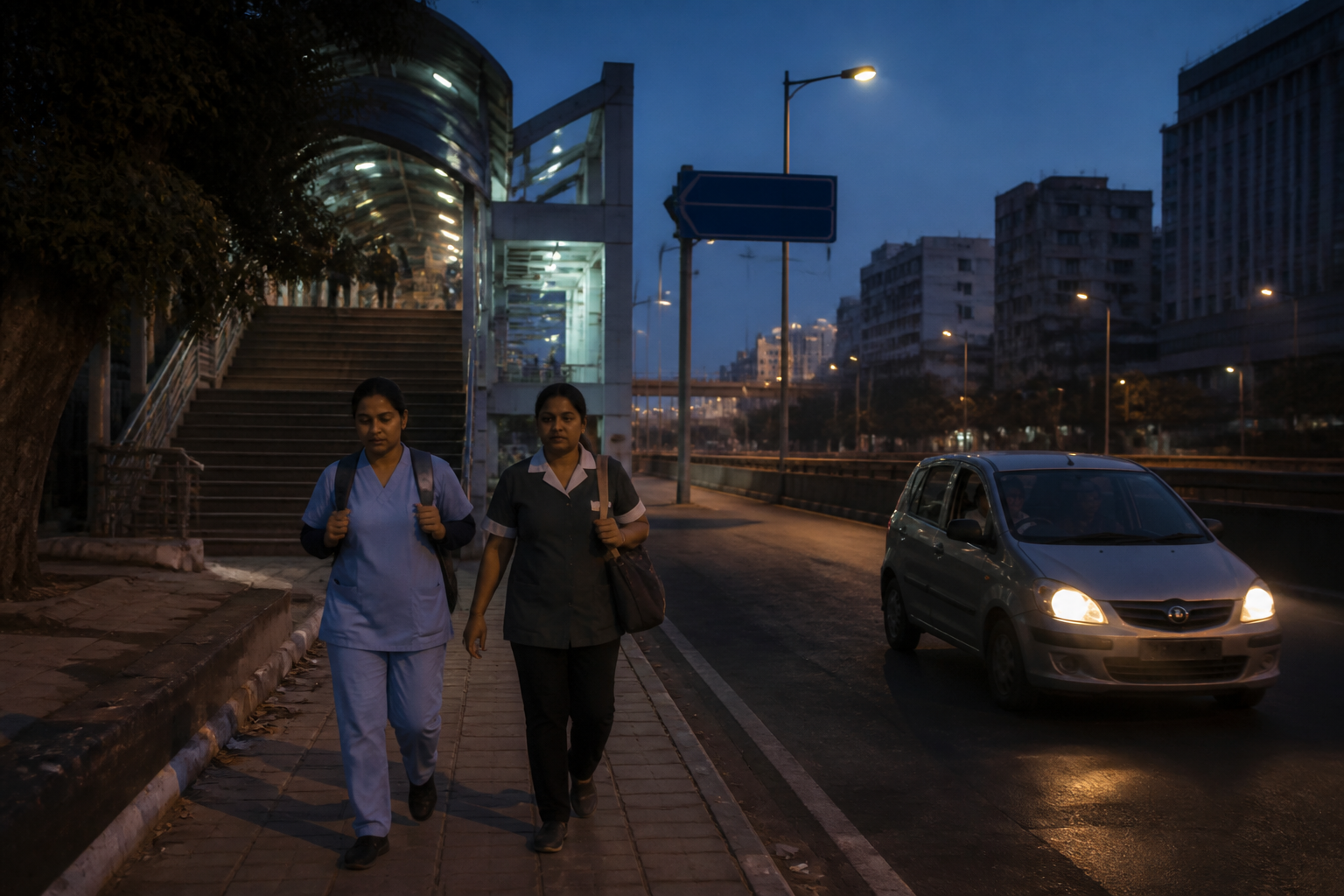
Women’s safety in Delhi after dark is being managed not only through public infrastructure, but through a collection of private arrangements and personal routines. A Times of India report documenting the journeys of women working at night across Delhi-NCR shows how company cabs, security escorts, live-location sharing, group travel and charged phones have become part of the working day for nurses, call-centre employees, cabin crew members, hotel workers, journalists and a woman cab driver.
The accounts point to an urban problem that begins after the shift ends. For a worker finishing at 5am, leaving a hospital at 11pm or walking a kilometre to a metro station before dawn, employment does not end at the workplace gate. The commute home becomes a separate safety task, often managed by the worker and her family rather than by a dependable public system.
That distinction matters because Delhi’s night-time economy depends on people who work when most of the city is closed. Hospitals require nurses through the night. Airports operate across shifts. Hotels, call centres, newsrooms and delivery networks continue functioning after conventional office hours. The report’s six accounts show that the city’s ability to provide these services is linked to whether workers can travel safely between workplaces, transport nodes and homes.
Yet the safety arrangements described are uneven. Priyanka Singh, a call-centre employee who finishes around 5am, said she relies on office transport for the journey between Dwarka and Netaji Subhash Place. Her concern was not limited to her own commute: she questioned how women working at smaller centres manage when such transport is unavailable. The observation exposes a structural divide between workers employed by organisations able to provide transport and those whose employers cannot or do not offer the same support.
For Rubina, a cabin crew member travelling between Sarita Vihar and Indira Gandhi International Airport, the employer arranges a cab and provides a guard between 7pm and 7am. She also shares her location with her husband whenever she leaves home. These measures reduce the risk attached to the journey, but they also show how formal workplace protection is supplemented by continuous private monitoring.
The same pattern appears in other forms. A journalist interviewed for the report described keeping her phone fully charged, sharing her location and avoiding isolated roads while travelling to assignments at night. A hotel worker walks about a kilometre to reach a metro station and said cars have slowed down beside her during that walk. She calls a family member, travels in groups when possible and avoids isolated stretches. The metro may provide the main leg of the journey, but the route to the station remains a point of exposure.
This is the overlooked geography of night-time mobility: not simply whether a train or bus is running, but what happens between the workplace and the transport stop, and between the final stop and home. A station can be operational while the road leading to it remains poorly watched, deserted or uncomfortable to walk along. The report does not provide a citywide audit of these routes, but the individual account makes the last-mile gap visible.
A nurse at a government hospital described another weakness. Her evening shift does not always finish when the roster says it should. After completing work and changing, she may leave at about 11pm, when buses are less frequent and few passengers are travelling. Her concern is not only the condition of the route but also the interaction between irregular work hours and public transport schedules. A system designed around regular peaks can leave essential workers with fewer options when shifts run late.
The report therefore presents night-time safety as a coordination problem involving employers, transport agencies, police, public-space managers and families. Each institution controls only part of the journey. Employers may arrange cabs. Transport agencies may run buses or metro services. Police may be responsible for surveillance and response. Municipal bodies influence lighting, street design and the condition of paths. The worker experiences the entire route as one continuous trip, even though responsibility is divided across institutions.
That division can make accountability difficult. If a worker feels unsafe while walking to a station, the issue may not fall neatly within the responsibility of the employer that arranged her final ride. If buses are infrequent after a shift, the transport problem may be separated from the hospital’s rostering system. If CCTV cameras are installed but not functional, the presence of equipment can create the appearance of coverage without providing reliable protection.
The cabin crew member specifically identified a lack of functional CCTV cameras as a problem and said dashcams had recently been installed in the family’s cars for safety. The journalist interviewed by the Times of India also said she could not rely on police surveillance or CCTV when travelling at odd hours. These comments do not establish the condition of Delhi’s surveillance network as a whole, but they do show that workers’ confidence in formal monitoring cannot be assumed merely because surveillance infrastructure exists in some locations.
The result is a layered safety system in which women are expected to anticipate risk before beginning the journey. The cab driver interviewed checks passenger details and names carefully before accepting a night ride, remains cautious about male passengers and pays attention to isolated roads. Her work involves providing mobility to others, but her own safety decisions shape which trips she accepts. This places a further burden on workers in the transport economy, where refusing rides may also affect earnings.
The personal precautions described in the report are practical, but their normalisation raises a larger urban question. When a charged phone, a live location, a call to a family member or a decision to reject a ride becomes a routine condition of employment, safety is being treated as an individual capability rather than a public service outcome. Workers are adapting to the city, but adaptation should not be confused with secure access.
There is also an employment dimension. The call-centre employee’s dependence on office transport suggests that the ability to take a night job may vary according to the resources of the employer. The nurse’s reliance on public buses presents a different situation from that of a cabin crew member travelling in an escorted company cab. These are not equivalent commuting conditions, even though all are part of the same metropolitan labour system.
The report does not supply comparative data on the number of women working night shifts, the availability of late-night buses, the functioning rate of CCTV cameras, reported incidents along these routes or the safety performance of employer-provided transport. Those gaps are important. The accounts establish a recurring lived experience, but they cannot by themselves measure the scale of the problem across Delhi-NCR.
What they do establish is that the night-time city is not experienced uniformly. A worker with a fixed company cab, familiar passengers and an escort has a different mobility network from a worker who must walk to a station and wait for an infrequent bus. The difference is shaped by occupation, employer, location, shift timing and access to family support. A single label such as “night transport” conceals these variations.
For urban administration, the evidence points towards the need to view the commute as a complete chain rather than as disconnected services. The relevant question is not only whether a metro station, bus route or road exists, but whether a worker can move from a workplace to that service and from the service to her home without relying on exceptional personal arrangements. The supplied accounts do not prescribe a specific policy response, but they clearly identify where the system is being tested: shift changes, isolated stretches, station approaches, bus waiting periods and employer boundaries.
Delhi’s night-time economy depends on women whose work continues after the city’s visible activity declines. Their stories show that safety currently rests on a mixture of institutional support and individual vigilance. The evidence confirms the need to examine the full journey, especially the last mile and the hours when public transport becomes less frequent. What remains unestablished is how widespread each problem is and which agencies are responsible for closing the gaps. Those are the questions that a citywide assessment of night-time mobility should answer.
