


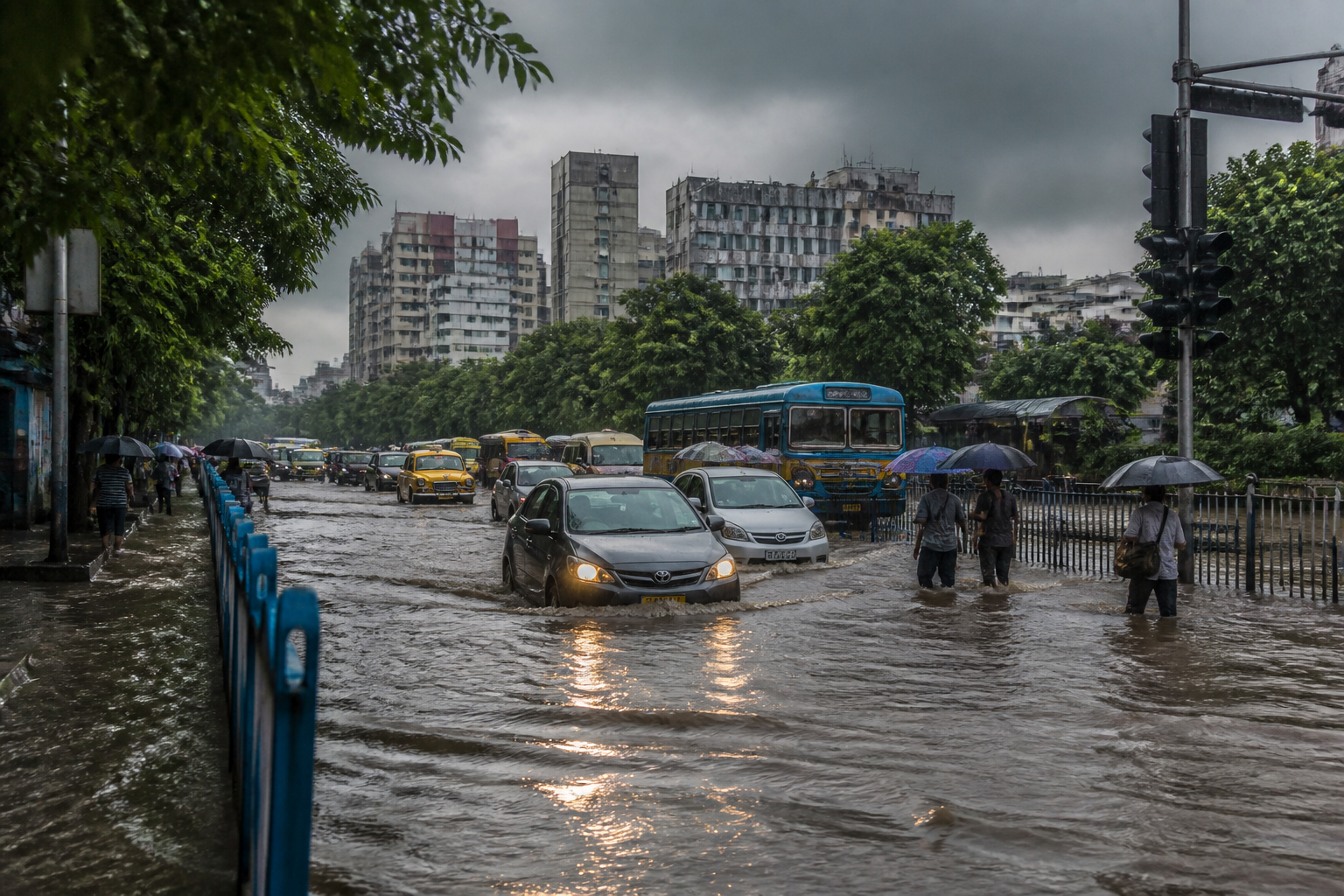
Kolkata faced widespread waterlogging on Thursday after repeated spells of heavy rain submerged roads across the city, disrupting peak-hour traffic and raising fresh concerns about dengue as the monsoon continues. The rainfall, linked to a low-pressure system, affected locations from BT Road and Amherst Street in the north to Ruby More, Park Circus and Anandapur in the south.
Several roads remained under water for long periods after heavy rain in the early morning. Before the accumulated water could drain fully, another spell lasting about 30 minutes in the afternoon caused fresh flooding on multiple city roads. Chittaranjan Avenue, MG Road, BT Road, Kashipur Road, Thantania, Ballygunge Place, Park Circus Connector, Topsia More and several other stretches reported waterlogging.
The disruption was particularly visible during office hours, when vehicles moved slowly through flooded roads and traffic congestion built up across key corridors. A large section of Chittaranjan Avenue between Shyambazar and Dharmatala remained congested after water accumulated on Chittaranjan Avenue. The road from Ruby More on the EM Bypass towards Anandapur was also heavily waterlogged in the morning, while several roads in Ballygunge Place and Ekbalpore remained submerged for extended periods.
In south Kolkata, Justice Dwarkanath Road, Dr Rajendra Prasad Road and Elgin Road in Ward 70 remained waterlogged through much of the day. Amherst Street near the Thantania Kalibari also faced severe flooding. The conditions made it difficult for pedestrians to cross roads in several parts of the city.
According to figures from the Kolkata Municipal Corporation’s drainage department, Jodhpur Park recorded the highest rainfall, at 115 millimetres, between early morning and evening. Topsia received 105 mm, Pagladanga near Dhapa 98 mm, Palmar Bazar and Thantania 95 mm and 95.2 mm respectively, Ballygunge 89 mm, Kalighat 79 mm, Maniktala 77 mm, Marcus Square 74 mm and Behala Flying Club 70 mm.
A drainage department official said water had receded from most other parts of the city despite localised accumulation. The official added that pumping station construction was under way at Thantania in north Kolkata and Northern Park in Bhawanipur, where water remained accumulated.
The pace at which water drains is also affected by tidal conditions, the official said. When the tide is high, lock gates connected to the Hooghly are kept closed. They can be opened after the tide recedes, allowing accumulated rainwater to flow into the river.
The repeated rainfall has also increased concern over dengue transmission. Health officials of the civic body said dengue cases were rising and that the disease generally remains a concern until November. They warned that stagnant clean water can provide a breeding environment for Aedes aegypti mosquito larvae and urged residents to prevent water from collecting in and around buildings.
The civic drainage department said additional precautions had been taken at pumping stations in anticipation of the weather conditions. Alongside permanent pumps, temporary pumps were operating in low-lying areas, according to the department.
