


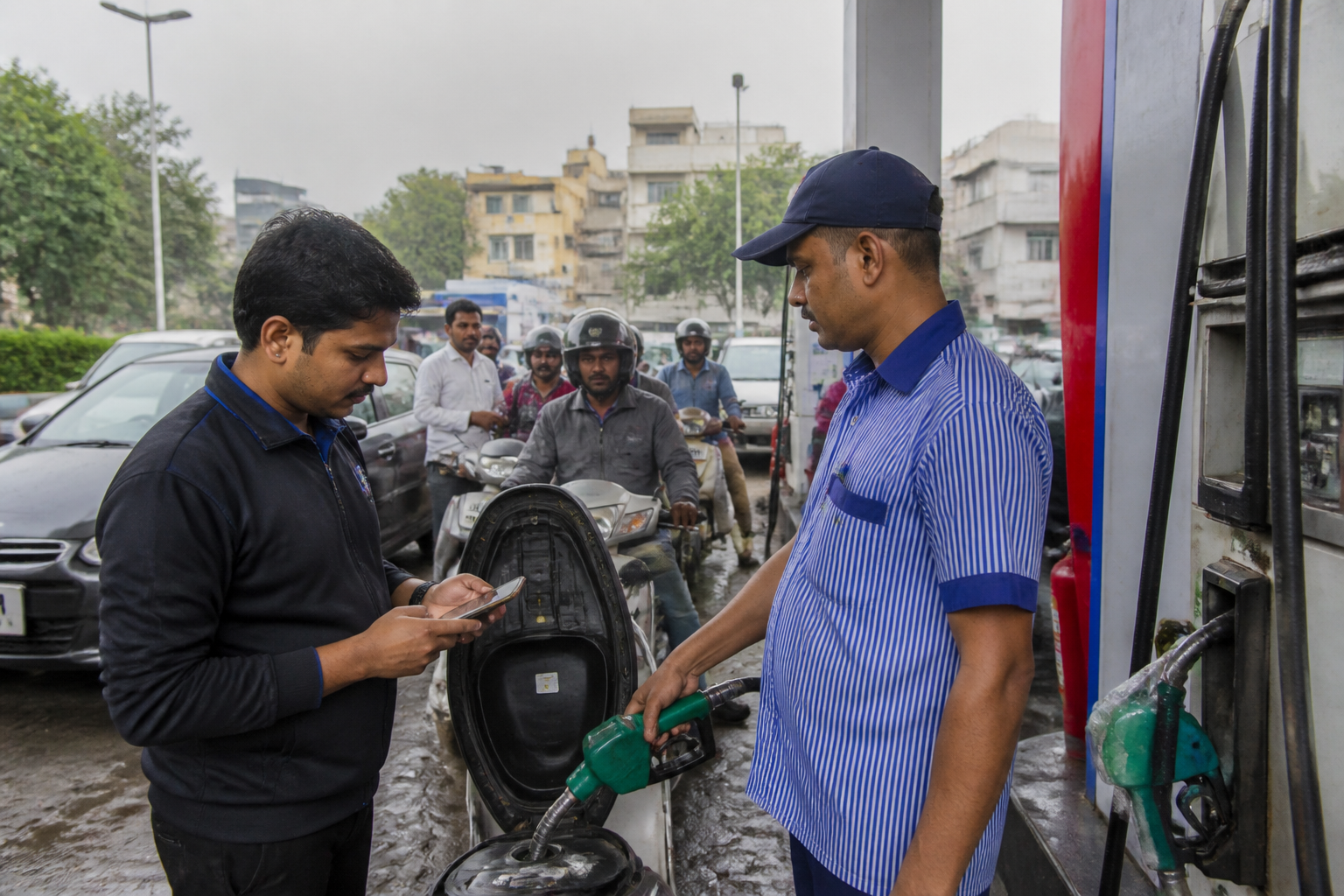
The debate over UPI MDR at petrol pumps is exposing a structural problem in India’s digital payment economy: fuel dealers operate businesses where prices and commissions are largely determined outside their control, yet any new transaction cost would be absorbed at the point of sale. The United Petroleum Dealers Association has asked the Centre and financial authorities to keep fuel outlets outside any proposed digital payment charge framework.
The association has written to the Union finance minister, the petroleum and natural gas minister, the Reserve Bank of India governor and the National Payments Corporation of India. Its demand is not limited to a request for lower charges. The dealers want fuel outlets to remain completely exempt from any form of digital fee, arguing that petrol and diesel are essential goods and that dealers do not have the freedom to raise prices or adjust their margins to recover additional costs.
The issue is significant because the transaction takes place at a highly visible urban interface. Petrol pumps are among the most frequently used points of sale in cities, serving commuters, commercial vehicles, delivery workers and households. The report states that Delhi has about 400 petrol pumps, while the national total is close to one lakh. Even a small charge applied repeatedly across these outlets would therefore affect a large and geographically dispersed retail network.
According to the report, dealers are concerned about proposed MDR on UPI transactions above Rs 2,000. They claim that a flat charge of Rs 5 on each such transaction could reduce their limited earnings. The dealers also say that a significant number of transactions at fuel stations exceed that threshold. The report does not provide a transaction-level breakdown, so the total financial effect on individual outlets or on the national dealer network cannot be established from the available material. But the dispute makes clear where the pressure would fall: at businesses whose selling prices and per-litre commissions are not freely determined by them.
This distinction matters. A conventional retailer may, depending on market conditions and applicable rules, try to revise prices or adjust product margins when operating costs rise. Petrol pump dealers, as described by the association, do not have the same flexibility. The selling price of petrol and diesel and the dealer commission per litre are determined by the government and oil marketing companies. If a payment charge is added without a corresponding revision in the commission structure, the dealer’s net return on each transaction would decline.
The association has also rejected the idea that the cost should simply be transferred to oil marketing companies. Its submission refers to earlier problems associated with card payments, including delayed settlement, unclear deductions and the rental cost of point-of-sale machines. That history is important because it shows that the disagreement is not only about the amount of a proposed MDR. It is also about who controls the payment system, who bears its operating cost and how transparently deductions are reflected in dealer accounts.
The petrol pump is therefore a useful test case for the next stage of digital payment policy. At the customer end, a UPI transaction can appear immediate and costless. At the merchant end, however, payment acceptance involves settlement arrangements, technology infrastructure and, where applicable, transaction charges. The association’s objection suggests that a policy designed around the convenience of digital payments can create a separate cost question for businesses operating on regulated or tightly limited margins.
The report says that some petrol pumps have begun encouraging customers to pay in cash instead of using UPI. It does not establish how widespread this practice is or whether it has been formally adopted by any particular oil company or dealer network. Nevertheless, even isolated instances point to a possible operational tension. Digital payments are increasingly integrated into everyday urban transactions, but merchants may reconsider their use when the cost of accepting them becomes visible in already constrained margins.
The potential impact would not be confined to petrol pump owners. Fuel stations are part of the operating infrastructure of cities. They support private mobility, freight movement, public-service vehicles and commercial activity. Any payment policy that changes the cost or convenience of transactions at these outlets would be experienced by a wide range of users, even if the charge itself is levied on merchants rather than customers. The supplied report does not indicate that consumers would be charged directly, and no such conclusion can be drawn from the association’s representation.
The institutional structure behind the dispute is equally important. The dealers have approached four separate authorities with different responsibilities: the finance ministry, the petroleum ministry, the RBI and NPCI. This reflects the way a payment charge at a fuel outlet cuts across regulatory and administrative boundaries. The petroleum system determines the commercial environment in which dealers operate, while the payment system determines how transactions are processed and settled. A decision on MDR would therefore have implications for both sectors.
The association’s position also highlights a gap between digital payment policy and retail economics. A uniform payment rule may not affect all merchants in the same way. A business with flexible pricing, higher margins or greater ability to pass on costs may absorb a charge differently from a dealer whose commission is fixed on a per-litre basis. The report does not compare petrol pump margins with those of other merchant categories, but it establishes the dealers’ central argument: a common payment cost can have unequal consequences depending on the commercial structure of the outlet.
The reference to transactions above Rs 2,000 adds another layer to the dispute. The effect of a threshold-based rule would depend on how many payments cross that level, how customers divide transactions and whether the charge is calculated as a flat amount or through another mechanism. The report identifies Rs 5 as the flat charge feared by dealers, but it does not provide an official notification or a detailed schedule of the proposed levy. The precise design of the rule, its legal status and its implementation conditions therefore remain matters requiring confirmation from the relevant authorities.
What the available evidence confirms is narrower but important. A representative body of fuel dealers has formally opposed the proposed digital charge; it has linked that opposition to regulated fuel pricing and limited dealer commissions; and it has asked multiple national institutions to exempt fuel outlets. The report also records concerns about past payment-system deductions and settlement practices. What remains unclear is whether the proposal has been formally notified, whether the reported October 15 implementation date will apply to petrol pumps, and how the government, RBI, NPCI and oil marketing companies will respond.
The larger urban question is not whether digital payments should be used at petrol pumps. It is whether payment policy can account for the different operating conditions of merchants that perform essential, regulated or infrastructure-linked functions. Petrol stations are private businesses, but their services are embedded in the daily functioning of cities. Any change to their transaction costs must therefore be assessed not only as a technology or banking decision, but also as a question of retail regulation and urban operations.
For now, the next step is the response to the association’s representation. Until the competent authorities publish the final terms of any MDR framework, the charge, its applicability to fuel outlets and its financial effect on dealers remain unsettled. Those details will determine whether the dispute becomes a temporary payment-sector disagreement or a wider challenge to how India finances the digital layer of essential urban commerce.
