


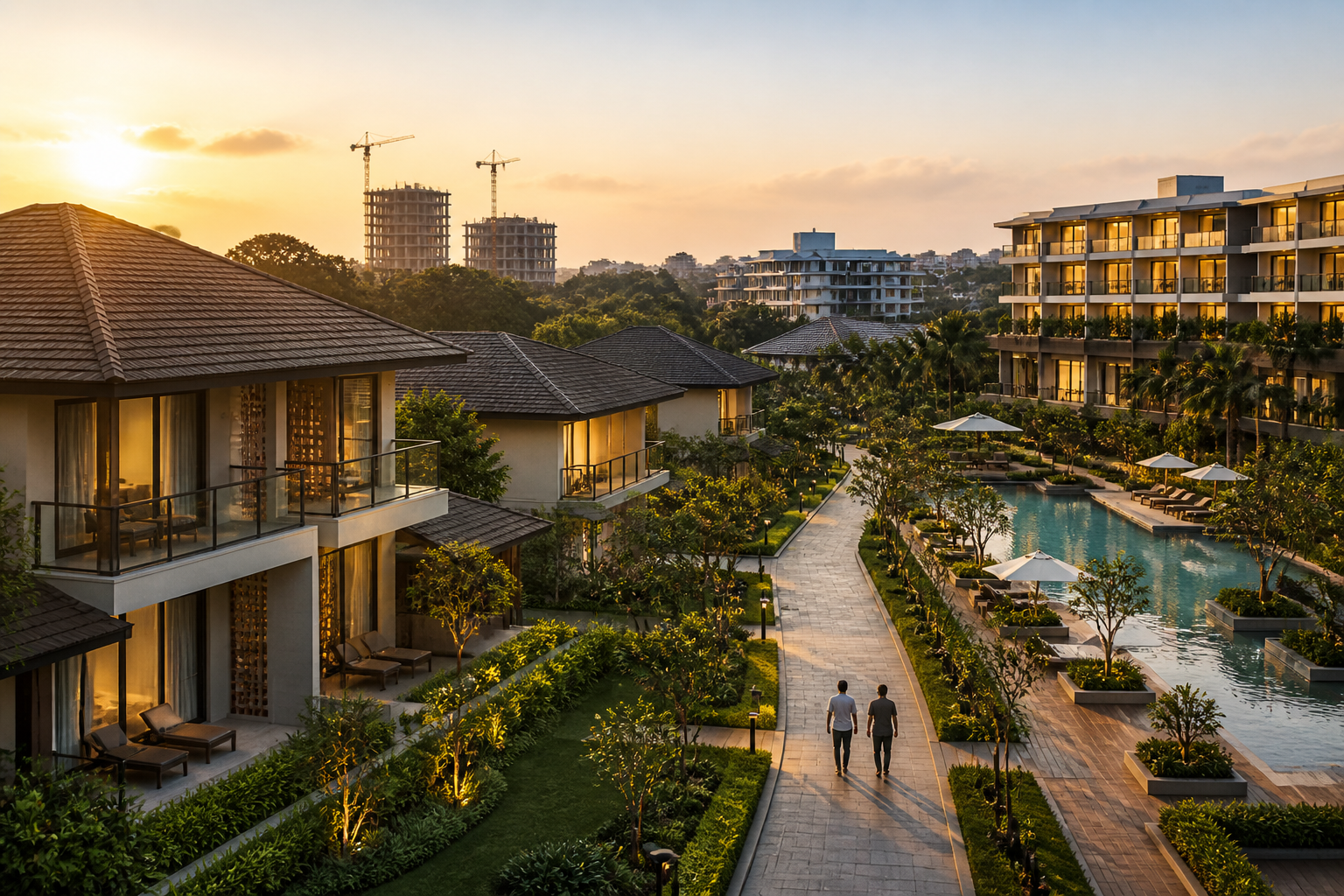
Hospitality-led real estate is emerging as a new format for India’s second-home market, as buyers increasingly seek managed services, leisure experiences and resort-style environments rather than standalone properties. The trend is visible in destinations such as Lonavala, Jaipur, Kasauli and Coorg, as well as in projects being developed around Bengaluru, according to a report by The Economic Times.
The change is significant because it shifts the proposition being sold to buyers. A conventional second home is primarily a property purchase, with ownership often separated from maintenance, operations and hospitality services. Resort-led developments attempt to combine those functions by bringing residential units, hotels, serviced accommodation, dining, leisure and social spaces into one managed environment.
The model is also creating a new relationship between residential ownership and hospitality operations. In a sale-and-leaseback arrangement described in the report, a portion of a resort is sold to individual buyers. Owners can use the property for stays and may also place it on lease when they are not using it. This gives developers a way to market a lifestyle asset while retaining an operating structure around the resort.
The format is not entirely new, but its current appeal reflects changing expectations from affluent homebuyers. Ashwin Chadha, chief executive officer of India Sotheby International Realty, said buyers were looking for “an elevated lifestyle, world-class design and services backed by a trusted brand”. He added that launches across Mumbai, Gurugram and Delhi had shown that buyers were willing to pay a premium for experiences rather than only physical space.
That claim points to a wider change in the way premium residential property is being positioned. Size, location and amenities remain part of the sales proposition, but hospitality introduces another layer: the promise of convenience and managed use. Buyers are not only purchasing an apartment, villa or resort unit; they are also being offered access to an operating environment with services, leisure facilities and branded management.
The investment structure is gaining institutional participation as well. The Economic Times reported that ASK Curated Luxury Assets Fund-I had invested in the Taj Mount Kusur Resort & Villas in Lonavala, a project developed by Amavi in partnership with Indian Hotels Company. The investment links a hospitality brand, a real estate development and a fund-backed ownership structure, illustrating how resort-led projects can attract capital beyond individual homebuyers.
For cities and urban regions, the implications depend heavily on how these developments are planned. A project that combines a hotel, serviced apartments, residences, retail and dining is not simply a housing scheme. It is a mixed-use urban system that requires access roads, water supply, waste management, electricity, parking and service infrastructure. The quality of the project therefore depends not only on its architecture or branding, but also on how it connects to the surrounding settlement and public systems.
This is particularly relevant to locations near major metropolitan areas. Lonavala, for instance, is linked to the Mumbai and Pune markets, while the projects discussed around Bengaluru are being positioned against the city’s technology-driven economic growth. Such locations can offer proximity to urban employment and investment markets while providing a resort setting. They can also bring new pressure on local roads, utilities and land markets if development expands faster than public infrastructure.
The Bengaluru example highlights why hospitality-led real estate is being associated with more than leisure. Vishal Vincent Tony, managing director of Aratt Developers, said that homebuying decisions were increasingly shaped by lifestyle choices and the environments people wanted for living. Aratt is executing multiple resort-led projects around Bengaluru, according to the report.
Tony said buyers were seeking “convenience, service, experiences and an environment that complements their aspirations and everyday routines”, rather than only amenities. This distinction matters. Amenities are typically treated as additions to a residential project. Hospitality-led development makes service and experience part of the core product, potentially changing how projects are designed, operated and maintained after completion.
The Bengaluru market is also being supported, according to the report, by the city’s business environment and its strong presence of information technology and technology companies. The report connects this economic base with demand for quality experiences in residential developments. However, it does not provide transaction volumes, absorption rates, pricing data or comparative performance figures. The available evidence therefore supports the identification of a development trend, but not a precise estimate of its market size.
The supply-side response is moving towards integrated environments. Developers are increasingly considering residential, hospitality, leisure and social uses together rather than treating them as separate real estate categories. Raghunath Reddy Bhattagiri, co-founder and managing director of Triguna Projects, said developments combining hotels, serviced apartments, shopping and dining were seeing high demand. He described the combination of hospitality, commercial and mixed-use development as creating new avenues for developers and investors.
That model can produce more active destinations than isolated second homes, but the outcome depends on occupancy and management. A resort-led project requires a functioning hospitality operation to deliver the services that justify its premium. If the hotel, dining, retail or leisure components do not operate as planned, the residential proposition may become closer to a conventional second-home development, while owners may still face maintenance and management costs.
The sale-and-leaseback structure also makes the distinction between property ownership and income generation important. Buyers may receive the option to use their units and lease them through the resort, but the report does not establish the terms, returns, occupancy assumptions or legal arrangements for these models. Those details are central to understanding the financial proposition and cannot be inferred from the existence of the projects alone.
There is a similar need for clarity around land use and local governance. Resort-led projects in leisure destinations may draw visitors and investment beyond the permanent resident population. That can support local economic activity, but it also means planning authorities must account for seasonal demand, traffic, water consumption, waste generation and emergency services. The supplied report does not provide information on approvals, infrastructure capacity or local authority assessments for the projects it mentions.
What the evidence does establish is a change in the language and structure of premium real estate. Developers are selling an integrated experience, and buyers are being approached as both residents and users of a hospitality ecosystem. The trend is visible across different formats: resort villas and second homes in leisure destinations, mixed-use projects near metropolitan areas, and hospitality-linked developments around Bengaluru.
The larger urban question is whether these projects remain private lifestyle enclaves or become part of a broader pattern of managed, mixed-use urbanisation. Their success will be measured not only by launch demand or the premium paid by buyers, but also by the reliability of services, the viability of the operating model and the capacity of local infrastructure to support them.
For now, the report points to a market moving beyond the simple second-home purchase. It confirms growing developer interest in combining residential ownership with hospitality, leisure and service components, while leaving important questions about scale, affordability, operating performance and local infrastructure unanswered. Those questions will determine whether hospitality-led real estate becomes a durable urban development model or remains a premium niche within India’s property market.
