


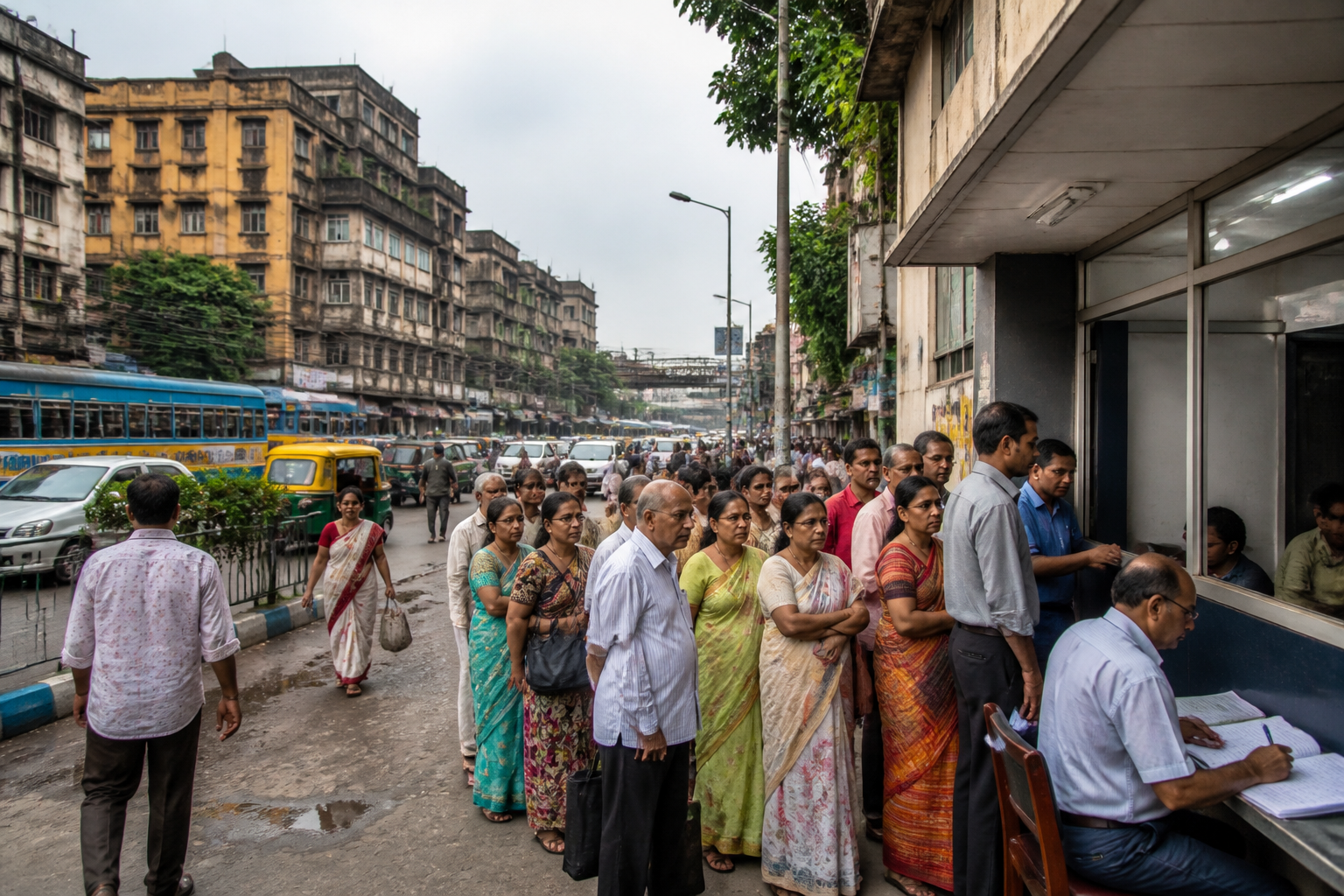
The proposed Kolkata municipal elections are approaching with 223,587 applicants in Kolkata and Howrah still uncertain about whether they will be able to vote. Their names were removed from the electoral rolls during the Special Intensive Revision, or SIR, process, after which they applied to tribunals in accordance with directions of the Supreme Court. Six months later, however, many of those applicants have not been called for hearings at the tribunals operating in Joka.
The immediate issue is administrative delay. The larger urban question is whether a city election can be considered meaningfully accessible when a large group of residents remains outside the electoral roll and has no clear date for resolving its claims. In municipal elections, voter-list disputes are not an abstract procedural matter. They determine who can participate in decisions involving roads, drainage, waste management, local planning, public health services and neighbourhood-level infrastructure.
According to a report by Sangbad Pratidin, the 223,587 applicants in the Kolkata and Howrah municipal areas are among people whose names were removed from the voter list during the SIR exercise ahead of the Assembly elections. They subsequently filed applications before tribunals. The report states that, even after six months, applicants had not received hearing notices from the Joka tribunal courts.
The Election Commission has said that nine tribunals at Joka examined applications from 5,485 voters in the two municipal areas during the past six months and restored their voting rights. Against the total of 223,587 applicants cited for Kolkata and Howrah, that amounts to a disposal rate of 2.68 per cent. The figure indicates the scale of the gap between applications filed and cases resolved before the proposed municipal poll timetable.
The commission reportedly told the Supreme Court on Monday that if the number of tribunals is not increased, it could take another 12 years to dispose of all applications. The statement places the local election dispute within a wider institutional-capacity problem: the number of cases requiring examination is substantially greater than the capacity currently available to hear and decide them.
The tribunal system is currently operating only at Joka in West Bengal, according to the report. That concentration creates a single administrative point through which applications from multiple municipalities must pass. The report says elections are expected in 11 other municipalities in addition to Kolkata and Howrah, where another large number of applicants are also awaiting decisions. It does not provide a consolidated figure for those municipalities.
The timing is particularly important because preparations for the proposed elections have already advanced. The state government has completed delimitation for 209 wards in Kolkata and 68 wards in Howrah, while the process for women’s reservation is described as nearly complete. These are essential electoral preparations, but they do not resolve the separate question of who will be eligible to vote when the polls take place.
This creates two parallel administrative tracks. Municipal boundaries and reservation arrangements are being prepared for the election, while the tribunal process that could determine the final voting rights of thousands of residents remains incomplete. Unless the two tracks are aligned, an election schedule may move ahead while the status of a significant group of potential voters remains unresolved.
The concentration of unresolved cases is not uniform across the two municipal areas. The report says that, as of Tuesday, no applicant from the Bhabanipur, Port, Rashbehari or Ballygunge Assembly constituencies had been called before the state government’s tribunal courts. Residents from these constituencies who had submitted applications with the assistance of lawyers therefore remain uncertain about how many of them will be able to vote in the municipal election.
The absence of a hearing is different from a final rejection. It means that the applicants’ claims have not yet received the adjudication required to determine whether their names should be restored. For affected residents, that distinction has a direct practical consequence: without restoration to the electoral roll, they cannot be certain that they will be able to exercise their voting rights at the municipal election.
The report also shows how an electoral-roll exercise can quickly become a municipal-governance issue. The people affected are not only participants in a state or national election. They are residents of wards that will elect representatives responsible for local civic administration. Municipal voting determines the political accountability structure for services that citizens encounter daily, including local roads, sanitation, drainage and neighbourhood infrastructure.
The Supreme Court’s role is central to the process described in the report. Applicants went to tribunals following the court’s directions, while the Election Commission has reported to the court on the pace of disposal and the possible consequences of retaining the current number of tribunals. The institutional chain therefore runs across the judiciary, the Election Commission and the state government, with each stage affecting the timing of the final electoral roll.
The report attributes responsibility for operating the tribunals to the state government. It also records allegations from the West Bengal Pradesh Congress president, Shubhankar Sarkar, and Baishwanar Chattopadhyay of Kalighat Trinamool that the government is deliberately not increasing the number of tribunals. Both alleged that the delay was politically motivated and claimed that affected voters would oppose the Bharatiya Janata Party. These are political allegations, not independently established findings in the supplied report.
The competing political claims also underline the need to separate the question of administrative capacity from speculation about voter preferences. The documented issue is the number of applications, the number of cases examined and the projected time required for disposal. The political motive alleged by opposition and ruling-party figures remains contested and would require further evidence beyond the statements quoted in the report.
The available figures provide the clearest measure of the problem. Only 5,485 applications were reportedly resolved in six months, while 223,587 applicants in Kolkata and Howrah remained within the group identified as facing uncertainty. At that pace, the proposed municipal election deadline becomes an immediate administrative milestone rather than a distant scheduling detail. The Election Commission’s estimate of 12 years, if the tribunal capacity is not expanded, further indicates that the current process cannot resolve the full caseload within a normal electoral cycle.
What remains unclear from the supplied material is the precise number of applicants whose names have already been restored through mechanisms outside the nine Joka tribunals, the final election notification and the legal deadline for preparing the municipal electoral rolls. It is also not established whether the number of tribunals will be increased, whether additional hearing locations will be created or how the cases will be prioritised before the proposed November-end election.
The Kolkata municipal elections therefore face a problem that is larger than ward delimitation or poll scheduling. The basic administrative question is whether the voter-verification system can process claims quickly enough to connect court-directed remedies with a live electoral timetable. The next significant developments will be any decision on expanding the tribunal system, the progress of hearings for applicants in the affected constituencies and the finalisation of the electoral roll before the municipal polls.
