


Alibaba’s new AI chip and plan to build computing capacity at a scale of up to 20 gigawatts by 2032 show how the race for artificial intelligence is becoming a race to assemble and operate vast physical infrastructure. The announcement, made at the company’s annual flagship conference in Hangzhou, was presented as a technology milestone. Its larger significance lies in the data centres, supply chains and power-intensive computing systems required to turn increasingly large AI models into usable services.
Alibaba CEO Eddie Wu said the company’s new Zhenwu V900 is the most powerful AI chip in China and can deliver three times the performance of the previous-generation Zhenwu M890. The chips are used in Alibaba’s data centres, where they support the training of AI models and the calculations required to deliver responses to users, known as inference. They also provide computing capacity to the company’s cloud clients.
The announcement came shortly before a scheduled meeting between Chinese leader Xi Jinping and US President Donald Trump, where artificial intelligence, trade and tariffs are expected to be discussed. It also arrived amid warnings from US technology leaders, including Anthropic CEO Dario Amodei, that China’s progress in AI presents a threat to the United States. This places Alibaba’s product announcement within a wider contest over technological capability, access to advanced chips and control over the infrastructure needed to develop and deploy AI.
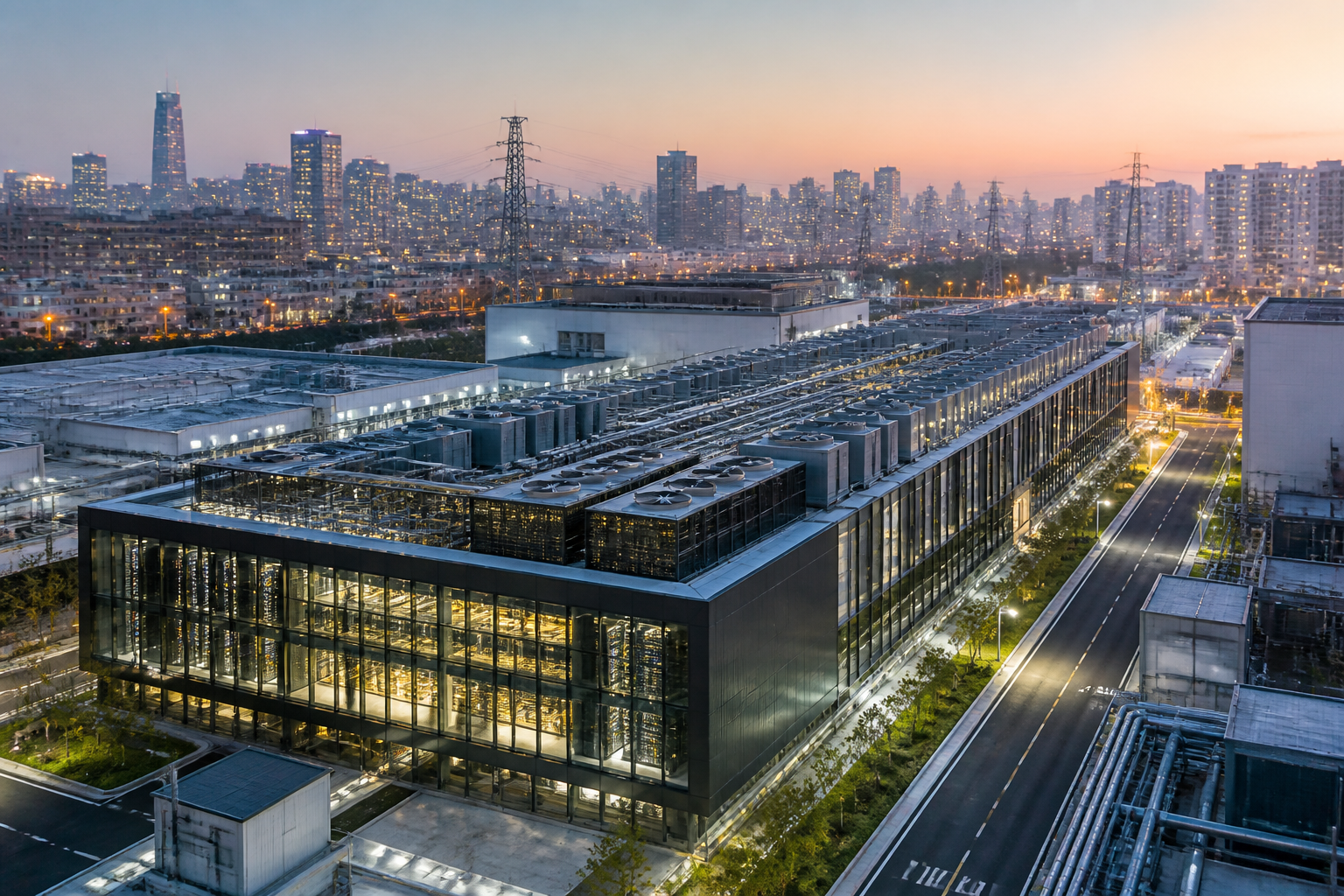
The most important urban and infrastructure dimension is the scale of computing that Alibaba says it intends to build. The company said it expects to have more than 20 gigawatts of computing by 2032 and described demand for AI computing as rising exponentially. That target is not simply a software ambition. It points to the expansion of data-centre capacity and the physical systems needed to keep those facilities operating.
Alibaba also said that global shortages across the AI data-centre supply chain are limiting the speed at which it can scale its computing infrastructure. Wu said the company was mobilising every resource to meet customer demand. The statement identifies a constraint that sits beyond model design: even when demand exists, the availability of chips and other components can determine how quickly computing capacity can be added.
This makes the AI economy dependent on an infrastructure chain that is both global and concentrated. Chips power the computing systems, data centres host them, cloud platforms distribute access to customers, and supply-chain availability determines the pace of expansion. The supplied announcement does not provide a breakdown of the facilities, locations, power arrangements or investment required for Alibaba’s 20-gigawatt target. It does, however, make clear that the company views computing capacity as a strategic asset and that the current supply chain is already affecting expansion speed.
Alibaba’s model plans underline why the infrastructure requirement is growing. The company said it intends to train a new AI model with between five trillion and 10 trillion parameters, a measure of a model’s learning capacity. Its latest Qwen3.8-Max model has 2.4 trillion parameters. Moonshot’s Kimi K3, released in July, was described by the company as the world’s largest open model, with 2.8 trillion parameters.
Parameter counts do not provide a complete measure of an AI model’s performance, but they indicate the scale of the systems companies are attempting to train. Training and operating such models require substantial computing resources. Alibaba’s announcement therefore links two forms of expansion: larger models and a larger physical computing base. The company’s planned increase in capacity is intended to respond to demand from its own services and cloud customers, rather than being only an internal research programme.
The comparison with SpaceX offers another indication of the scale involved. SpaceX has approximately 1.4 gigawatts of AI computing capacity as of the middle of this year and says it aims to exceed 10 gigawatts in 2027. Alibaba’s stated goal of more than 20 gigawatts by 2032 would be larger than that announced SpaceX target, although the two companies may use different definitions and deployment models. The comparison should therefore be read as an indication of ambition, not as a direct performance ranking.
The announcement also illustrates how computing capacity is becoming part of national technology policy. US-led export restrictions have prevented China from accessing some of the world’s most advanced technologies, including AI chips and chipmaking machines. Against that backdrop, recent Chinese advances are giving Beijing greater leverage in its discussions with Washington, according to analysts cited in the report. Alibaba’s new chip is presented as part of a broader push towards technological self-reliance.
That push is not limited to one company. Huawei unveiled new chip technologies the previous week as it sought to challenge global leaders such as Nvidia. Alibaba’s development of its own Zhenwu chip line, combined with Huawei’s efforts and the expansion of Chinese AI models, suggests that domestic technology companies are attempting to build more parts of the computing stack themselves. The available evidence does not establish how independent China’s overall AI supply chain has become, but it shows that self-reliance is a stated strategic objective.
For cities, the practical consequence is that data centres are moving closer to the centre of technology and economic planning. Alibaba’s cloud business depends on facilities that can host advanced chips, train models and provide inference services to customers. As computing demand rises, the capacity of these facilities becomes a factor in whether companies can deliver AI services at the speed and scale they promise.
The report does not identify where Alibaba’s planned additional computing capacity will be built or describe its effect on local electricity systems, land use, water requirements, employment or surrounding communities. Those details matter because a gigawatt-scale computing target ultimately has to be translated into physical facilities and operational systems. Without that information, the announcement establishes the scale of the ambition but not its local urban footprint.
The institutional landscape is also becoming more complex. Alibaba is simultaneously a technology developer, a cloud provider and an operator of data centres used by external clients. Its chip decisions affect its own AI models, while its cloud infrastructure determines what computing capacity can be sold to other organisations. Export controls, national industrial policy and corporate investment are therefore converging around infrastructure that is operated by private companies but has wider strategic importance.
The company’s comments also reveal a growing tension between demand and deliverability. Alibaba says demand for AI computing is rising exponentially, while global shortages are restricting the pace at which infrastructure can be scaled. This means that the next phase of AI competition will not be determined only by who produces the most capable model. It will also depend on who can secure chips, expand data centres and provide reliable computing capacity to users.
Alibaba CEO Wu described AI growth as comparable to the Industrial Revolution and said machine intelligence would rapidly outgrow human thinking capacity. He also said that machine intelligence is not currently a substitute for human intelligence, while predicting that machines could eventually produce more than 1,000 times the amount of thinking attributed to all humanity combined, compared with less than 3% today. These projections are statements from the company’s chief executive, not independently established findings in the supplied report.
What is established is more concrete: Alibaba has announced a new chip, claimed a threefold performance improvement over its previous generation, outlined plans for models with five trillion to 10 trillion parameters and set a target of more than 20 gigawatts of computing capacity by 2032. It has also acknowledged that shortages in the AI data-centre supply chain are already limiting expansion.
The larger question is how quickly these corporate targets can be converted into functioning infrastructure. The next developments to monitor are Alibaba’s progress in deploying the Zhenwu V900, the details of its planned data-centre expansion and whether supply-chain constraints continue to limit growth. Those milestones will show whether the company’s AI strategy is primarily a model race, or part of a much larger build-out of computing infrastructure.
