


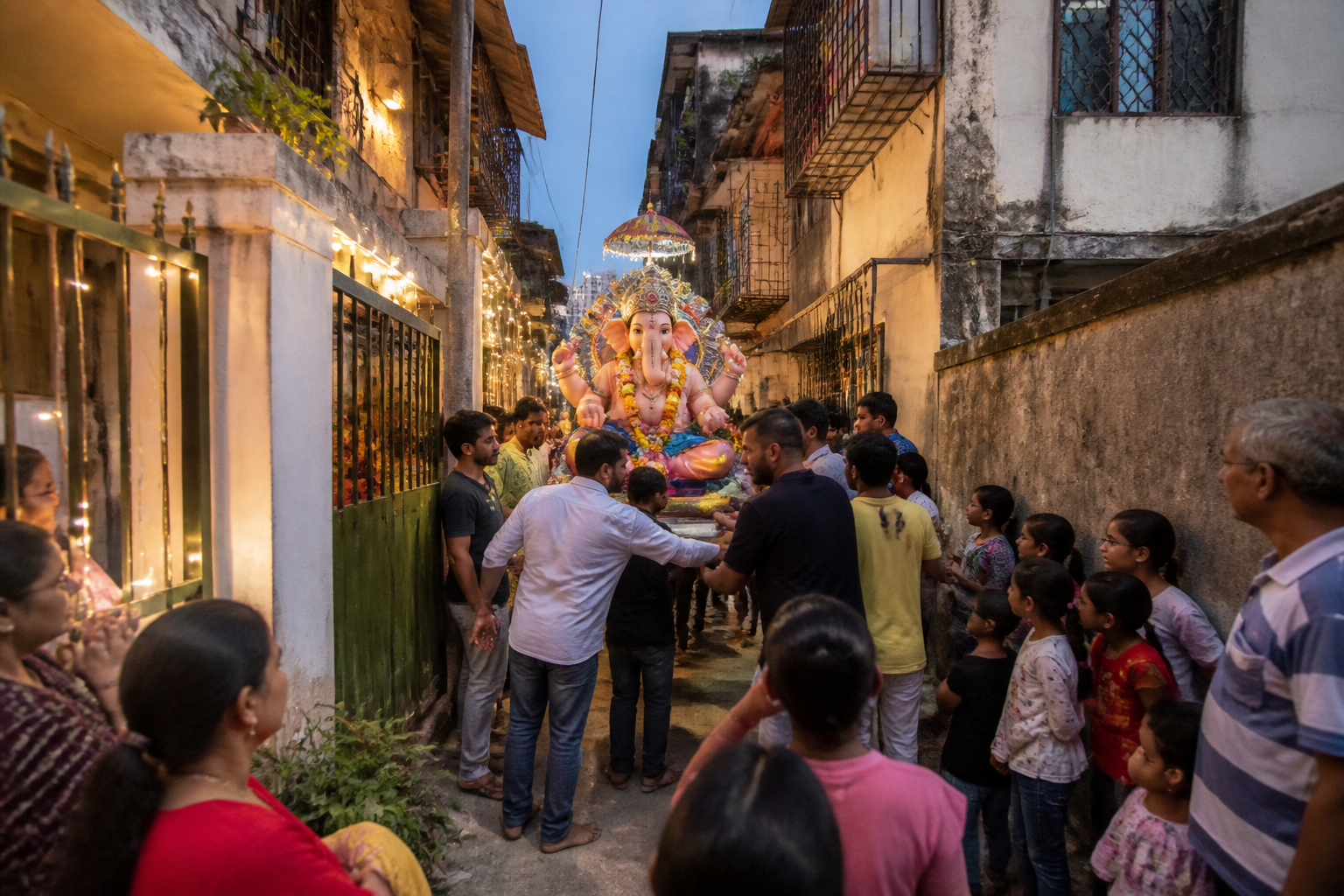
Across Mumbai, some of the city’s most distinctive Ganesh celebrations are taking place not in large grounds or prominent public squares, but in narrow lanes, labour settlements and dense neighbourhood compounds. A report by the Times of India – Mumbai documents mandals in Parel, Matunga, Dharavi, Vikhroli and Andheri where working-class youth and local residents are self-funding idols, decorations, food distribution and public programming.
Taken together, these mandals reveal a form of urban organisation that is easy to overlook. Their celebrations depend on small spaces, volunteer labour and local contributions rather than large institutional budgets. The scale of the installations varies sharply, but the underlying model is consistent: residents convert leftover or tightly constrained urban space into temporary cultural infrastructure.
At Swapnakshay, the Andheri mandal near Four Bungalows, a 9.5-foot Ganesh idol made from paper pulp anchors a theme called “Verses of the Forest”. The installation shows a timber-loaded truck carrying bird nests while birds and animals attempt to save their homes. Another element depicts a tree on an intensive-care bed receiving water and fertiliser through a saline drip. According to mandal president Devendra Amberkar, art director Sumit Patil and lighting designer Shital Talpade created the installation, while a four-minute video communicates an environmental protection message to devotees.
The environmental theme is significant because it shows how a festival installation can operate as a form of public communication. The mandal is not only presenting an idol; it is using a temporary neighbourhood gathering to make ecological damage visible. The message is delivered through familiar local spaces and a format that residents and visitors already understand. The source report does not establish how many people viewed the video or whether it changed behaviour, but it records an attempt to connect religious celebration with environmental awareness.
In Lower Parel, the Hukmil Lane mandal reflects another layer of Mumbai’s urban history. The mandal was established in 1934 by workers from Podar Mill and Apollo Mill, according to spokesman Aditya Bachankar. Its history includes an 18-foot idol carved from bananas in 1992, followed in other years by themes involving musical instruments, puja material and coconuts. This year, a balancing Ganesh created by moortikar Arun Datte is drawing crowds to the lane.
The mandal’s continuity links present-day neighbourhood activity to the former mill districts that shaped central Mumbai. Lower Parel’s urban landscape has changed substantially over the decades, but the account of Hukmil Lane shows how a local institution can preserve a connection with the workers and communities associated with the area’s industrial past. The mandal’s physical setting remains a lane rather than a purpose-built cultural venue, making the street itself part of the celebration.
Matunga Labour Camp presents a different spatial challenge. Labour Camp Cha Sukhkarta has installed a 32-foot Ganesh idol for the first time, according to mandal president Suraj Lot. The mandal is also using a hydraulic prabhaval, or backdrop, for the first time. Another local installation, the Sukhkarta mandal, is themed around Ram Avtar, with elements from the Ramayan including sage Valmiki and Hanuman. The idol was crafted by moortikar Aniket Shewale.
The 32-foot installation illustrates the tension between the ambitions of community celebrations and the physical limits of dense neighbourhoods. A large idol requires movement, assembly, circulation space and crowd management. In a labour settlement, those requirements have to be accommodated within an existing urban fabric rather than a venue designed for large gatherings. The supplied report does not provide details of permissions, traffic arrangements or emergency access, so the administrative mechanisms behind the installation remain outside the available evidence.
Dharavi Sharks offers the clearest example of how a small mandal can grow from a local initiative. Organiser Martin Nadar says the Om Sai Mitra Mandal began in 2003, when 13-year-old Neelesh, later known as Nilu Anna, installed a 1.5-foot Ganpati idol. The celebration is now self-funded by 40 families at Damber Compound behind Royal City School.
This year’s 5.5-foot idol, crafted by moortikar Vinayak from Pratiksha Nagar, must pass through a lane only 3.5 feet wide. Residents coordinate every movement as the idol is carried through the passage. The physical journey is more than a logistical detail: it shows how the city’s narrow access routes shape cultural activity. The mandal can host a larger celebration only if residents collectively solve the problem of transporting the idol through a space that was not designed for such movement.
That coordination is a form of local capacity. It relies on familiarity with the settlement, shared responsibility and careful timing. In formal urban planning, access widths and movement corridors are treated as technical parameters. In Dharavi, the account shows how residents negotiate those parameters through collective effort. It does not establish that this arrangement is risk-free or officially approved, but it demonstrates how everyday urban life is organised when public space is scarce.
At Vikhroli’s Tagore Nagar 1, the Ganesh Mandircha Raja celebration is drawing long queues near Kabutarkhana. The mandal, now in its 13th year, has designed its idol in a Mahadev avatar, according to mandal head Sanket Kate. Co-organiser Raj Nikam says the group distributes food to 2,500 people. Moortikar Mitesh Pevekar created the idol, Harishchandra Gad designed the theme and mandal members handled the decoration themselves.
The food distribution adds a service function to the festival. As with the self-funded celebrations elsewhere, the mandal is not simply a display platform. It is also a mechanism for mobilising money, labour, creative skills and volunteer time. The scale of the reported food distribution indicates the reach these neighbourhood institutions can achieve, although the supplied report does not specify the duration, funding arrangements or operating process.
Across the locations covered, the central resource is not land alone. It is the ability of residents to organise within limited land, adapt to local access conditions and produce an event using community funds and skills. Sculptors, art directors, lighting designers, decorators, organisers and families each contribute to a temporary civic ecosystem. The resulting installations are visible for a short period, but the relationships that support them are built over years.
The stories also show that Mumbai’s cultural geography is distributed. Major public attention often gravitates towards the city’s best-known mandals, yet smaller celebrations can carry distinct histories and local identities. A 1934 mill-worker institution in Lower Parel, a first-time large installation in Matunga Labour Camp, a family-funded celebration in Dharavi and a food-distributing mandal in Vikhroli represent different neighbourhood conditions. Their common feature is the use of community initiative to create public activity in places where formal cultural infrastructure is limited or absent.
For city authorities, such celebrations raise practical questions about the management of temporary public space. The available report does not document permission systems, crowd plans, fire-safety measures, access for emergency services or waste arrangements. Those details would be necessary to assess how safely and equitably the events are integrated into the city’s administrative framework. What the report does establish is that the physical form of each neighbourhood directly affects how a mandal can operate.
The evidence therefore points to two overlapping realities. Mumbai’s narrow lanes and dense settlements constrain movement and gathering, but they also host strong networks of participation. The city’s built environment can make festivals difficult to stage while simultaneously giving them their distinctive local character. The mandals documented by the Times of India – Mumbai show how residents respond through self-financing, shared labour, artistic adaptation and careful coordination.
What remains unclear from the available material is how these local systems interact with municipal regulation and whether the growing scale of some installations is matched by formal planning support. Those questions merit further reporting. For now, the mandals offer a grounded view of Mumbai as a city where community infrastructure is often assembled temporarily, collectively and within the tightest spaces available.
