


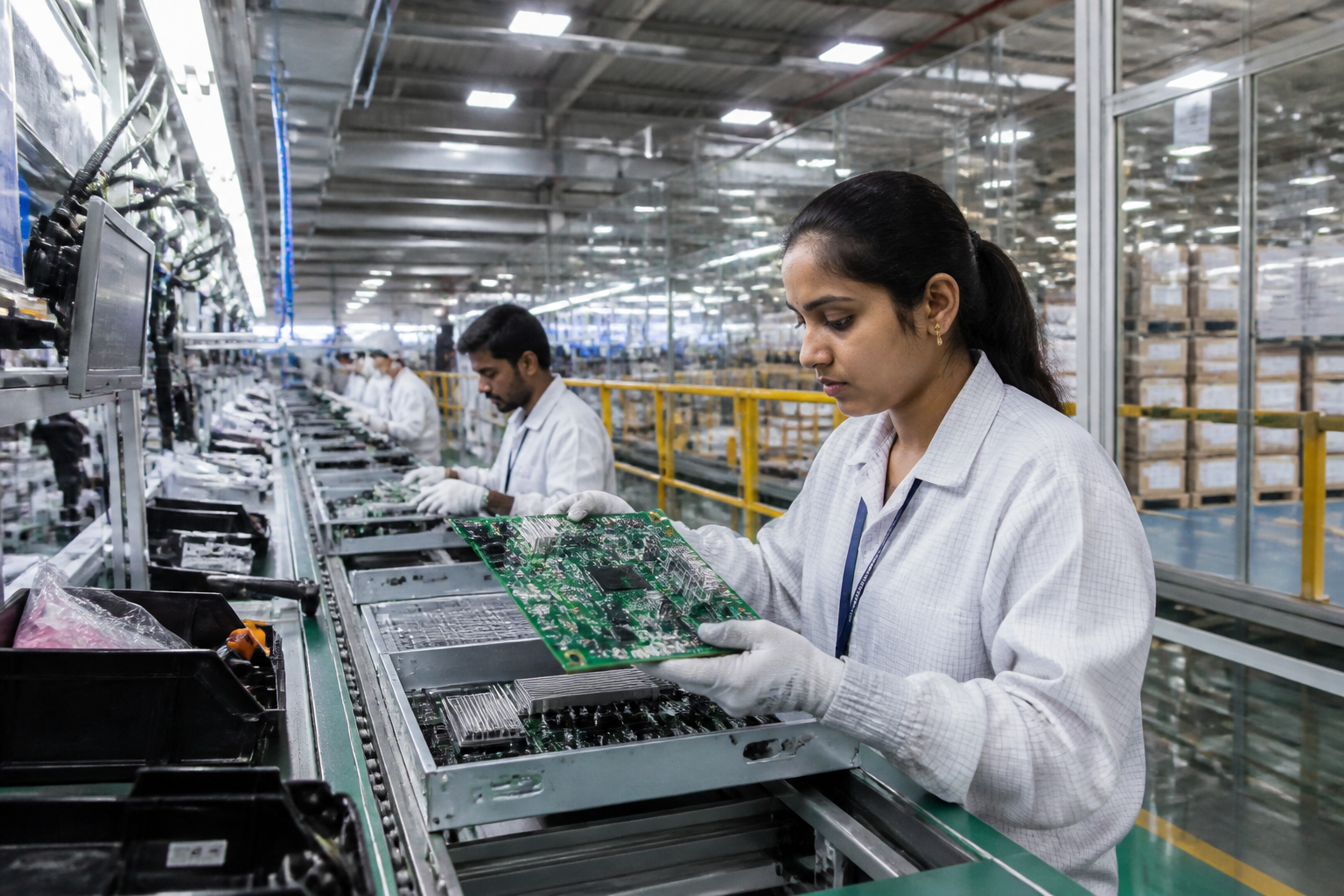
India’s electronics exports to China are rising sharply, but the increase remains too small to alter the basic structure of the relationship between the two countries. Government data analysed by Bloomberg News show that Indian exports to China rose almost 40 per cent in the five months through August, with electronics and engineering products among the main contributors. The development offers evidence that Indian manufacturing is gaining a foothold in demanding global supply chains, while also exposing how far the country remains from balancing its trade with its largest Asian neighbour.
The export increase is linked to products including printed circuit board assemblies, smartphones, display modules and telecom equipment. Electronics shipments to China rose more than 15 per cent in the April-August period compared with the previous year. In the financial year ended March, electronics exports to China tripled to $3.18 billion, according to the report.
That growth matters because electronics manufacturing is not simply a trade category. It depends on factories, industrial land, reliable power, logistics networks, skilled labour, component ecosystems and access to large markets. When Indian facilities supply products or sub-assemblies to Chinese buyers, the change reflects a broader attempt to move the country from a primarily consumption-driven electronics market towards a more integrated production base.
However, the figures do not establish that India has begun competing with China across the electronics value chain. The increase comes from a relatively low base, and China remains a comparatively small destination for Indian exports. China accounted for 4.4 per cent of India’s exports in the year ended March, up from just over 3 per cent a year earlier. By contrast, the United States accounted for almost one-fifth of India’s exports.
The scale of imports shows the imbalance more clearly. India imported $131.6 billion of Chinese goods in the year ended March, representing almost 17 per cent of its total imports. The value of Indian goods sold to China remains far below that figure. The recent export gains therefore signal a change at the margin rather than a reversal of the wider trade relationship.
The immediate driver identified by industry representatives is the global expansion of artificial intelligence infrastructure and data centres. Rajoo Goel, secretary general of the Electronic Industries Association of India, said pressure on suppliers to meet demand for high-end equipment required for AI-related products and growing data-centre capacity was contributing to the rise in electronics exports from India to China.
This connection between data-centre expansion and Indian manufacturing is important, but it must be read precisely. The report does not show that India is supplying complete AI systems or becoming a dominant producer of advanced computing hardware. Instead, it points to opportunities in equipment, assemblies, telecom products and related manufacturing activity. Such segments can create industrial demand, but their long-term value depends on how much design, component production and higher-value engineering takes place domestically.
Pankaj Mohindroo, chairman of the Indian Cellular and Electronics Association, said the figures indicated that Indian manufacturing was beginning to gain credibility in one of the world’s most competitive global value chains. He also said the next task was to sustain exports and expand across components, sub-assemblies and finished products while deepening Indian design and component capabilities.
That distinction between assembly and capability is central to India’s manufacturing ambitions. Export growth can rise rapidly when production is attracted to India for cost, market access or geopolitical reasons. But the durability of that growth depends on whether factories are connected to local suppliers and whether domestic firms build capabilities in design, tooling, components and product development. The supplied data show growth in shipments, but they do not quantify the domestic value added in those exports.
There is also a measurement problem. Chinese customs data do not record a comparable increase in printed circuit boards arriving from India. Much of the rise appears instead under smartphones and other telecom products. Industry executives cited differences in the way the two countries classify goods as one reason it is difficult to determine precisely what is driving the increase.
This discrepancy does not invalidate the Indian export figures, but it limits what can be concluded from them. Bilateral trade data are not always directly comparable when similar products are assigned different customs classifications. As a result, the reported rise is strongest as evidence of increased recorded shipments, not as a definitive measure of the exact product flows or the depth of India’s role in China’s electronics supply chain.
The timing also gives the development a wider institutional context. India and China are attempting to repair relations after a multi-decade low, while US tariff policies have created an additional incentive for both countries to explore deeper economic engagement. The report suggests that the export increase may indicate greater receptiveness in China to Indian goods, although the evidence supplied does not establish a formal policy shift or a new trade arrangement.
For India, the gains support a years-long effort to expand manufacturing and secure a larger position in global supply chains. That effort has direct implications for urban and industrial systems. Electronics production requires concentrated manufacturing clusters, freight connections, industrial utilities and a workforce capable of operating increasingly specialised facilities. Export performance therefore depends not only on factory-level decisions but also on the reliability and cost of the wider urban-industrial environment.
The engineering export figures suggest that the trend is not limited to consumer electronics. Engineering exports to China increased about 21 per cent in the April-August period, according to exporters, with machinery and parts, auto components and hand tools among the products included. This broadening matters because a more resilient manufacturing base usually involves several linked sectors rather than a single fast-growing product category.
At the same time, the evidence does not show whether these gains are geographically broad-based or concentrated in a small number of industrial clusters. It also does not establish how many new jobs have been created, whether local component sourcing has increased, or whether export growth has improved profitability for Indian manufacturers. Those are important measures of industrial depth, but they are not provided in the report.
The central policy question is therefore not whether India can record a sharp year-on-year increase. It is whether that increase can be converted into sustained industrial capability. The numbers show that exports to China are growing, electronics shipments are rising and engineering goods are gaining ground. They also show that China remains a relatively small market for Indian exports and a much larger source of imports.
India’s electronics export surge is consequently best understood as an opening rather than a transformation. It provides evidence that Indian factories are participating in supply chains connected to smartphones, telecom equipment, components and data-centre demand. But the trade imbalance, low starting base and uncertainty over product classification show that the structural gap remains substantial. The next indicators to watch are whether growth continues, whether it spreads from assemblies to components and design, and whether comparable trade data clarify the actual composition of the increase.
