


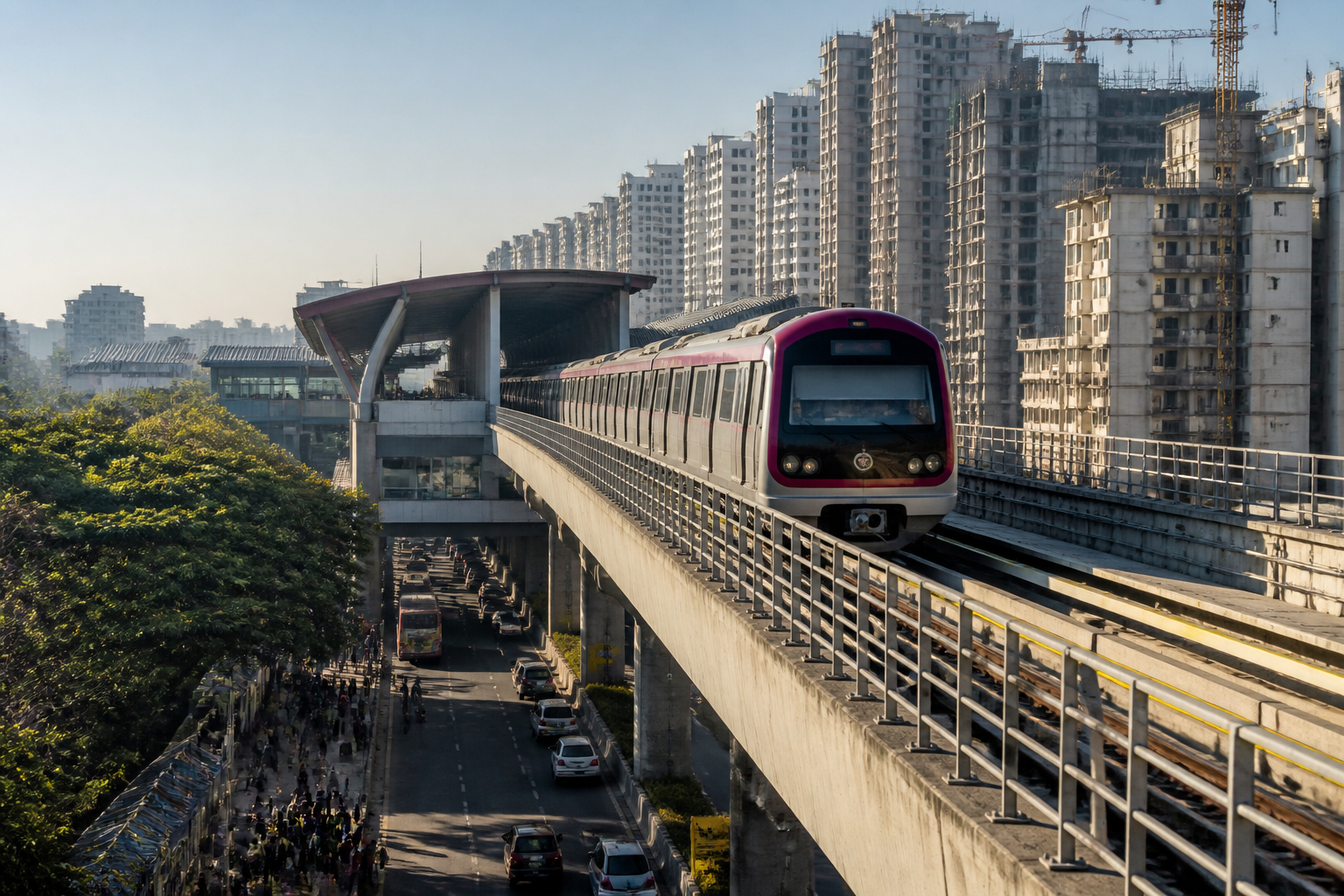
Bengaluru’s metro network has improved access to the central business district, but the city still offers a much narrower affordable housing catchment to rail-dependent workers than Mumbai, Kolkata and Chennai. The comparison is not simply about the size of a metro system. It is about whether public transport allows households to move far enough from expensive employment centres to find lower-cost housing without taking on an unaffordable daily commute.
The analysis published by The Hindu compares Bengaluru with cities where suburban rail has long connected distant residential areas to major employment centres. Its central finding is that Bengaluru commuters generally pay more for rail-based travel while being able to travel across a considerably smaller practical distance from the periphery to the central business district. That combination limits the number of locations where workers can live affordably while remaining dependent on public transport.
The difference comes from the type of rail system each city has developed. Mumbai, Kolkata and Chennai have extensive suburban rail networks, often working alongside metro systems. These networks connect the core city to distant suburbs and satellite settlements. In those cities, a person can live more than 50 km from the central areas and still reach the economic core by rail. The analysis places Mumbai’s practical commuting reach at up to 100 km, Kolkata’s at 70-100 km and Chennai’s at 60-75 km.
Delhi presents a different model. Its metro is primarily an urban system rather than a traditional suburban railway, but its network extends into Gurugram, Noida, Greater Noida, Ghaziabad and Faridabad. The analysis estimates that residents in Delhi-NCR can generally commute from 30-40 km away to Connaught Place, with an interchange required in some cases.
Bengaluru’s present rail-served catchment is considerably smaller. Residents near Whitefield, Kengeri or Madavara can reach the central business district using Namma Metro, but the practical periphery-to-CBD distance is estimated at only 20-25 km, with an average maximum distance of about 22.5 km for the comparison. Even after the airport line opens, the analysis says Bengaluru will remain behind Mumbai, Chennai and Kolkata in terms of the distance that can be covered through a rail-based commute.
That difference changes the housing equation. The farther a household can live from a central employment area while retaining a reliable and affordable rail connection, the larger the potential housing market available to it. Distant suburbs generally offer more scope for lower-cost housing than central areas, although the supplied analysis does not attempt to measure rents or property prices across the four cities. Its argument is narrower: rail access determines whether those lower-cost locations are practically available to workers.
The monthly fare comparison illustrates the imbalance. A commuter living 100 km from Mumbai’s CBD is estimated to spend about ₹2,080 a month on travel. A Bengaluru commuter travelling from the outer edge of the current practical metro catchment, roughly 22-25 km from the CBD, is estimated to spend about ₹3,850 a month. The comparison does not mean that every commuter in either city pays these exact amounts. It is a scenario based on stated assumptions about distance and travel patterns. But it highlights the different cost structures of suburban rail and metro-only commuting.
The analysis attributes the lower long-distance cost in Mumbai, Kolkata and Chennai partly to the scale of their suburban rail systems. Large passenger volumes spread fixed infrastructure costs across more users and longer distances. A suburban railway is designed to move substantial numbers of passengers between distant residential areas and employment centres. A metro system, by contrast, is usually designed for urban movement between stations within a more concentrated metropolitan area.
This distinction matters because a modern metro is not automatically the cheapest transport option for every distance. Its primary advantage is predictable movement through congested urban areas. A passenger can avoid some of the uncertainty associated with road traffic, even when the trip itself is not especially long. The analysis therefore places metro systems within a broader calculation involving cost, time and convenience rather than treating fare alone as the measure of transport value.
For shorter trips, private vehicles may still appear attractive to some commuters because they provide door-to-door access. The comparison cites earlier calculations for Bengaluru that put the monthly cost of a two-wheeler at roughly ₹2,500-3,000 for a 22.5-km one-way commute over 22 working days. The estimated cost for a car is about ₹8,000-10,000 a month. These figures are presented as indicative calculations rather than universal costs, and they do not make private vehicles cheaper once wider burdens such as congestion, parking, maintenance, depreciation, insurance and tolls are included.
At longer distances, however, the economics change sharply. The analysis estimates that a 100-km one-way car commute could cost more than ₹15,000-20,000 a month in fuel and related expenses, before accounting fully for maintenance, depreciation, insurance, parking and tolls. Mumbai’s suburban railway, by comparison, is estimated to support a similar distance for roughly ₹2,000 a month. The comparison shows why a city with a large suburban rail system can extend its effective labour and housing market far beyond the areas served by its urban metro alone.
Bengaluru’s transport geography has developed differently. Its metro network has become the city’s principal rail-based expansion mechanism, but the analysis says the network remains metro-centric rather than part of a mature suburban rail ecosystem comparable to those in Mumbai, Kolkata and Chennai. As a result, housing and employment remain more concentrated, rail trips cover shorter distances and workers have fewer affordable residential options that are connected by public transport.
This does not mean that Namma Metro has failed as an urban transport system. The analysis explicitly recognises its ability to improve mobility and provide more predictable journeys through a congested city. Its concern is that mobility improvement and housing-market expansion are not the same outcome. A metro can reduce travel uncertainty within its catchment without enabling workers to live far outside the core at a low transport cost.
The distinction also reveals an institutional question. Transport planning is often assessed through network length, station numbers, ridership or travel-time savings. Those are important measures, but they do not fully capture whether a rail system expands access to affordable housing. The relevant geography is not only the distance between stations. It is the distance between homes, employment centres and the wider set of residential locations that households can realistically consider.
A larger rail-accessible catchment can also influence labour mobility. When workers can reach employment centres from distant suburbs at a relatively low cost, employers draw from a broader labour pool and households are not forced to compete only for housing close to major job clusters. The supplied analysis presents this as one of the wider economic benefits of suburban rail, while also noting that the hidden cost of commuting includes time, stress and uncertainty.
For Bengaluru, the airport line is an important future addition to the network, but the analysis does not treat it as sufficient to close the gap with cities that possess extensive suburban rail systems. The comparison suggests that the city’s challenge is structural: expanding a metro network within the existing urban footprint is different from building a rail system capable of connecting distant lower-cost settlements to the economic core.
The evidence therefore supports a more specific conclusion than the claim that Bengaluru public transport is expensive. Bengaluru’s metro improves urban connectivity, but its current rail model provides a relatively small and costly residential catchment compared with the long-distance suburban rail systems of Mumbai, Kolkata and Chennai. The scenarios depend on assumptions about distances, working days and last-mile costs, and may not describe every commuter’s experience. The larger question for future transport planning is whether Bengaluru’s rail expansion will merely add routes within the city or also widen the geography of affordable living around its employment centres.
