


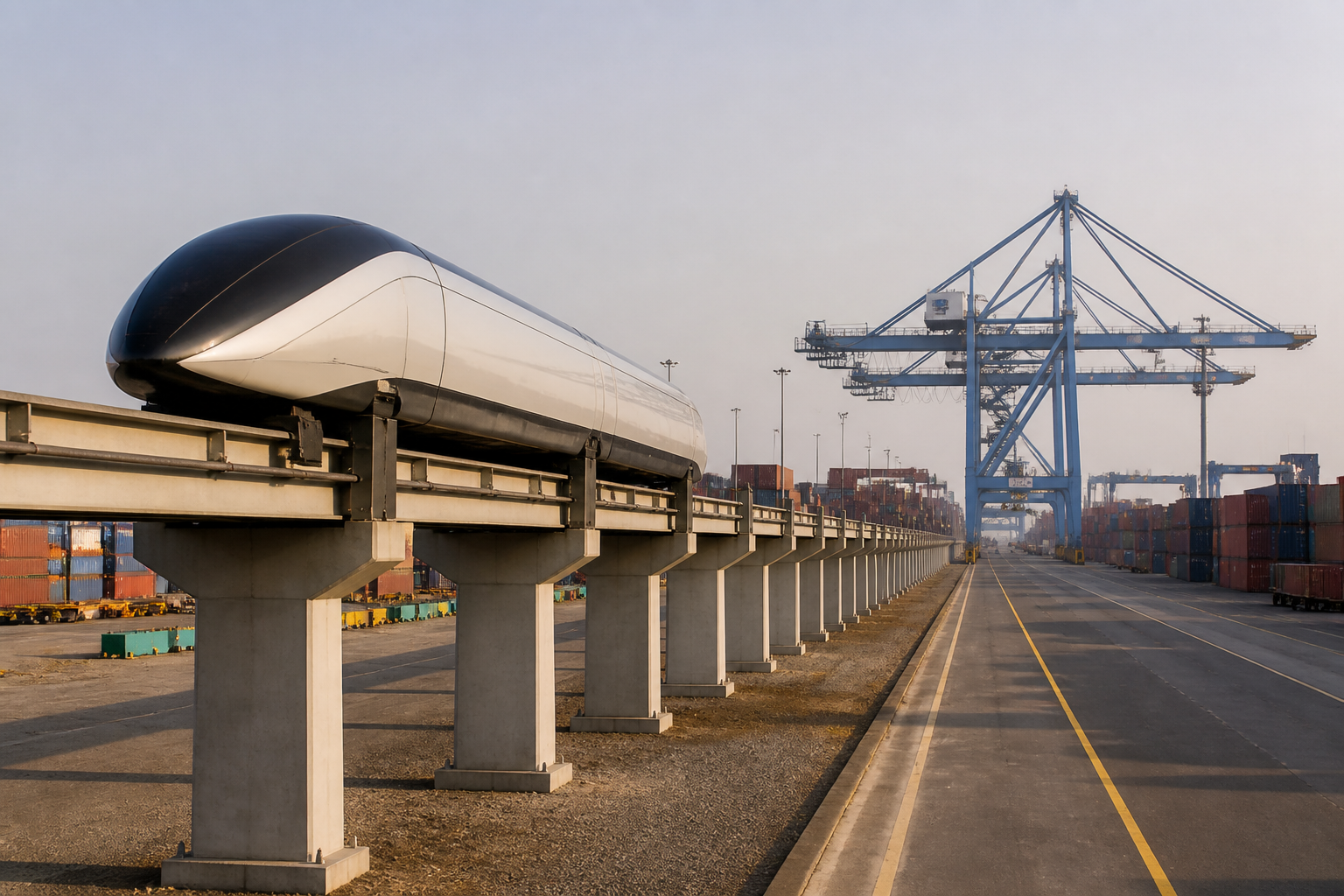
The push to develop a Hyperloop freight network in India has moved beyond an academic technology discussion, but its next test will not be the speed of a vehicle in a tube. It will be whether the system can connect ports with logistics parks, warehouses, industrial clusters and inland freight terminals in a way that is technically reliable, institutionally workable and commercially viable.
That question was central to the Parivahan 2.0 – Global Hyperloop Summit held at IIT Madras’ Discovery satellite campus at Thaiyur near Chennai on September 19. The summit brought together the institute, the Deendayal Port Authority at Kandla, technology company TuTr Hyperloop, Larsen and Toubro, government representatives, researchers, startups and students. Their discussions indicate that Hyperloop is increasingly being framed not only as a transport technology, but as a possible component of the country’s future freight infrastructure.
The immediate developments were industry participation and a renewed push towards real-world demonstrations. TuTr Hyperloop and L&T signed an agreement at the summit, marking a step towards greater industry involvement in Hyperloop-related technologies. The event also examined freight movement, port-to-hinterland connectivity and the technological, infrastructure, regulatory and commercial conditions required to build an ecosystem around the system.
Union Minister for Ports, Shipping and Waterways Sarbananda Sonowal, addressing the summit virtually, said Hyperloop could connect ports to logistics parks, warehouses, industrial clusters and inland freight terminals. His framing places the technology within a broader logistics chain rather than treating it as an isolated high-speed corridor. For ports, the relevant question is not simply how fast cargo can travel between two points, but how efficiently it can move through the network before and after that journey.
The minister pointed to the progress of TuTr Hyperloop’s Linear Induction Motor technology demonstrator at Deendayal Port, followed by Maglev technology. He described this as a step in moving the technology from the laboratory to the port and towards commercialisation. Sonowal also said India should move beyond technology demonstration and work towards a full-scale cargo Hyperloop system as part of its future logistics network.
That transition is significant because a technology demonstrator and a freight system serve different purposes. A demonstrator can establish that a propulsion, levitation or control concept operates under controlled conditions. A commercial freight corridor would have to function as part of a larger chain involving cargo handling, terminals, storage, customs and port operations. The supplied account does not provide cost estimates, corridor lengths, cargo volumes, construction timelines or an approved commercial project. Those omissions mean that the summit represents an institutional and technological step, not evidence that a full-scale network has been sanctioned.
IIT Madras Director V Kamakoti described Hyperloop as a major interdisciplinary initiative involving several departments at the institute. He stressed the need to demonstrate indigenous technology on real platforms and called for Hyperloop clubs across IITs, along with skill-development courses on structures, levitation and propulsion through SWAYAM and SWAYAM Plus.
This emphasis on skills and institutional capacity reveals one of the less visible requirements of emerging infrastructure. Building a freight system would require more than a functioning vehicle or propulsion system. It would also require expertise in civil structures, guideways, power systems, safety, operations and maintenance. The proposal to expand training and student participation suggests that the ecosystem is still being built, with education and research institutions expected to supply both talent and experimentation.
The involvement of Deendayal Port Authority is equally important. A port provides a real operating environment in which a technology can be assessed against freight-related requirements. Sushil Kumar Singh, chairman of the authority, said the Hyperloop competition would bring students, researchers, innovators, startups and industry together to explore the possibilities and viability of Hyperloop-based transportation solutions.
The word “viability” is central to the discussion. The summit’s sessions addressed not only Linear Induction Motors and Magnetic Levitation, but also infrastructure, regulation and commercial requirements. These areas are interconnected. A freight system cannot be deployed at scale without a regulatory framework that defines safety and operating responsibilities. It cannot be commercially sustained without a clear use case, suitable cargo flows and integration with existing logistics facilities. It cannot be built without infrastructure standards and an institutional arrangement covering land, terminals, power and maintenance.
The report does not establish that these questions have been resolved. Instead, it shows that they are now part of the formal discussion involving government, industry and academia. Panel discussions focused on collaboration among these three groups, while technical sessions addressed the underlying propulsion and levitation systems. The shape of the summit therefore reflects an early ecosystem-building phase: technology development is proceeding alongside efforts to create a community, an industry base and a policy conversation.
The proposed 2027 Global Hyperloop Competition could give that ecosystem a continuing institutional platform. IIT Madras Faculty Advisor Satya Chakravarthy said the third edition would be integrated with Shaastra, the institute’s annual technical festival. This would provide a recurring setting for student teams, researchers, startups and industry participants to test ideas and build visibility around the technology.
Competitions can help develop prototypes and attract talent, but they do not by themselves establish freight demand or commercial operations. The connection between a competition platform and a port-based logistics system will depend on whether successful technical demonstrations can be adapted to real cargo requirements. The summit’s focus on port-to-hinterland connectivity suggests that this translation from prototype to network is now the central challenge.
The institutional responsibilities are also beginning to emerge. IIT Madras is contributing research, interdisciplinary expertise and education. TuTr Hyperloop is developing technology, including the Linear Induction Motor demonstrator referenced at Deendayal Port. L&T’s agreement signals potential construction and industry participation. The Deendayal Port Authority provides an operational setting and a link to maritime logistics. The Union ports ministry is positioning the technology within the country’s future freight network. None of the supplied material, however, specifies the final division of responsibilities for financing, regulation, land acquisition, operations or risk.
That distinction matters for infrastructure planning. Large transport systems are shaped as much by governance and interfaces as by engineering. A port connection would have to work with existing road, rail, warehouse and terminal systems. The value of a new mode would depend on how it handles the movement of cargo into and out of the Hyperloop network. Without details on cargo categories, terminal locations, capacity, pricing or integration with current freight systems, the operational case remains under development.
The summit also highlights the current data gap. The supplied report records institutional participation and technical areas, but it does not provide projected speeds, carrying capacity, capital costs, operating costs, emissions performance, land requirements or a comparison with existing freight modes. It also does not identify a specific full-scale corridor, implementation schedule or commercial approval. These are the indicators that would allow policymakers and logistics users to assess whether Hyperloop can move from a promising demonstrator to a useful network component.
For now, the strongest evidence is that India’s Hyperloop effort is being connected to an actual port environment and a broader logistics conversation. The agreement between TuTr Hyperloop and L&T, the Linear Induction Motor demonstrator at Deendayal Port and the planned 2027 competition all point to efforts to expand participation beyond a single research institution. The evidence does not yet show that a commercial freight corridor is ready for construction.
The larger urban and infrastructure question is how India will connect ports to the industrial and logistics systems around them. Faster movement between a port and its hinterland could have value only if the complete chain becomes more coordinated. That makes Hyperloop’s future dependent not just on levitation and propulsion, but on terminals, warehouses, industrial clusters, regulatory systems and cargo operations.
The summit confirms a shift in emphasis from laboratory research towards demonstration, industry participation and port connectivity. It leaves open the questions that will determine whether the idea becomes infrastructure: what cargo will use it, where the first full-scale corridor will be built, how it will be funded and regulated, and whether its costs and capacity can compete with established freight systems. The next milestones identified in the supplied account are continued work at Deendayal Port, wider institutional collaboration and the integration of the third Global Hyperloop Competition with Shaastra in 2027.
