


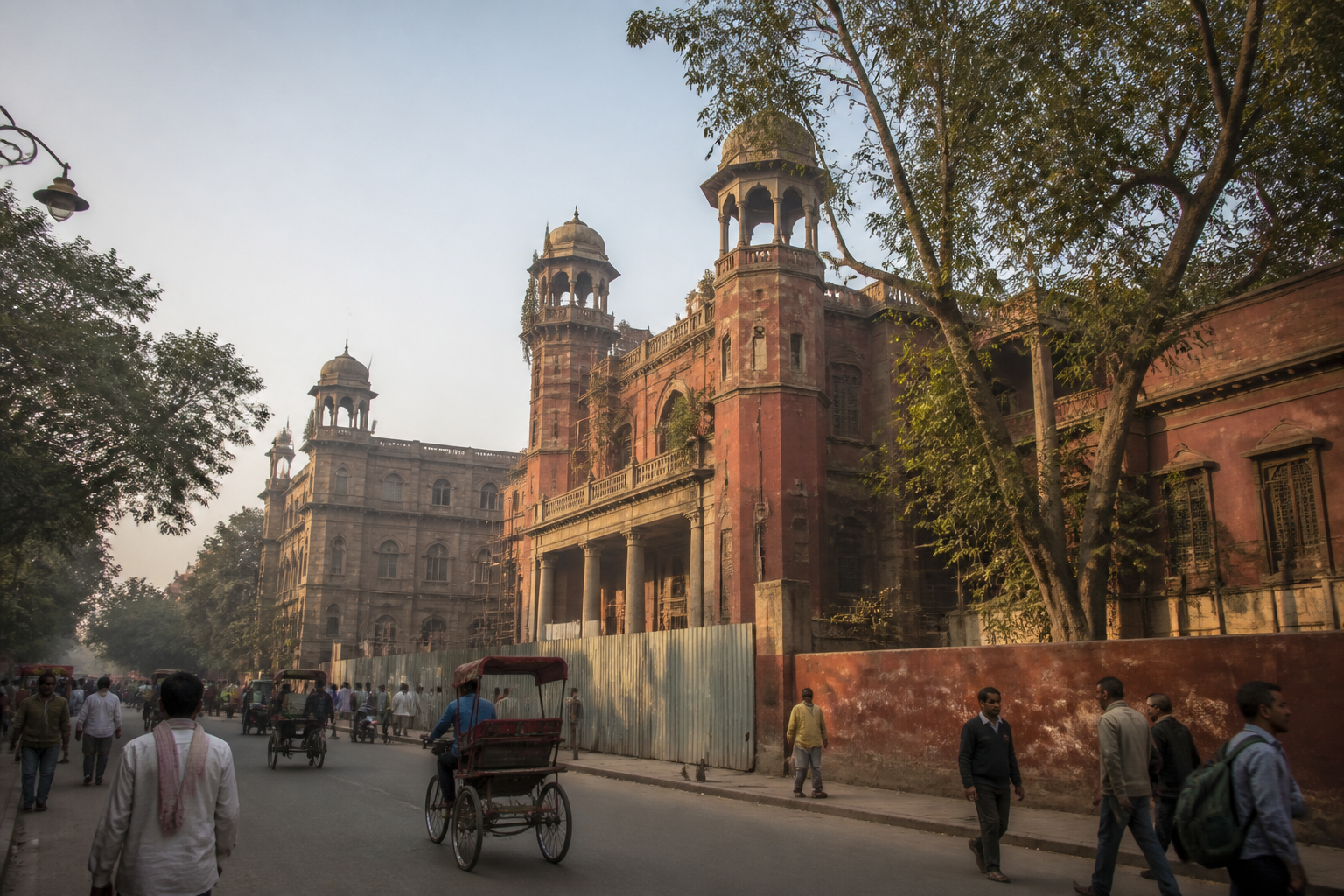
The proposed redevelopment of Chandni Chowk Town Hall as a Global Heritage Centre is more than a tourism announcement. It is a test of whether Delhi can bring a long-vacant civic building back into public use without weakening the historical identity that makes the Shahjahanabad precinct valuable in the first place.
The Delhi government said on Sunday that the Town Hall, along with the adjoining Press Building and Park, will be redeveloped as a centre containing a museum, cultural activities and tourism-related facilities. The complex covers approximately 12,180 square metres in the Chandni Chowk and Shahjahanabad areas. A Memorandum of Understanding has been signed between the Municipal Corporation of Delhi and the Delhi Tourism and Transportation Development Corporation.
The immediate significance of the agreement is institutional. Ownership of the historic complex will remain with the MCD, while DTTDC has been assigned the next stage of work: conducting surveys, carrying out a structural assessment and preparing a Detailed Project Report. The financial and operational model has not yet been settled. According to the MoU, the project could subsequently be developed through public investment or a public-private partnership.
That sequence matters because the Town Hall is not an empty site awaiting a conventional construction project. It is a Grade-I heritage complex built between 1860 and 1866. It served as the headquarters of the MCD until the civic body moved to the Dr. S.P. Mukherjee Civic Centre on Minto Road in 2010. Since then, a large part of the complex has remained vacant.
The proposed intervention is therefore framed as adaptive reuse rather than replacement. The government’s statement says the original heritage identity of the building will be preserved while new cultural and tourism uses are introduced. In practical terms, the project must reconcile two different requirements: the building needs to become active and useful again, but the changes required for public access, museum functions and visitor facilities must remain compatible with its historical and architectural character.
The source material does not establish the extent of structural deterioration, the restoration methods that will be used, the expected cost or the number of visitors the centre is intended to accommodate. Those questions are meant to be addressed through the structural assessment and DPR. Until those documents are prepared, the announcement describes an institutional direction rather than a fully designed project.
That distinction is important in heritage-led urban development. A building can be historically significant and still be difficult to operate as a public destination. A museum requires controlled movement, display areas, security, maintenance and visitor services. Cultural activities require space, scheduling and management. Tourism facilities need to function within a dense and heavily visited urban district. The project’s success will depend not only on restoring the structure, but also on making these uses work together without turning the complex into a disconnected visitor enclave.
The location gives the proposal considerable visibility. The government statement places the complex near Chandni Chowk and the Old Delhi Railway Station, in an area with a large flow of tourists. The Town Hall is therefore being considered as part of an already active urban environment rather than as a destination that must create demand from scratch. Its future use will be shaped by the movement of visitors through Chandni Chowk, the relationship between the heritage complex and surrounding public spaces, and the ability of the site to handle tourism and cultural activity in a busy part of Old Delhi.
The proposed Global Heritage Centre also reflects a shift in the way the complex is being described. The Town Hall was previously a working municipal headquarters. After the MCD moved out in 2010, the building’s primary administrative function ended and much of the site remained vacant. The new plan seeks to replace that lost civic role with a public-facing cultural and tourism role. This is not simply a change of tenant. It is a change in the building’s relationship with the city, from an administrative workplace to a place intended to interpret heritage and host public activity.
The MCD-DTTDC arrangement divides responsibilities between the asset owner and the agency tasked with developing the project proposal. The MCD retains ownership, while DTTDC will gather information and prepare the DPR. This creates a formal pathway from an underused municipal property to a potential tourism and cultural facility. It also means that important decisions remain ahead: the findings of the structural assessment, the scope of conservation work, the proposed facilities, the investment requirement and the operating arrangement.
The choice between public investment and a PPP model will be particularly consequential. The source does not say which model will be selected or what conditions would govern private participation. A public investment model could keep the project more directly within government control, while a PPP could bring an alternative financing and operating structure. The available information does not support conclusions about which approach will be adopted or how it would affect access, programming or maintenance. Those issues will become clearer only after the DPR and subsequent decisions.
The project also raises a question about the meaning of heritage access. The Chief Minister said the government would preserve the building’s historical and architectural identity while connecting it with modern tourism and cultural activities. Tourism Minister Kapil Mishra said the effort was intended to make historical monuments more attractive and useful for domestic and international tourists while preserving their heritage. These statements establish the stated policy balance: increased public use is being presented as a means of strengthening, rather than displacing, heritage value.
However, the available announcement does not yet explain how that balance will be measured. It does not specify the proposed museum’s content, the cultural activities to be hosted, the visitor facilities planned or the safeguards for the Grade-I complex. It also does not identify an implementation timeline. These omissions are not necessarily failures at the announcement stage, because the structural assessment and DPR are yet to be prepared. They do show that the project is currently at the planning and feasibility stage.
The numbers available in the announcement help define the scale but not the final scope. The site covers approximately 12,180 square metres and contains the Town Hall, Press Building and Park. The complex is more than 150 years old, having been built between 1860 and 1866, and remained associated with the MCD until 2010. These facts point to a substantial heritage property with a long institutional history, but they do not establish how much of the area can be publicly programmed or what portion requires conservation.
The location near the Old Delhi Railway Station is another part of the project’s urban logic. The government has identified the area’s tourist flow as evidence of the complex’s potential for better utilisation. Yet proximity to a major visitor route also makes management central to the project. A heritage centre in a busy district must be designed around circulation, entry, public activity and the protection of the historic complex. The source material does not provide a traffic, access or crowd-management plan, so the eventual DPR will need to clarify how the site is expected to function within its surroundings.
For Delhi, the larger question is whether adaptive reuse can turn an underused civic asset into a functioning public institution without reducing heritage to a backdrop for tourism. The Town Hall proposal brings that question into a specific institutional framework: the MCD remains owner, DTTDC is responsible for surveys and project preparation, and the government will later decide whether public investment or a PPP model is appropriate.
What is confirmed is the signing of the MoU, the proposed use of the Town Hall complex, its approximate area, its heritage status and the responsibilities assigned for the next planning stage. What remains unresolved is equally important: the structural condition, the project cost, the conservation design, the operating model, the funding route and the implementation timeline. The next decisive document will be the Detailed Project Report, supported by the structural assessment and surveys assigned to DTTDC.
