


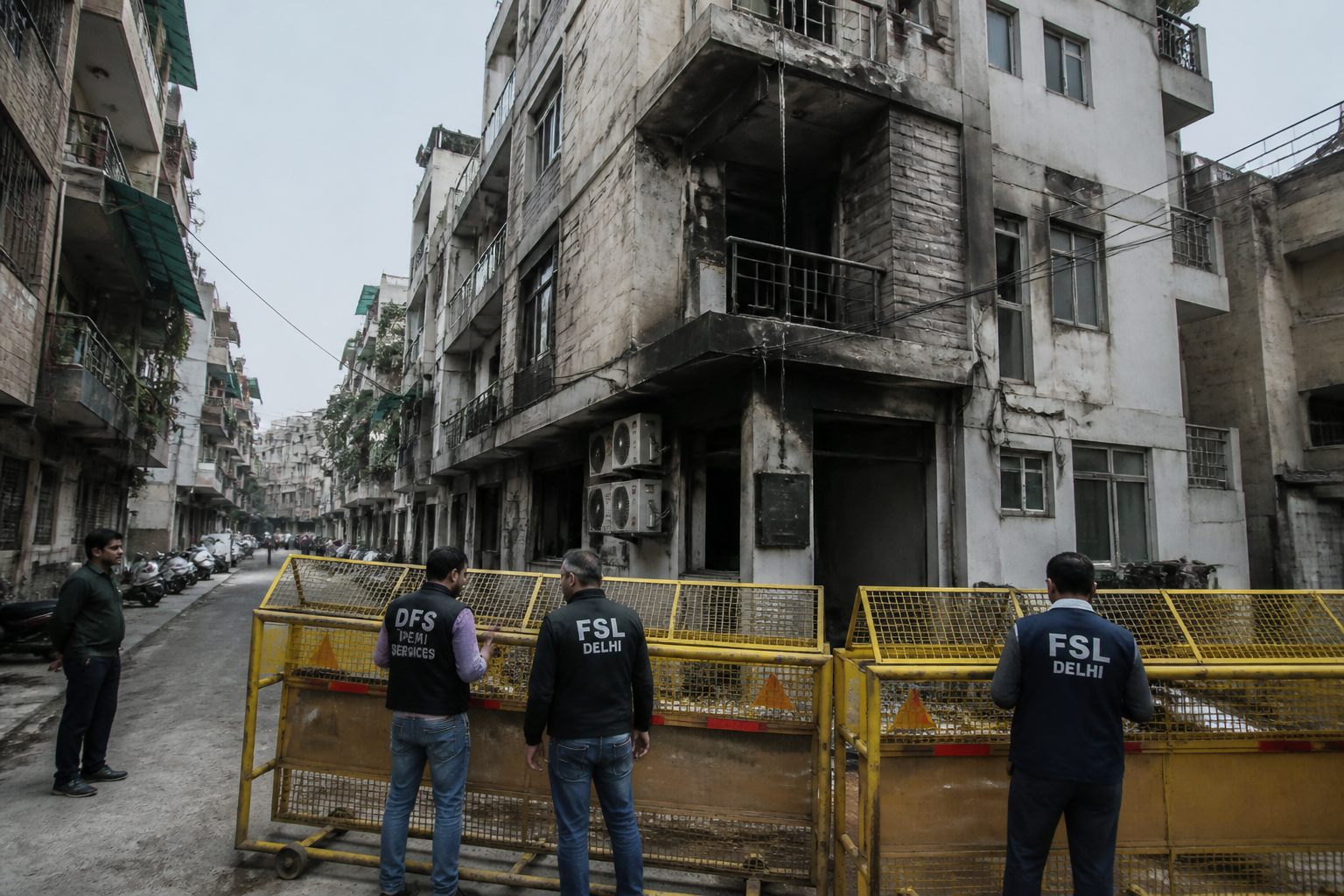
The collapse of a paying guest building in Satyaniketan, near Delhi University’s South Campus, killed seven students and turned an ordinary housing arrangement into a test of the city’s accountability systems. The questions raised after the tragedy are not limited to one building: who is responsible for the safety of privately operated PG accommodation, how are older residential structures monitored, and why do students have so few clearly safe alternatives near educational institutions?
The incident took place on 6 September in a building being used as accommodation for male students. Seven students died. The building’s use as a PG facility has brought renewed scrutiny to the safety of private hostels and PGs operating from older residential properties. Rahul Gandhi, the Leader of the Opposition in the Lok Sabha and a Congress leader, raised these questions in a post on X on Sunday, referring to the death of student Arpit Jhaj and demanding accountability for the students’ safety.
His intervention did not establish new findings about the cause of the collapse. It did, however, bring the housing conditions of students into the centre of the public discussion. Gandhi asked whether the incident could have been prevented if safety standards had been properly followed. He also questioned why new and safe hostels were not being built and why students were being compelled to live in unsafe PG accommodation.
Those questions connect the tragedy to a wider urban pattern visible in the facts supplied in the report: students arriving in the capital from smaller towns depend on private accommodation close to universities, but the safety and regulatory status of that accommodation may not be clear to them or their families. In a city where educational institutions attract students from across the country, access to housing is not separate from access to education. A room near campus can determine whether a student can attend a course, manage daily travel and remain in the city.
The Satyaniketan case has also exposed the institutional complexity surrounding such housing. A privately run PG can function as a commercial accommodation facility while operating from a building originally designed for another residential purpose. The report identifies questions about the safety of old residential buildings being used as private PGs and hostels, but it does not provide the building’s approval records, structural assessment, occupancy details or the precise findings of investigators. Those facts remain important to establishing how the collapse occurred and whether specific rules were violated.
The Delhi High Court’s response indicates that the matter cannot be treated only as an isolated accident. The court expressed concern about the safety of students living in PGs and private hostels and questioned the provisions governing such establishments. It ordered a high-level investigation by the Municipal Corporation of Delhi. The court also declined to view the incident as an ordinary accident, according to the report, pointing to the circumstances of students who had come to the capital with aspirations and expectations that were shattered by the collapse.
That judicial response places the MCD investigation at the centre of the next stage of accountability. An investigation of this nature has to clarify not only what failed physically, but also whether the city’s administrative chain had adequate information about the building and its use. The supplied report does not state when the investigation will be completed, what agencies are participating, or whether any findings have been made public. Until those details emerge, responsibility cannot be assigned beyond the concerns and demands already placed on record.
The distinction matters because building safety depends on more than the condition of a single structure on the day it collapses. It also depends on whether changes in use are identified, whether occupancy is known, whether safety standards are communicated and enforced, and whether residents have a way to report dangerous conditions. The report does not provide evidence on how these processes operated at the Satyaniketan property. It does show that the tragedy has prompted questions about the safety arrangements in similar private PGs and hostels across Delhi.
The shortage of safe student accommodation is another part of the problem identified by the public debate. Gandhi argued that Arpit’s family had been forced to send him to an unsafe place because adequate and safe hostels were not available. That is a political statement and should not be treated as an independently established finding about the family’s circumstances. But it points to a structural issue: when students and families search for rooms in high-demand education districts, the choice may be shaped by availability, cost and proximity rather than by transparent information about structural and fire safety.
The article also refers to concern among students after the collapse, including fear about living alone in PG accommodation. That reaction is significant at the ground level. A building is not experienced by residents as a planning file or an enforcement record. It is where they sleep, study, store their belongings and expect to remain safe. When a collapse occurs, uncertainty can spread beyond the affected property to other students living in buildings that appear similar but whose safety status is unknown.
The report further refers to a separate warning involving a dilapidated building in Mangolpuri’s Punjabi Camp, described as posing the possibility of another incident similar to Satyaniketan. That reference does not establish that another collapse is imminent, nor does it provide an engineering assessment of the building. It does, however, show how the Satyaniketan tragedy has shifted attention towards the condition of other ageing structures in Delhi and the consequences of delayed action.
The governance question is therefore broader than whether one building complied with a particular standard. It concerns the city’s ability to maintain an accurate picture of buildings that house large numbers of people, especially when their use changes over time. A private PG may be found through brokers, online listings or local networks, while the resident may have limited knowledge of municipal permissions or the building’s structural history. The supplied material does not say whether Delhi maintains a public register of PGs and private hostels or whether students can independently verify their safety status. That absence of information is itself one of the issues requiring clarification through the investigation and court proceedings.
The case also raises the question of how responsibility is divided. The High Court has directed an MCD investigation, while Gandhi has demanded that responsibility for student safety be fixed. The source does not specify the roles of the property owner, operator, occupants, municipal officials or other authorities in this particular case. Nor does it report arrests, prosecutions, notices or compensation measures. A credible account of accountability will require those details to be established rather than inferred from the collapse alone.
The timing of the political intervention, after the 6 September collapse, also shifts the story from immediate rescue and loss to institutional follow-up. Once a disaster has occurred, the public interest lies in understanding what the authorities have learned, whether comparable buildings are being examined and how the investigation will be made transparent. The source confirms concern and an MCD probe, but does not record a completed safety audit of other PGs or a new regulatory framework.
For students and their families, the central issue remains practical: whether a room offered as accommodation can be trusted to meet basic safety expectations. The tragedy demonstrates the consequences when that trust fails, but the available material does not yet establish whether the failure arose from unauthorised construction, poor maintenance, overcrowding, inadequate enforcement or another cause. Those distinctions will determine whether the response addresses the underlying risk or remains limited to the affected property.
The Satyaniketan collapse has therefore become a measure of Delhi’s ability to connect housing regulation with urban safety. Seven deaths have prompted questions from the court, demands for accountability from a national political leader and renewed anxiety among students living in private accommodation. What remains to be established is the investigation’s factual account of the collapse, the responsibility of the parties involved and the steps the MCD and other authorities will take to identify and regulate comparable PG and hostel buildings.

