


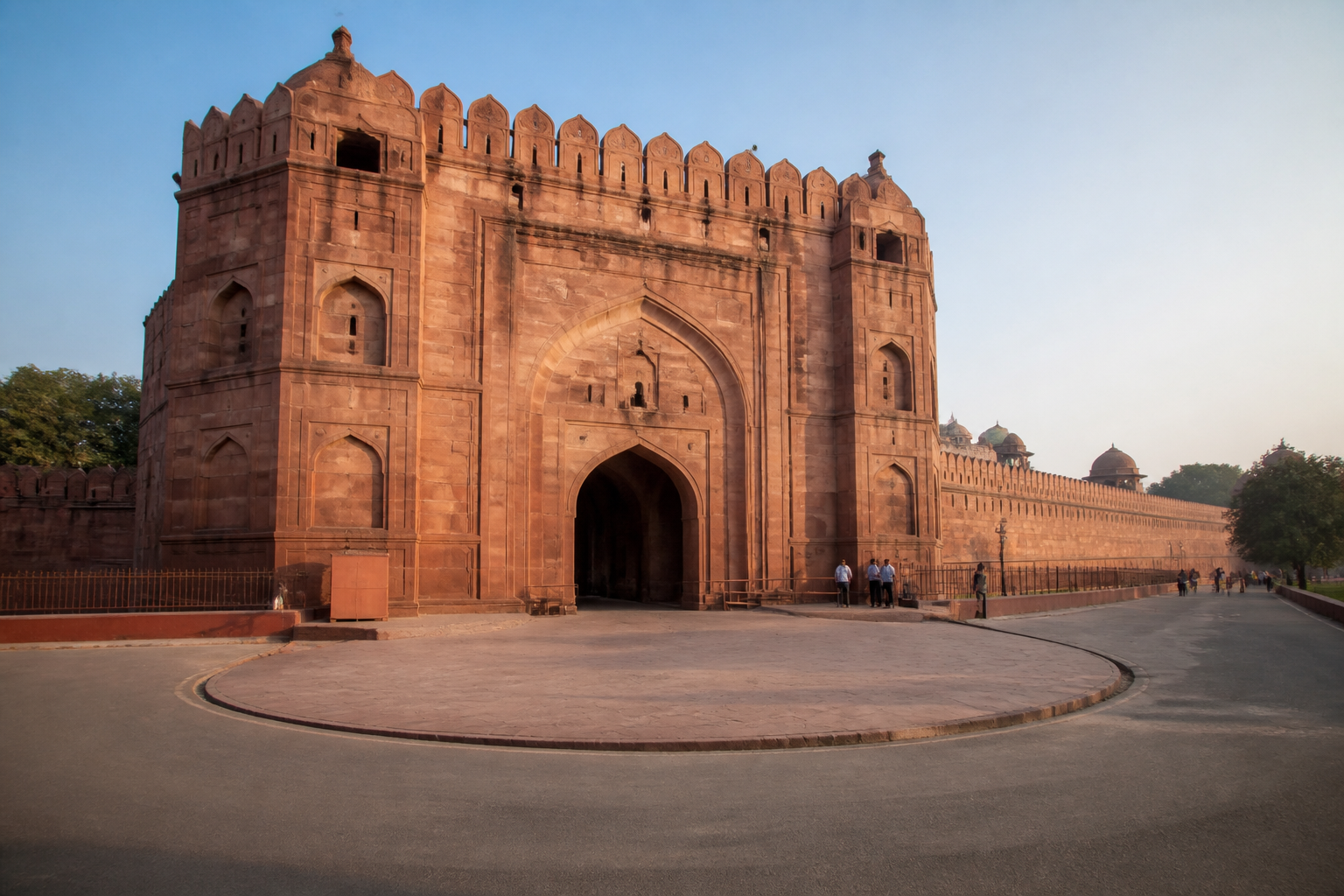
The Archaeological Survey of India has restored the Lahori Gate of Delhi’s Red Fort to the light brown shade believed to have existed when the monument was built in 1648, replacing the darker red paint that had covered the area for years.
The change is most visible in the gate’s circular well area, which forms part of the approach to the ramparts where the Prime Minister addresses the nation on Independence Day. The restoration follows an ASI study of the structure and its historic surface layers. The agency is also studying the Red Fort’s Delhi Gate, where a similar colour change is planned in the coming period.
According to the report, multiple layers of red paint had been applied to the Lahori Gate over time. The ASI said these layers were allowing moisture to enter the walls and affecting the structure’s natural capacity. They also concealed the original Mughal-era rough stone masonry and the details of the arches.
The old paint was removed using sandblasting, a surface-finishing process in which compressed air propels sand particles at high speed. The work was carried out without damaging the original masonry, according to the report. Loose stones were stabilised, cracks were filled and lime mortar pointing was undertaken to strengthen the walls.
The restoration also covers later additions made during the British period. After the British took control of the Red Fort following the capture of Bahadur Shah Zafar in 1857, they altered parts of the complex for military use. Heavy cannons were placed above the two gates, and stairways and other structures were added to move the guns. These additions are now being treated as part of the monument’s heritage fabric rather than being removed solely because they are not Mughal-era construction.
Work has also been carried out on the roof and columns in the Lahori Gate’s entrance area. The report said several cracks had developed where nails had been driven into the structure. Layers of paint were removed from the columns, while the old brick-and-cement pointing on the British-era arches was replaced with semi-moulded lime plaster and traditional lime-based material.
The restoration is part of a continuing conservation effort at the Red Fort. The same sandblasting technique was used on sections of the monument’s Meena Bazaar, where work was completed last year. The ASI’s planned intervention at the Delhi Gate will determine whether the conservation approach used at the Lahori Gate is extended to another major entrance of the World Heritage monument.
