


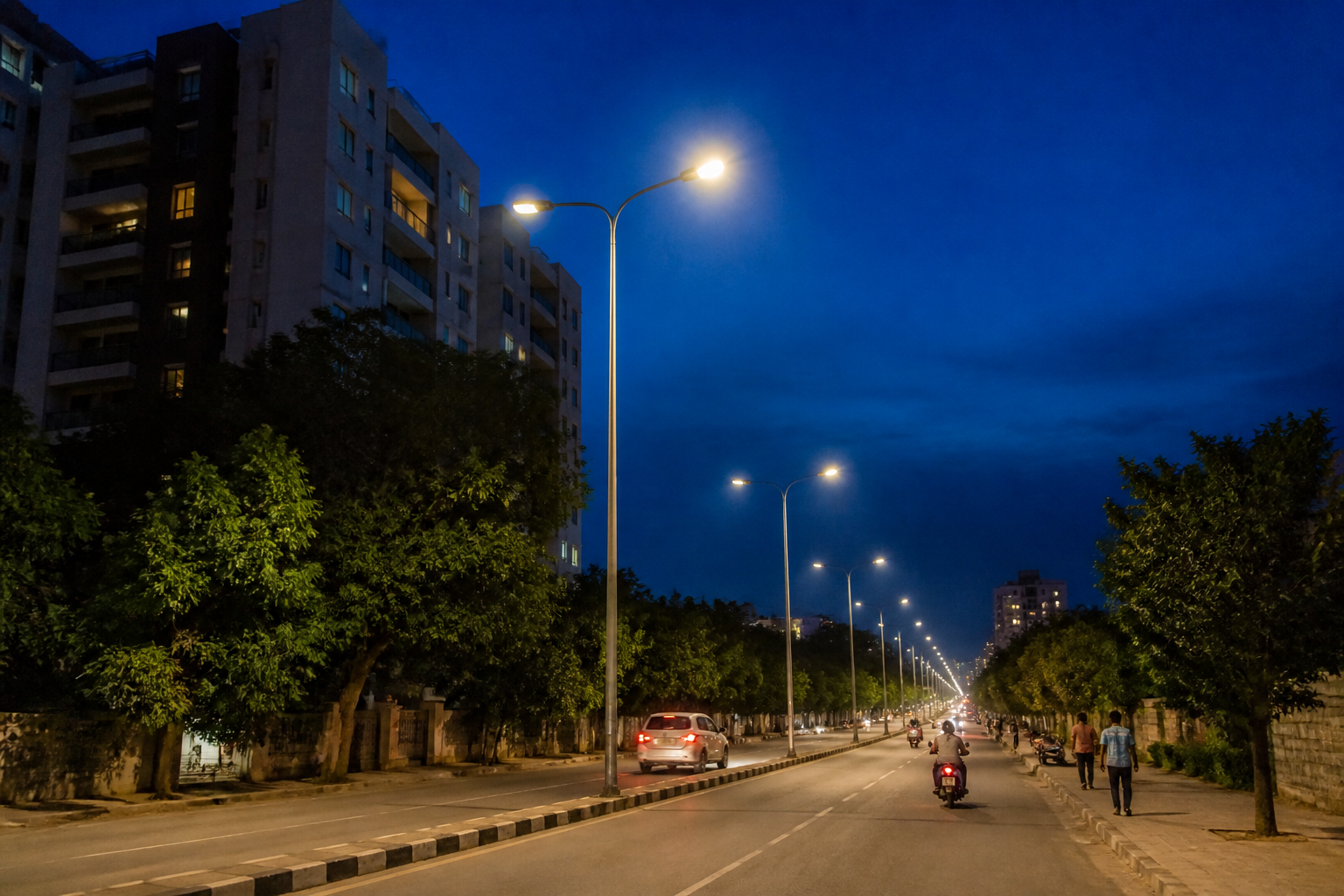
The Telangana government’s plan to hand over the operation and maintenance of LED streetlights in the Greater Hyderabad Municipal Corporation and other urban local bodies to private agencies has opened a larger question than who will service the lights: how should cities organise, monitor and pay for a public utility that residents experience every night?
The proposed arrangement would cover three municipal corporations under a 10-year contract estimated at Rs 1,341.60 crore. It comes after the expiry of contracts held by Energy Efficiency Services Limited, or EESL, the government entity that has installed, operated and maintained LED streetlights across Telangana. EESL has proposed continuing the programme through an integrated system with an Individual Lighting Monitoring System, but the current tender process has invited other agencies to undertake the work.
The immediate issue is therefore not simply public versus private provision. It is whether the next contract will preserve the operational visibility and service-response systems that modern street lighting requires, while giving municipal bodies sufficient control over a service that affects safety, mobility and the everyday functioning of urban streets.
Telangana streetlights and the shift from installation to service delivery
EESL has installed, operated and maintained 17.24 lakh LED streetlights across Telangana, according to the report. The programme has been associated with significant energy savings and improved public lighting services. Of the total, contracts covering 14.88 lakh lights have been completed, while EESL is currently carrying out operation and maintenance for 2.85 lakh LED streetlights in urban local bodies across the state.
In GHMC limits, the EESL contract was signed in 2017 and expired in 2025. Contracts in several other urban local bodies have also expired. This creates an administrative transition point: municipalities must ensure that lighting does not deteriorate while deciding how future installation, maintenance, monitoring and payment responsibilities will be structured.
That transition matters because LED streetlights are not only a procurement item. Once installed across thousands of kilometres of roads, they become a distributed urban system. A failed light can affect a junction, footpath, bus stop, residential street or market area. The quality of the service depends not only on the equipment but also on the speed with which failures are detected, assigned and repaired.
The earlier model placed these functions within a state-wide programme led by EESL. The new model could place them with private agencies selected through tenders. The supplied report does not establish which agencies will be selected or whether the tender conditions require the same monitoring capabilities proposed by EESL. That unresolved detail is central to the public value of the contract.
Why individual monitoring changes municipal control
EESL’s new proposal includes an Individual Lighting Monitoring System, or ILMS, across all urban local bodies in Telangana. The proposed system would be implemented through a Per Light Per Month service delivery model for seven years. It would include the replacement or installation of LED streetlights and ILMS during that period.
The distinction between conventional maintenance and individual monitoring is operationally important. Under a conventional system, a group of streetlights may go defunct, requiring officials or maintenance teams to inspect the wider group to identify the fault. Under ILMS, officials can detect faults in individual streetlights and address them directly, according to the report.
This changes the information available to a municipality. Without individual monitoring, officials may know that an area is dark only after a complaint or a physical inspection. With monitoring, the system can potentially identify the affected light and create a more precise maintenance record. The supplied material does not provide response-time data, repair-performance figures or an assessment of the existing ILMS performance. It does, however, establish the difference in the proposed operating logic: the city moves from periodic or complaint-led inspection towards digitally identified faults.
That distinction also affects accountability. A contract based only on the number of lights installed can measure physical delivery but not necessarily service quality. A service model based on each light and each month creates the possibility of linking payment to continuing availability, although the precise performance conditions in the proposed arrangements are not stated in the report. Whether that accountability is enforceable would depend on the contract’s monitoring, reporting, penalty and audit provisions, none of which have been detailed in the supplied material.
The cost and duration question
The proposed private-agency contract is estimated at Rs 1,341.60 crore over 10 years. EESL, meanwhile, has proposed a seven-year PLPM arrangement for its integrated system. The two proposals are not directly comparable on the available information because the reported durations, coverage details and included services are different. The private-agency tender is described as covering operation and maintenance in three municipal corporations, while EESL’s proposal is described as covering all urban local bodies in Telangana.
Even so, the difference in contract duration raises a governance question. A 10-year agreement can offer continuity for maintenance teams, equipment planning and budgeting. It can also lock a municipality into a service model for a long period, especially if technology, operational requirements or institutional priorities change during the contract. The report records apprehensions over the proposed 10-year period but does not provide the tender’s exit conditions, review clauses or mechanisms for revising service requirements.
Long contracts therefore require clear division of responsibility. Municipal corporations must be able to verify the number of functioning lights, assess repair performance, monitor energy use and establish what happens when the contractor fails to meet agreed standards. If these functions are not clearly defined, the city may have a contract but limited operational control over the public service it is purchasing.
The reported project value also makes procurement design significant. Rs 1,341.60 crore is not merely a maintenance allocation; it represents a long-term commitment by urban institutions to a particular service arrangement. The supplied report does not state how the estimated cost was calculated, whether it includes energy expenditure, replacement of failed equipment, monitoring infrastructure or other components, or how payments would be distributed among the three municipal corporations.
A state-wide system managed through fragmented urban institutions
Streetlight services sit within a complicated administrative landscape. Telangana’s LED programme covers urban local bodies across the state, but the tender described in the report concerns three municipal corporations. GHMC is the most prominent of these institutions, and its EESL contract expired in 2025. Other urban local bodies have also reached the end of their earlier contracts.
This creates a coordination challenge. A state-wide technology and maintenance model may provide common standards, but urban local bodies remain responsible for streets and public services within their jurisdictions. If different agencies operate different systems, municipalities could face variation in fault reporting, spare parts, data access and service standards. The supplied material does not establish whether the proposed private arrangements would use a common platform or whether ILMS would be mandatory across the tendered areas.
The question is particularly relevant because the government had earlier directed officials to ensure continuous monitoring of LED streetlights and install control boxes along with the lights. That direction indicates that monitoring and control infrastructure had already been recognised as part of the service requirement. The present uncertainty is whether the next operating arrangement will implement that objective through ILMS or use a different system.
The experience of neighbouring Andhra Pradesh provides a relevant comparison within the supplied material. The Andhra Pradesh government has signed a contract with EESL for an ILMS-equipped LED streetlighting system. EESL is learnt to have signed the agreement at a cost of Rs 175 per light per month. The report does not provide enough information to compare the scope, service conditions or coverage of that contract with the proposed Telangana tender. The figure nevertheless shows that per-light monthly pricing is already being used as a reference point in the region.
What the evidence confirms—and what remains open
The evidence establishes four important facts. First, Telangana has already moved at scale from conventional street lighting to LED infrastructure, with 17.24 lakh lights installed, operated and maintained through EESL’s programme. Second, a substantial part of the earlier contract coverage has expired, including the GHMC agreement signed in 2017. Third, EESL has proposed a new seven-year, ILMS-equipped model using PLPM service delivery. Fourth, GHMC has floated tenders for private agencies for a 10-year operation and maintenance contract estimated at Rs 1,341.60 crore for three municipal corporations.
What the evidence does not establish is equally important. It does not identify the successful private agencies, confirm whether the tender mandates ILMS, disclose the detailed performance standards or explain how the contract value was calculated. It also does not establish whether EESL’s proposal was rejected, deferred or simply not selected for the present tender process. The report says the government’s decision has raised questions over the proposed arrangement, but the precise administrative basis for choosing the tender route is not provided.
Those gaps should be resolved through the procurement documents and the final contract. For residents, the practical test will be straightforward: whether lights remain functional, whether faults are detected quickly, whether repairs can be tracked and whether municipal officials retain reliable oversight. For urban institutions, the test is more structural: whether the contract treats streetlighting as a measurable, continuously monitored service rather than a one-time infrastructure purchase.
The next phase of Telangana’s streetlight programme will therefore be defined not only by the agency that wins the tender, but by the information and accountability built into the agreement. The state government’s earlier emphasis on continuous monitoring, EESL’s ILMS proposal and the proposed 10-year private contract point to a decision about how urban maintenance will be organised for the next decade. The tender conditions, technology requirements and final operating framework will determine whether that decision improves public lighting or merely changes the contractor responsible for it.

