


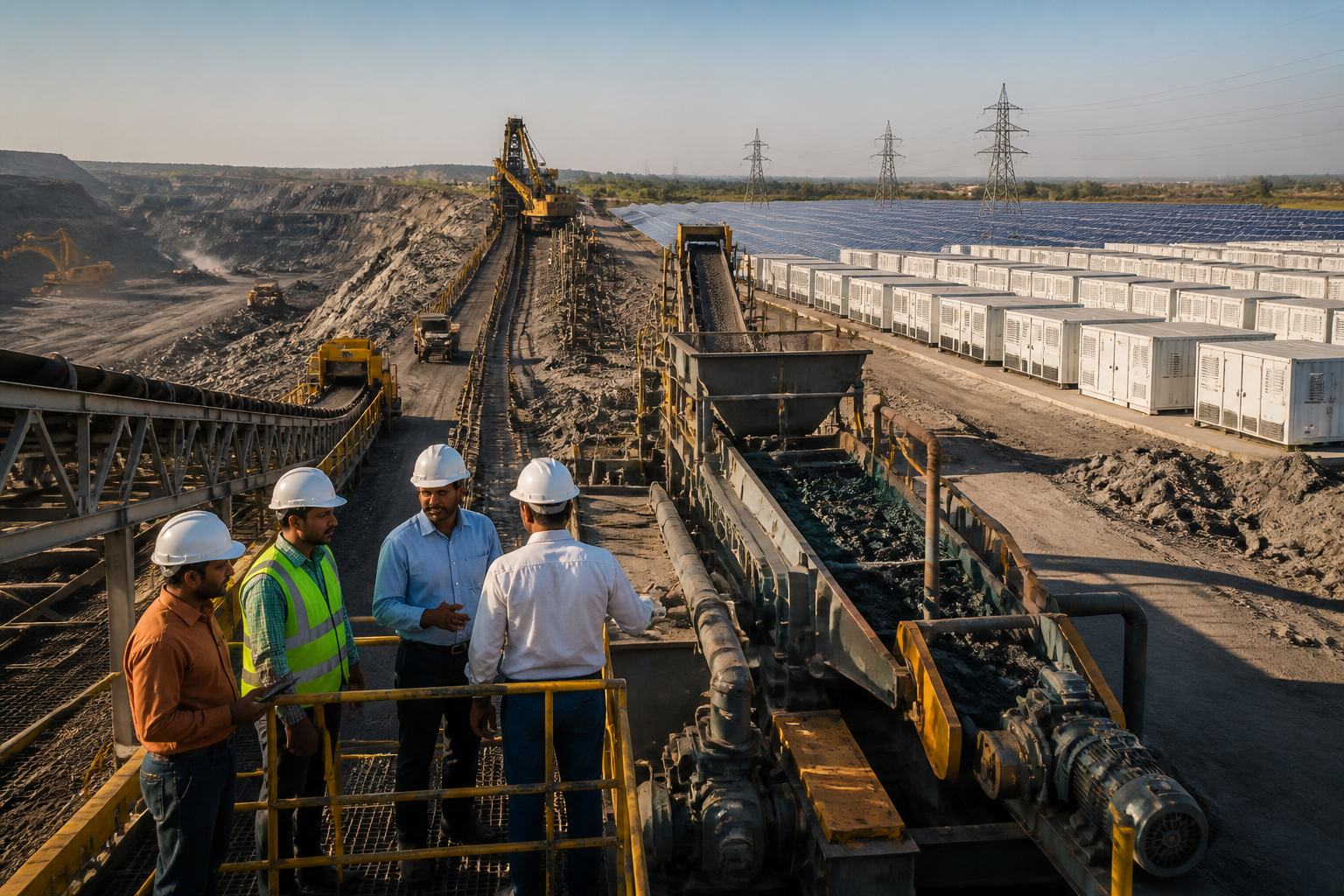
Coal India’s plan to raise annual R&D spending to ₹500 crore by 2029-30 is more than a larger research budget. It marks an attempt by the country’s dominant coal producer to build technological capacity across mining, critical minerals, clean coal, energy storage and alternative industrial uses of coal while the energy system around it changes.
The proposed increase is substantial. Coal India Ltd (CIL) has planned R&D expenditure of ₹225 crore for 2026-27, rising to ₹350 crore in 2027-28, ₹400 crore in 2028-29 and ₹500 crore in 2029-30, according to a coal ministry statement reported by Business Standard. The planned 2029-30 allocation is considerably above the company’s actual expenditure of ₹61.31 crore in 2023-24, ₹245.38 crore in 2024-25 and ₹183.88 crore in 2025-26.
That trajectory shows both the scale of the proposed expansion and the challenge of converting budgetary intent into deployable technology. Spending rose sharply between 2023-24 and 2024-25 before falling in 2025-26. The new plan therefore represents not only a commitment to spend more, but also an effort to establish a more consistent pipeline from research to demonstration and commercial use.
CIL’s 2026 R&D policy prioritises projects at Technology Readiness Level 4 and above. In practical terms, the focus is shifting towards technologies that have moved beyond early-stage research and can progress towards demonstration and field deployment. The company currently has 20 R&D projects with an approved outlay of ₹231 crore.
This emphasis is important for a mining company because the value of research is ultimately measured in operating mines, safer workplaces, better mineral recovery, lower waste and commercially usable products. Laboratory results alone do not alter the performance of a mine, processing plant or energy system. The ministry’s stated objective of moving research towards field deployment places implementation capacity at the centre of the programme.
One of the clearest examples is CIL’s proposed integrated graphite value chain. The programme covers mining, beneficiation, purification, spheronisation, coating and the production of anode materials. In collaboration with the Non-Ferrous Technology Development Centre, the company has proposed a demonstration plant for coated spherical purified graphite with a purity of at least 99.95 per cent.
The graphite programme also illustrates the difference between identifying a mineral opportunity and building a viable industrial chain. Commercial scale-up will follow only after consistent product quality, process performance and customer qualification have been established, the statement said. The sequence points to the technical and commercial stages that stand between mineral extraction and a product that can be accepted by industrial users.
CIL is pursuing domestic graphite opportunities in Madhya Pradesh and Chhattisgarh, as well as rare-earth and rare-metal opportunities in Andhra Pradesh and Maharashtra. The company’s collaborations include Indian Rare Earths Ltd, NFTDC, Curtin University in Australia, Hindustan Copper and state entities. These partnerships indicate that the proposed R&D system is being designed as a network involving public-sector companies, research institutions, universities and state agencies rather than as an isolated corporate laboratory.
The mining technology agenda is similarly broad. CIL’s stated thrust areas include artificial intelligence, machine learning and Internet of Things-based smart mining, mine planning and exploration, mine safety, waste-to-wealth, alternative uses of coal, renewable energy, clean coal, beneficiation and mineral processing. Each area is connected to a different operational problem: extracting resources more efficiently, improving safety, processing lower-quality or complex ores, finding uses for waste and reducing dependence on a single revenue stream.
The safety component is particularly significant in an industry where technology is closely linked to working conditions. The source does not provide performance results from the company’s AI, machine-learning or IoT projects, so it is not yet possible to establish how much they have improved safety or productivity. The R&D policy’s movement towards higher Technology Readiness Levels, however, provides a framework for assessing whether these projects eventually move from trials to routine use.
CIL’s wider diversification portfolio shows why the R&D programme is being connected to infrastructure and industrial planning. The company has four coal-to-chemicals projects with a combined estimated project cost of around ₹69,346 crore. These include a 1.27 million tonnes per annum urea project at Talcher Fertilizers, a 0.66 million tonnes ammonium nitrate project under Bharat Coal Gasification & Chemicals, and two synthetic natural gas projects.
These projects extend the role of a coal producer into chemicals and industrial feedstocks. They also create a larger requirement for process technology, project execution and reliable supply chains. The supplied information gives the estimated costs and project capacities, but does not establish their construction status, commissioning dates or commercial performance. Those milestones will be necessary to judge whether the diversification strategy is translating into operating assets.
CIL is also expanding into grid-scale energy storage. Its projects include a 187.5 MW/750 MWh battery energy storage system at Choutuppal in Telangana and an 80 MW/320 MWh battery energy storage portfolio across four locations in Odisha. Together, the announced storage projects represent 267.5 MW of power capacity and 1,070 MWh of storage capacity.
The storage portfolio sits alongside CIL’s renewable-energy activity. The company has commissioned around 550 MW of solar capacity and is developing a 20 MW AC grid-connected floating solar project at Chilwa Taal in Gorakhpur, Uttar Pradesh. These figures show that the company’s transition-related investments are not limited to research proposals; they also include operating solar capacity and announced storage and floating-solar projects.
At the same time, the available information does not show how these projects will be integrated into local electricity systems, how they will be financed beyond the stated project details, or what utilisation and revenue outcomes are expected. Those questions matter because energy storage is not simply a technology purchase. It requires grid connection, operating protocols, market arrangements and long-term asset management.
The institutional structure behind the R&D effort is another important part of the story. CIL’s R&D ecosystem includes centres of excellence at IIT Madras, IIT Hyderabad and IIT (ISM) Dhanbad, among others. The ministry also plans to strengthen the National Centre for Coal and Energy Research and expand collaboration with IITs, National Institutes of Technology, the Council of Scientific and Industrial Research, research institutions, startups and industry.
This network reflects a familiar challenge in public-sector technology programmes: research capability may exist across several institutions, but commercialisation requires coordination between laboratories, operating companies, regulators, financiers, manufacturers and customers. The proposed collaborations could widen the knowledge base available to CIL, while the higher readiness-level focus could help connect research work to operational requirements.
The company filed five patents during 2026-27, with two additional patents under process, while a patent for bifacial perovskite solar cells has been granted. Patents are an indicator of research output, but they do not by themselves demonstrate commercial adoption. The more consequential measures will be whether patented or developed technologies reach demonstration, secure customers, improve mine or plant performance and generate repeatable deployment.
The numbers also reveal the scale mismatch between research spending and the capital intensity of diversification. The planned annual R&D allocation of ₹500 crore is significant compared with CIL’s recent actual R&D expenditure, but it is small relative to the approximately ₹69,346 crore estimated cost of the four coal-to-chemicals projects. This makes R&D an enabling layer within a much larger investment programme rather than a substitute for project finance, construction capacity or operational management.
For cities and the built environment, the implications are indirect but material. Critical-mineral processing, coal-chemical plants, renewable-energy facilities, battery storage and mining operations require land, transport links, water systems, power connections and industrial infrastructure. Their development can influence regional employment and supply chains while also placing demands on local authorities and surrounding settlements. The supplied material does not quantify those local impacts, but the geographic spread of the initiatives—from Telangana and Odisha to Uttar Pradesh, Madhya Pradesh, Chhattisgarh, Andhra Pradesh and Maharashtra—shows that the programme is distributed across multiple regions.
The central question is therefore not whether Coal India is spending more on research. It is whether a large state-owned producer can convert a higher R&D allocation into reliable technologies, domestic mineral-processing capability and commercially functioning energy assets. The company’s announced portfolio provides evidence of a broad transition strategy, but not yet of completed commercial outcomes.
The next phase will be defined by milestones that can be independently assessed: the execution of the graphite demonstration plant, customer qualification for coated spherical purified graphite, progress on the coal-to-chemicals projects, development of the battery-storage systems, and the movement of AI, smart-mining, safety and processing projects into field deployment. Until those milestones are reached, the ₹500-crore target is best understood as an institutional commitment to build a technology pipeline rather than proof that the transition has already been achieved.

