


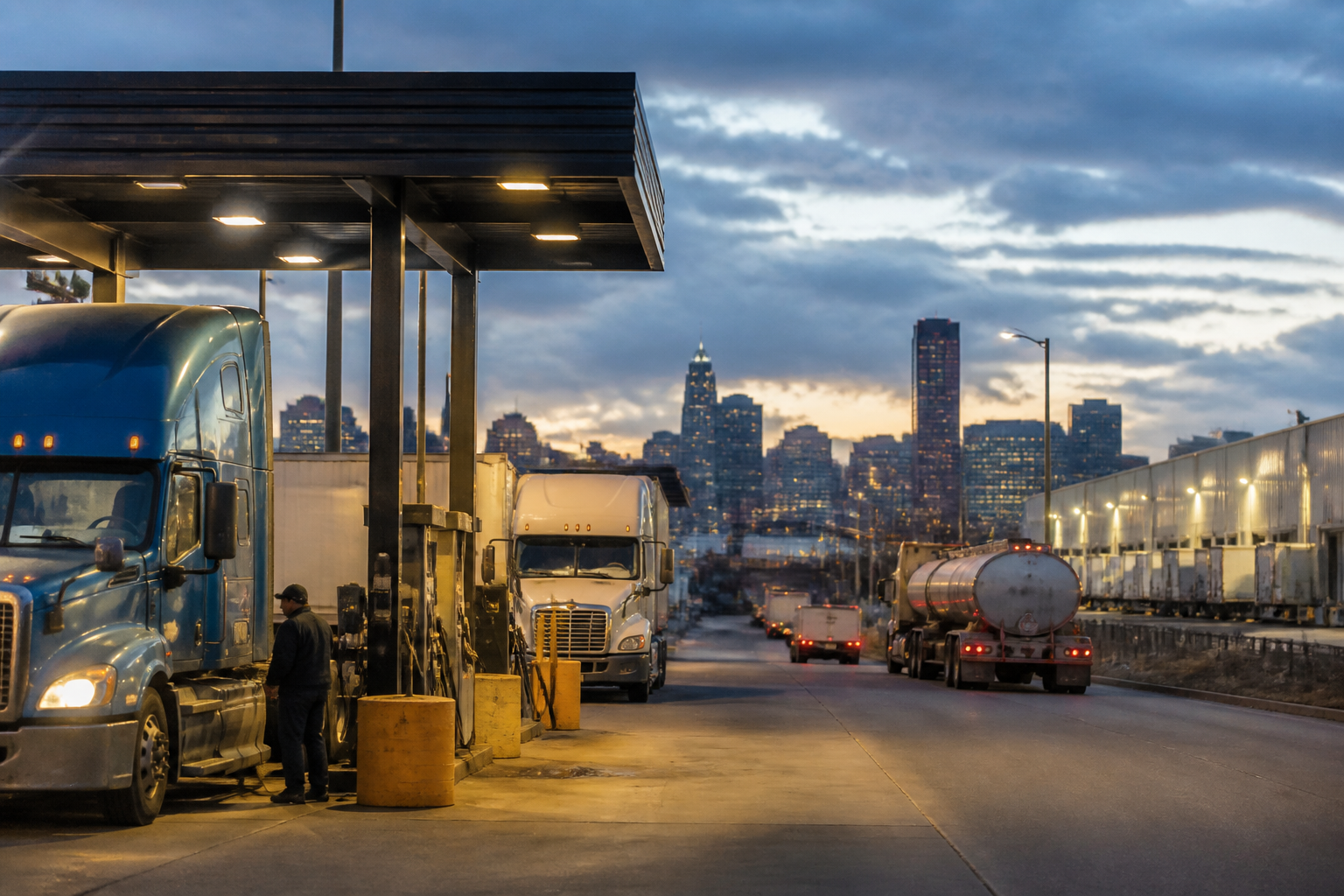
US diesel prices have reached a record national average, according to figures cited from the American Automobile Association, turning a geopolitical and maritime disruption into a direct pressure on freight networks, farms, businesses and consumers. The rise shows how dependent urban economies remain on fuel systems that most residents encounter only through the price of transported goods.
The AAA figure cited in the report puts the national average diesel price at $6.4866 per gallon on 19 September. A week earlier, the average was $6.16 per gallon, representing an increase of about 33 cents, or 5.3%. The report says the price was about $3.71 per gallon a year earlier and $3.75 on 27 February, before the reported US-Iran conflict began on 28 February.
That comparison is significant because diesel is not only a retail fuel. It is an operating input for the movement of goods, agricultural production, construction activity, rail services, fishing and several other parts of the economy. When diesel becomes more expensive, the effect is distributed across the logistics chain rather than remaining confined to vehicle owners.
The immediate trigger identified in the report is the disruption around the Strait of Hormuz, a major maritime route for global oil flows. The report says the strait accounts for about 20% of global oil demand and that its closure by Iran has disrupted a fifth of global oil and gas supply. It also cites a Reuters report stating that oil exports from eight major Gulf producers had fallen by at least 60% from February levels during the conflict.
These figures describe a supply shock with an urban expression. Most cities do not produce the food, fuel, building materials and manufactured goods they consume. They depend on long-distance transport and on a chain of refineries, storage terminals, ports, distribution depots and roads. A disruption at a maritime chokepoint can therefore appear later as a higher delivery charge, a more expensive bus or truck operation, or a rise in the cost of goods on an urban shelf.
## How US diesel prices move through cities
The report identifies heavy trucks, trains, agricultural machinery and fishing boats as major diesel users. Of these, heavy road transport has the most visible connection to urban life. Trucks connect ports, warehouses, industrial areas, wholesale markets, retail centres and neighbourhood delivery points. Their fuel expenditure is built into the cost of almost every transported product.
The same relationship applies to construction and infrastructure. Diesel-powered trucks carry aggregates, cement, steel, equipment and excavated material. Construction machinery and generators can also depend on diesel. The supplied report does not quantify the effect on any specific project, but its broader evidence indicates that a sustained fuel increase can raise operating costs across the built environment.
Rail systems are also part of this equation. The report includes trains among the affected diesel users, although it does not distinguish between freight and passenger operations or identify particular rail networks. The central point is that transport energy is embedded in the movement of people and materials. Where alternatives are limited, higher fuel costs can quickly become a broader cost-of-living issue.
Food is especially exposed because diesel is used at several stages before a product reaches a consumer. Farm machinery requires fuel, harvested goods must be transported, and food distribution relies on trucks and storage facilities. The report links higher diesel costs to agricultural expenses, freight rates and food prices. It does not provide a measured estimate of the eventual increase in consumer inflation, but the transmission mechanism is clear: fuel affects the cost of moving goods through the urban supply chain.
This is why fuel-price stories are also infrastructure stories. Roads, ports, warehouses and distribution networks may continue to operate, but their cost structure changes. The physical infrastructure remains in place while the financial pressure of operating it rises. For households, that pressure is often experienced indirectly through prices rather than through a visible breakdown of services.
## The supply problem is larger than crude oil
The report cites the US Energy Information Administration as saying diesel prices reflect more than the cost of crude oil. They also include refining margins, distribution costs, taxes and the diesel crack spread, which measures the difference between crude input costs and wholesale diesel prices.
That distinction matters because a crude-oil shock does not automatically explain the entire movement in diesel prices. Refineries must convert crude into usable products, and the availability of refining capacity and refined fuels can become a separate constraint. The report says global distillate supplies are limited and that both oil costs and refining margins have risen.
The reported disruption has also affected the geography of supply. The article says the United States emerged as an important supplier of refined petroleum products to markets facing shortages. That role can support global markets, but it may also put pressure on domestic diesel inventories. The Wall Street Journal is cited in the report as linking increased US exports to additional pressure on domestic supplies.
This creates a difficult policy balance. Supplying international markets can strengthen the position of a major exporting country and help address shortages elsewhere. At the same time, drawing more refined product out of domestic inventories can tighten the local market. The supplied material does not establish how long this pressure will last or what policy response, if any, authorities have adopted.
The distinction between crude supply and refined-product supply is important for urban administrators and infrastructure operators. A city may be close to a port or refinery and still face higher fuel costs if distribution, storage or refining capacity becomes constrained. Location alone does not guarantee resilience. The system depends on the ability to move, process and store fuel at each stage.
## California shows the uneven geography of fuel stress
The national average also hides major regional differences. AAA data cited in the report puts California’s average diesel price at $8.4161 per gallon, nearly $2 above the national average. The report identifies California as the most expensive US fuel market in this comparison.
That gap demonstrates that a global disruption is filtered through local conditions. Taxes, refinery access, distribution distances and market structure can all influence the price paid in a particular state, although the supplied article does not separately quantify the contribution of each factor. The result is that businesses and households do not experience the same fuel shock even within one country.
For urban areas, this unevenness can affect the relative cost of logistics and production. A region with higher diesel prices may face greater pressure on freight operators, agricultural producers and fuel-intensive businesses. The article does not provide city-level data, so it cannot establish which metropolitan areas have experienced the greatest impact. It does, however, show why national averages are an incomplete measure of infrastructure stress.
The same principle applies to India and other fuel-importing economies, but the supplied report does not provide data on their prices, import exposure or policy responses. Any direct comparison would require separate evidence. What can be established from the report is that global oil disruptions are transmitted through a network in which countries, ports, refineries and urban markets are closely connected.
## The governance challenge behind the price rise
Fuel security is often discussed as a matter of energy supply, but the urban consequences involve several institutions. Maritime authorities and national governments respond to geopolitical and shipping risks. Energy agencies monitor inventories and prices. Refineries and petroleum companies manage production and distribution. Transport operators absorb or pass on fuel costs, while food and industrial businesses respond to higher logistics expenses.
This institutional chain makes the consequences difficult to manage through a single intervention. A government may increase supply from reserves, adjust taxes or support particular sectors, but the supplied report does not state that any such measure has been announced in response to the current rise. Nor does it establish whether the disruption will be short-lived or prolonged.
What the evidence does show is the importance of refined-product capacity and storage. A country can have access to crude oil and still face high diesel prices if refining margins rise, inventories fall or exports compete with domestic demand. Distribution infrastructure also matters because fuel must reach the locations where trucks, farms, railways and businesses operate.
For cities, resilience therefore extends beyond visible infrastructure such as roads and transit systems. It includes the less visible logistics systems that keep markets supplied. Warehouses, fuel terminals, freight corridors and last-mile distribution networks form part of the urban operating system, even when they sit outside municipal boundaries.
## What the evidence confirms
The reported numbers confirm a sharp movement in US diesel prices: $6.4866 per gallon nationally on 19 September, up from $6.16 a week earlier and about $3.71 a year earlier. California’s cited average of $8.4161 shows that the burden is uneven across markets. The article also connects the increase to disruption around the Strait of Hormuz, lower Gulf exports, limited global distillate supply and pressure on US inventories caused by refined-product exports.
The evidence does not establish the precise contribution of each factor to the final retail price, nor does it provide a forecast for inflation or a timetable for easing. It does establish why diesel prices matter beyond fuel stations. They influence the cost of moving food, materials and manufactured goods, and they expose the dependence of urban economies on energy-intensive logistics.
The next developments to monitor are the status of the Strait of Hormuz, Gulf export volumes, US diesel inventories, refining margins and regional price differences. Until those indicators become clearer, the record diesel price remains not only an energy-market event but also a warning about how quickly geopolitical shocks can enter the everyday economics of cities.

