


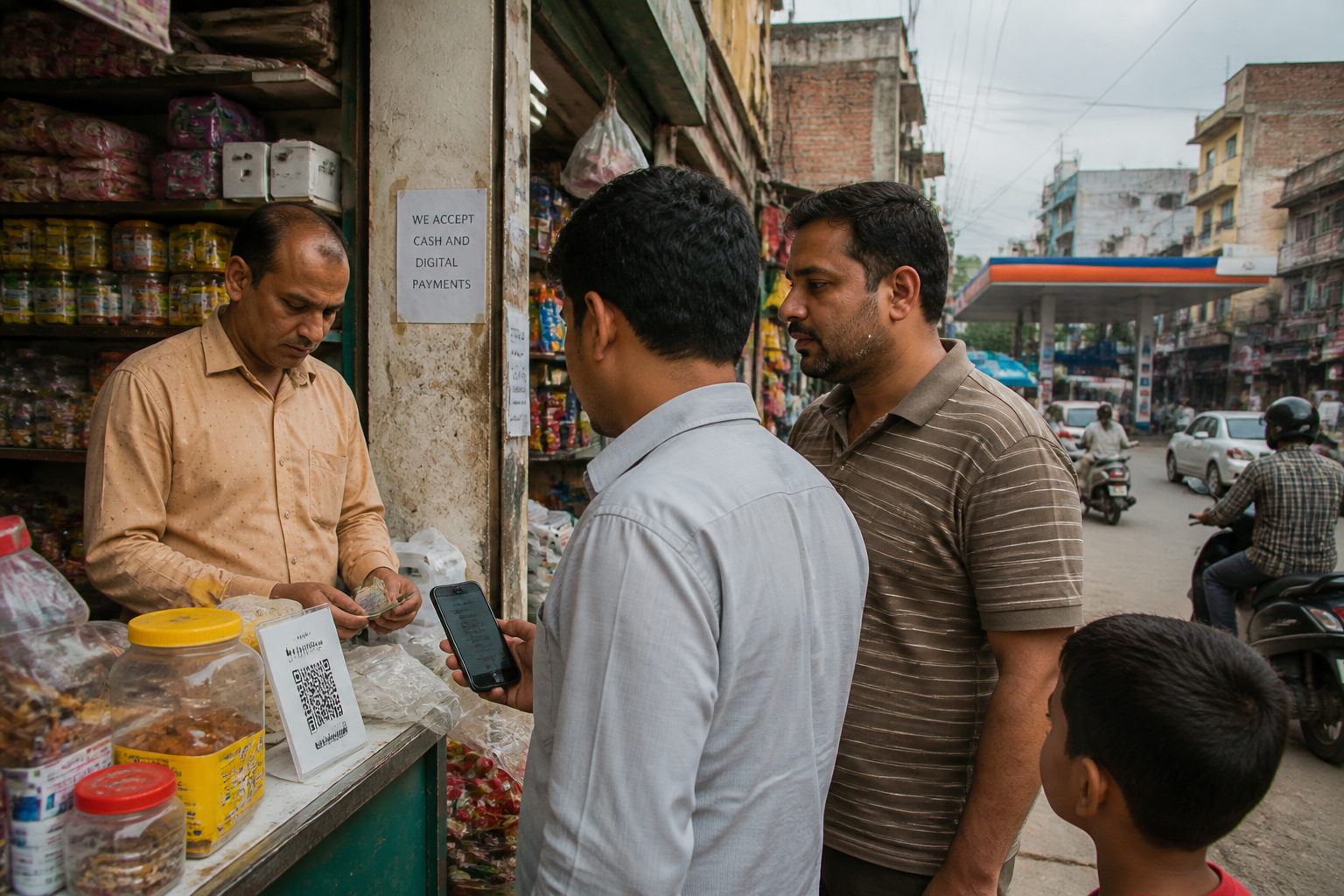
The proposed UPI MDR regime is already changing how some merchants in Ghaziabad think about digital payments. From 15 October 2026, traders say they may stop accepting certain UPI transactions or shift customers towards cash because the new merchant cost would be borne by the shop or business rather than the customer.
The response in Ghaziabad is significant not simply because some shopkeepers have displayed posters. It shows how a change in the economics of a digital payment can alter everyday urban commerce at street level. UPI has become part of the operating system of shops, fuel stations and markets, but its continued use depends on whether small businesses can absorb the cost of accepting it.
According to the report, the Centre announced on Tuesday that a 0.4% Merchant Discount Rate, or MDR, would apply from 15 October to UPI payments above Rs 2,000 made to merchants. Payments between two individuals and smaller payments would remain outside the new charge, the report said. It also stated that the maximum MDR for transactions of Rs 75,000 and above would be capped at Rs 300.
The proposed structure therefore creates a threshold-based distinction in daily transactions. A customer paying a merchant more than Rs 2,000 through UPI could trigger a cost for the business, while smaller payments would not. For merchants handling frequent, high-value transactions, the issue is not only the percentage itself but also the cumulative effect across a day or month.
That distinction is already visible in the response from Ghaziabad’s traders. Sanjay Bindal, who runs a grocery shop in Sector 9 of Vijay Nagar, reportedly placed a notice outside his shop saying that UPI payments would not be accepted from 15 October. He said the decision was linked to the inability to recover the MDR amount from customers.
The example is important because grocery retail works on repeated, relatively low-margin transactions. The source does not provide Bindal’s turnover, margins or payment mix, so it is not possible to calculate the precise effect on his business. But his stated concern identifies the basic institutional arrangement: the merchant is expected to absorb the charge, while passing it on to the customer is not permitted under the reported announcement.
For a shopkeeper, that leaves a limited set of choices. The business can accept the cost, adjust discounts, raise prices indirectly or ask customers to use cash. Ghaziabad trader Rajnish Bansal, associated with the Turab Nagar market, said the MDR would become a business expense and that merchants could respond by reducing discounts or increasing costs. He also said several shopkeepers had put up posters and that traders wanted more cash transactions, even though this would run against the direction of a cashless economy.
This tension places payment policy inside the everyday economics of urban markets. A market is not only a physical collection of shops; it is also a network of payment systems, credit arrangements, suppliers and customers. When the cost of one payment channel changes, the adjustment can appear in shop-level decisions rather than in a formal policy debate. A poster on a storefront is therefore a small but visible indicator of how national payment rules are being interpreted by local businesses.
The fuel retail sector illustrates the issue differently. Vipin Sharma, president of the Ghaziabad Diesel-Petrol Dealers Association, said the matter had been raised across Uttar Pradesh. He said fuel stations had decided, for the time being, not to accept UPI payments above Rs 2,000 from 15 October.
Fuel stations handle transactions where the value can exceed the reported threshold quickly. A customer buying fuel for a car, commercial vehicle or two-wheeler may cross Rs 2,000 in a single transaction, making the payment rule more operationally significant for the sector than for a shop where most purchases remain below that level. The source does not establish how many fuel stations will implement the proposed limit or whether the decision is uniform across the city. It does, however, show that merchant concerns extend beyond small retail.
## UPI MDR and the economics of acceptance
The central question is who pays for the convenience of digital acceptance. Under the arrangement described in the report, customers would not bear the MDR directly. The merchant would. That approach protects the customer’s payment experience but transfers the cost to businesses whose ability to absorb it varies according to sector, transaction size and operating margin.
A percentage-based cost also produces different pressures for different merchants. A shop that receives many payments just above Rs 2,000 would face a different exposure from a business that receives occasional large payments. The reported cap of Rs 300 for transactions of Rs 75,000 and above limits the charge at the upper end, but the source does not explain how the cap would be administered, which payment intermediaries would collect it or how disputes would be handled.
Those unanswered operational details matter because the policy will be experienced through payment failures, revised store notices and conversations between customers and merchants. If a customer reaches a fuel station or shop expecting to pay by UPI, the merchant’s acceptance policy will determine whether the transaction is completed digitally or shifted to cash. The result could vary from one neighbourhood and business category to another.
The Ghaziabad reaction also reveals a difference between formal policy design and street-level implementation. A national rule can define the charge and the exemption threshold, but local merchants decide how to respond in real time. Their choices may depend on cash availability, customer expectations, the size of their average transaction and the ease of maintaining alternative payment arrangements.
The report does not provide data on the share of UPI payments in Ghaziabad’s retail economy, the number of affected merchants or the volume of transactions above Rs 2,000. It also does not establish whether the proposed MDR will be applied uniformly across all merchant categories. These gaps prevent a citywide estimate of the policy’s economic effect. They also make the early merchant response more important as evidence of concern rather than proof of the final outcome.
## The cashless economy faces a local test
India’s digital payment expansion is often discussed at the level of technology and national infrastructure. The Ghaziabad episode brings the question down to the market lane: will merchants continue to offer digital payment when acceptance carries a cost, and will customers change their behaviour when a familiar option disappears?
The answer may not be uniform. Some customers may carry cash, while others may choose a different shop that continues to accept UPI. Some merchants may absorb the cost to retain convenience and avoid losing sales. Others may impose internal limits, as the fuel dealers’ association has proposed, or withdraw from UPI for selected transactions. Each response changes the balance between customer convenience and merchant expense.
For urban administration and local commerce, this is also a question of inclusion. The source does not provide evidence on which groups in Ghaziabad depend most heavily on UPI or which customers may find a return to cash difficult. It would therefore be premature to claim a specific impact on any demographic group. But the reported shift towards cash shows that payment policy can affect how people access everyday goods and services, particularly in markets where transactions are immediate and informal.
The policy also creates a coordination challenge. Merchants need clarity on the exact threshold, the calculation of the MDR, the transaction cap and the treatment of refunds or failed payments. Customers need to know whether a shop accepts UPI and whether the restriction applies to all transactions or only those above Rs 2,000. The source records merchant announcements but does not mention a citywide communication mechanism or a formal implementation plan for local markets.
That gap between announcement and execution is where confusion can emerge. Individual shops may use different limits, while trade associations may issue sector-specific guidance. In such a situation, the practical meaning of the policy will be determined as much by merchant coordination and customer adaptation as by the headline rate.
The Ghaziabad case therefore should be read as an early signal, not a completed assessment of the UPI MDR regime. The reported government announcement establishes the proposed charge and exemptions. Named merchants and a fuel dealers’ association have described their planned responses. What remains unclear is the scale of implementation, the final operating rules and whether the announced restrictions will persist after 15 October.
The next decisive evidence will come from how merchants actually handle payments once the new regime begins. The number of shops displaying restrictions, the sectors most affected and the extent to which customers shift to cash will show whether the change remains a limited business adjustment or becomes a wider challenge for digital commerce in Ghaziabad.
