


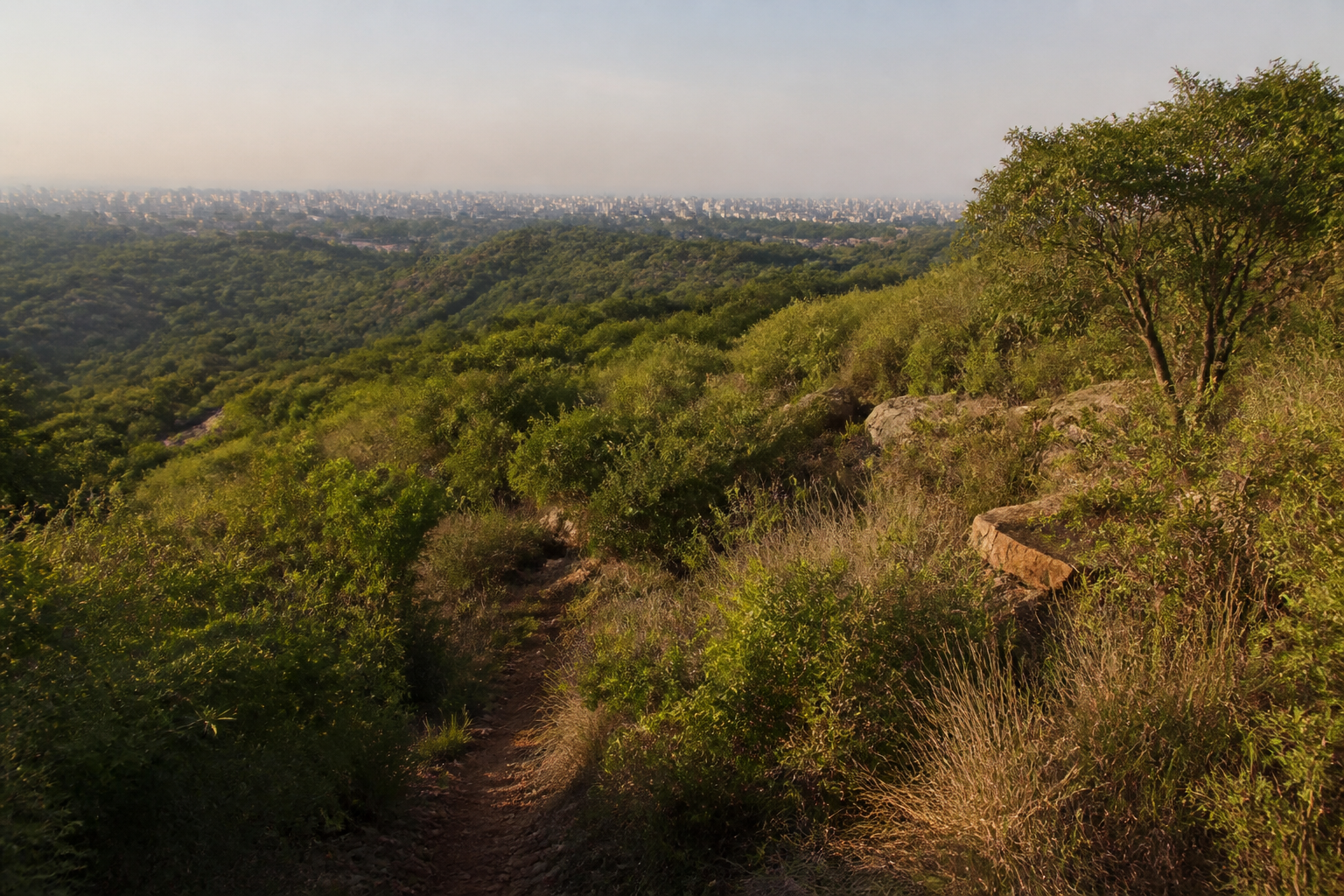
Delhi’s decision to notify around 1,000 acres of the Southern Ridge as Reserved Forest is more than an addition to the capital’s protected-area map. It closes, at least for this parcel, a legal gap that had persisted since the land was first brought under the Indian Forest Act in 1994 and places the question of Ridge protection back within the wider challenge of managing Delhi’s shrinking ecological infrastructure.
The notification covers about 400 hectares of Southern Ridge Phase-II(A), spread across 15 villages. According to the report, the Forest Department had identified the parcel as awaiting final notification under Section 20 of the Indian Forest Act, 1927. The Delhi government’s approval gives the land final statutory protection as Reserved Forest and takes the capital’s notified Ridge area to nearly 13,000 acres, or about 5,250 hectares.
The significance lies in the difference between preliminary protection and final legal status. The parcel had initially been brought under the Act through a Section 4 notification in 1994, but the final process remained pending for decades. That delay left a gap between the government’s recognition of the land as part of the Ridge and its completion of the statutory process needed to provide the strongest form of protection described in the announcement.
A Forest Department submission before the National Green Tribunal recorded that 4,850.3 hectares of Delhi’s Ridge had been notified under Section 20 until August, including 4,176 hectares of Southern Ridge. The latest approval adds about 400 hectares of Southern Ridge to that legally protected area. In administrative terms, the decision therefore represents both a fresh notification and a continuation of a much longer effort to convert identified Ridge land into land with final statutory status.
That distinction matters because the Ridge is not simply a patch of open land. The Delhi government describes it as an extension of the Aravalli mountain range and one of the capital’s most important natural green areas. Chief minister Rekha Gupta said the Ridge supports biodiversity, helps control dust and regulates local temperatures. She also described the Southern Ridge as an ecological link at the northern end of the Aravallis, as well as Delhi’s “green lung” and a carbon sink.
These functions place the Ridge within the city’s infrastructure debate, even though it is not built infrastructure. The government’s own description connects the forest landscape to air pollution, local heat and climate change. Protection of the Ridge is therefore being presented as a form of ecological risk management: retaining natural systems that support environmental conditions in a city facing pressure from development, dust and rising climate stresses.
The notification, however, does not resolve the wider management problem. The report records that remaining portions of the Southern Ridge continue to face encroachments, village habitation, unauthorised colonies, JJ clusters and religious structures. Forest and Revenue departments have been carrying out joint verification of such parcels. This indicates that the legal boundary of protected land and the conditions on the ground do not always align neatly.
That is the central governance issue exposed by the announcement. A notification can establish statutory status, but protection also depends on identifying the land accurately, maintaining records, coordinating departments and managing existing occupation and competing claims. The reference to joint verification by the Forest and Revenue departments shows that the administrative work is still active. It also suggests that final notification is one stage in a longer process rather than the endpoint of Ridge management.
The government has linked the notification to a broader programme of ecological restoration. It plans to restore degraded areas, promote native species and control invasive vegetation in accordance with the Ridge Working Plan. Officials said the larger ecological restoration programme covers more than 6,300 hectares, while the process of notifying other eligible Ridge land will continue in phases.
The choice of restoration measures is significant because legal protection alone does not restore ecological function. The stated focus on native species and invasive vegetation indicates an attempt to manage the quality of the habitat, not merely its legal classification. At the same time, the supplied material does not establish how much of the newly notified parcel is degraded, what restoration targets have been fixed, how progress will be measured or what funding and staffing will support the programme.
The creation of the Delhi Ridge Management Board adds another institutional layer. The board was constituted in June 2026 to oversee the protection, restoration and management of Ridge forests. Its role will be important because Ridge governance involves more than one department and intersects with land records, settlements, unauthorised construction and environmental regulation. The notification gives the board a larger protected landscape to manage, but the announcement does not specify its operational powers, reporting structure or enforcement capacity.
This is where the legal history of the Southern Ridge meets the practical limits of urban administration. The parcel’s final notification followed a process that began in 1994 and remained incomplete for decades. The delay shows that identifying environmentally important land is not the same as completing the administrative steps needed to secure it. It also raises a broader question about how quickly other eligible Ridge parcels can move from preliminary recognition to final protection.
The available figures show the scale of the task. Delhi’s notified Ridge area is expected to reach nearly 13,000 acres, or about 5,250 hectares, following the decision. The Forest Department’s earlier submission had recorded 4,850.3 hectares notified under Section 20, with 4,176 hectares in the Southern Ridge. The restoration programme, meanwhile, is described as covering more than 6,300 hectares. These figures refer to different administrative or programme categories, and the supplied announcement does not explain their precise relationship. That distinction will matter when progress is assessed.
For residents, the immediate effect is not a new transport service or a newly opened public facility. The impact is distributed through environmental conditions: the retention of green cover, the ecological role of the Ridge, and the ability of authorities to prevent further degradation. The government has specifically linked the landscape to dust control, temperature regulation, biodiversity and resilience to air pollution and climate change. Whether those benefits are sustained will depend on what follows the notification.
The Southern Ridge decision therefore has two clear dimensions. The first is a legal gain: around 400 hectares have received final statutory protection after decades of delay. The second is an implementation test: authorities must now manage a landscape affected by encroachments, settlements, unauthorised colonies, informal clusters and religious structures while advancing restoration across a much larger area.
What the announcement confirms is that Delhi is continuing to expand the portion of the Ridge with final legal protection and is building a formal institutional framework around its management. What remains unclear from the available material is how disputed or occupied parcels will be handled, how the restoration programme will be financed and measured, and how the Delhi Ridge Management Board will coordinate with the Forest and Revenue departments. The next phases of notification, joint verification and restoration will determine whether the latest legal protection becomes durable ecological protection on the ground.
