


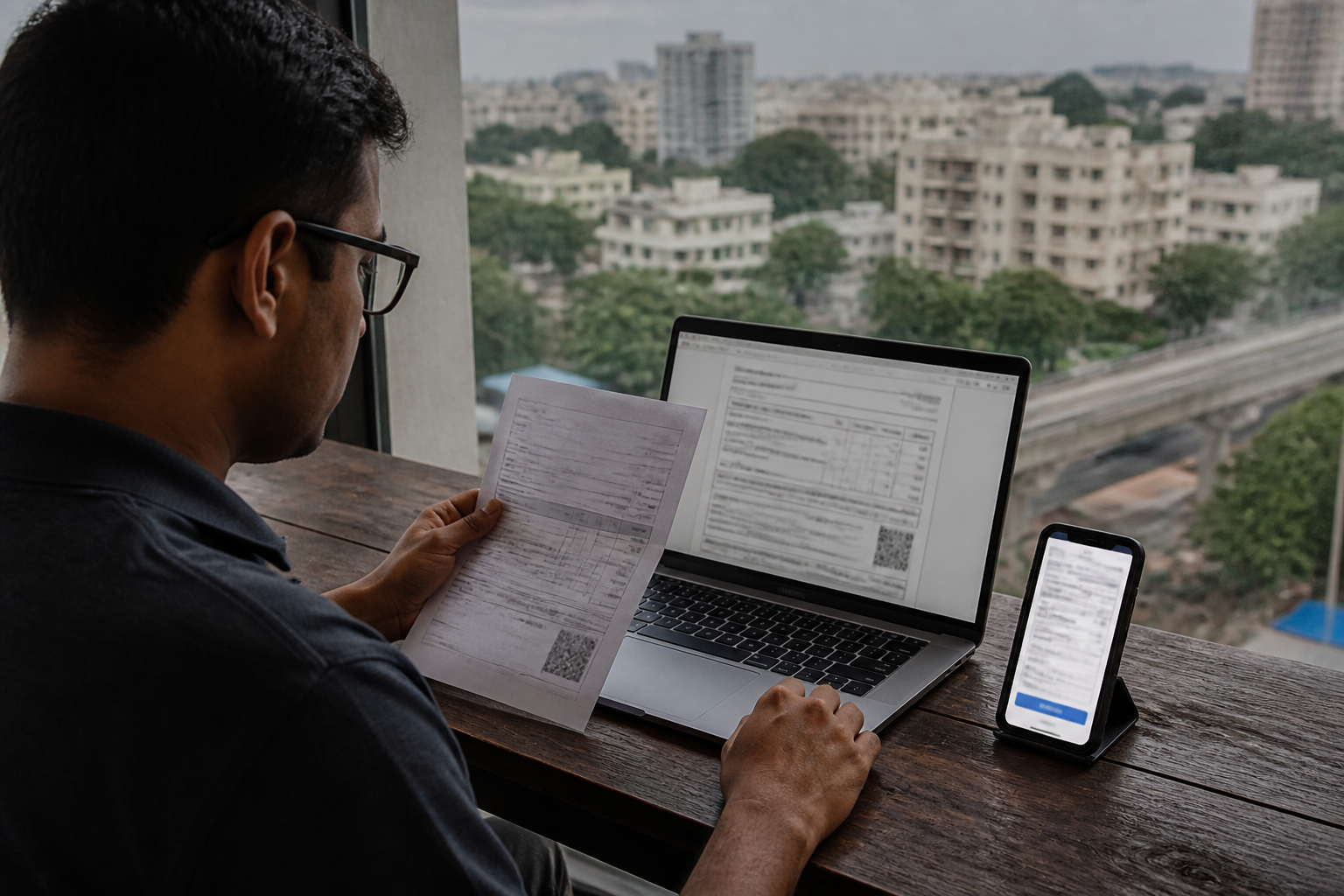
Bengaluru’s new software charge has turned a small line item on property-tax receipts into a larger test of civic trust. The Greater Bengaluru Authority (GBA) is defending the annual levy as payment for the digital systems that support online civic services, while taxpayers and political leaders are questioning its legal basis, transparency and relationship with the taxes they already pay.
The charge is listed as “Software Charges” on property-tax receipts. Residential property owners are being asked to pay Rs 200 a year, while commercial properties face a charge of Rs 1,000. According to the report, the item began appearing on the property-tax portal midway through the financial year, meaning some owners who had already paid their tax earlier in the year did not initially see it.
That timing matters because property tax is not experienced by citizens as an abstract municipal revenue stream. It is a recurring obligation tied to a specific property, a digital receipt and an official calculation. When a new component appears after taxpayers have already paid, the immediate question is not only how much it costs. It is how the charge was introduced, who authorised it, what service it funds and whether citizens were informed before it was added.
GBA’s explanation is based on the “user pays” principle. Munish Moudgil, the authority’s special commissioner for revenue and IT, said creating, maintaining and upgrading digital infrastructure involves substantial expenditure. He argued that a residential charge of Rs 200 a year is small compared with the convenience and time savings generated by online civic services.
The authority has linked the levy to a broader digital transformation of Bengaluru’s civic administration. Moudgil said technology has reduced dependence on manual processes and accelerated service delivery. He cited the issuance of nearly 12 lakh e-khatas in less than two years, with citizens receiving an e-Khata in about a week on average. He also said the disposal rate was around 98%, with applications taking seven to eight days on average.
These figures, as presented by the GBA official, establish the scale of the authority’s digital operations. They also reveal the administrative argument behind the charge: civic technology is being treated as an operating layer of the city, not simply as a one-time software purchase. Property records, tax payments and e-Khata applications increasingly depend on platforms that require development, maintenance and upgrades.
But the same argument creates a governance obligation. If digital infrastructure is essential to municipal administration, the authority must make the funding model intelligible. A taxpayer needs to know whether the software charge is a fee for a clearly defined service, a cost-recovery mechanism for a shared civic platform or an additional levy attached to property taxation. The supplied report does not establish the legal provision under which the charge was imposed, nor does it record a public consultation or a formal notification explaining the levy.
That gap is at the centre of the controversy. BJP state president BY Vijayendra called it a “software tax” and questioned why property owners should separately fund government software systems. In a post on X, he asked what citizens were paying for and whether the charge amounted to “looting in broad daylight”. These are political criticisms, not independent findings, but they identify the precise point at which a technology initiative becomes a public-finance issue: citizens are being asked to pay for a system whose scope and authority have not been clearly explained in the material available.
Resident responses reported by the Times of India show a similar loss of clarity. One taxpayer asked whether software code was being written for each property, while another questioned whether the charge was being imposed without meaningful service delivery. The comments may be informal, but they reflect a practical problem in public administration. Digital systems are often invisible when they work. Their costs become visible only when a separate line appears on a bill.
This is particularly important in Bengaluru, where the civic technology layer is now connected to basic administrative transactions. An e-Khata is not merely an online convenience for a technology-oriented population. It is part of the documentation and property-record system through which ownership, taxation and transactions are processed. If the GBA’s stated performance figures are accurate, the platform is handling a large volume of applications and reducing the time required for a process that was previously more dependent on manual administration.
However, efficiency alone does not settle the question of who should pay. A digital service can produce administrative savings, citizen convenience and better record management while still requiring transparent budgeting. The authority’s argument that digital systems cost money explains the expenditure, but it does not by itself explain why the cost must be recovered through a separate property-level charge, why the residential and commercial amounts are set at Rs 200 and Rs 1,000, or how the amounts relate to the actual cost of service delivery.
The report also does not establish whether the charge applies uniformly across properties, whether it is linked to the use of a particular service, or whether it is intended to continue in future tax cycles. Those details are not minor administrative matters. They determine whether taxpayers understand the levy as a predictable civic fee or as an unexplained addition to an existing obligation.
The episode points to a broader institutional tension in urban governance. Municipal authorities are increasingly expected to deliver services through digital platforms, but technology is frequently treated as an internal administrative matter rather than as public infrastructure requiring public disclosure. Roads, drains and water networks are visible physical assets. Property portals, databases and application systems are less visible, even though failures in these systems can delay transactions, create uncertainty and affect access to civic services.
Calling digital infrastructure “world-class”, as Moudgil did, also raises the standard against which it should be assessed. Citizens must be able to see what service improvements the infrastructure delivers, how performance is measured and how much public money is being spent on it. The GBA’s figures on e-Khata issuance, disposal rates and processing time offer the beginning of such an account. They do not yet amount to a full explanation of the charge.
For Bengaluru property owners, the immediate financial burden is limited in absolute terms. The larger issue is cumulative accountability. Property tax is one of the principal recurring payments made by owners to the civic system. Additional charges, even small ones, can weaken confidence when they appear without a clear public explanation. The controversy therefore cannot be reduced to whether Rs 200 is affordable. It is about whether every component of a civic bill is understandable, authorised and connected to a stated service.
The GBA has defended the charge by pointing to the cost and benefits of its digital platforms. Critics have challenged the absence of clarity over its legal basis and public consultation. On the evidence available in the report, neither side has fully closed that gap. The next important development is a clear official explanation of the authority under which the software charge was introduced, the purpose for which the money will be used, the basis for the two rates and how the levy will be reflected in future property-tax bills.
