


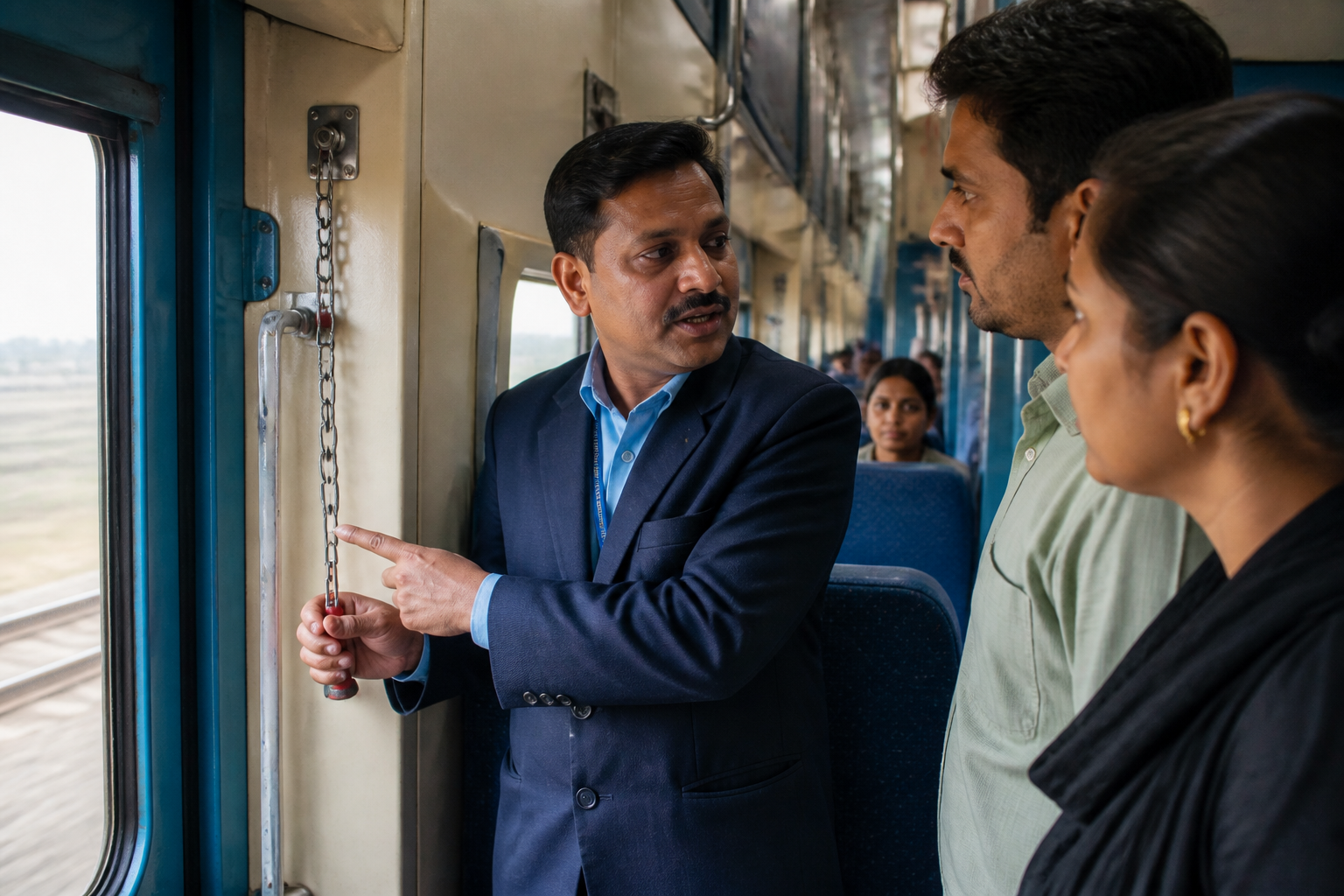
Northern Railway’s latest warning on unnecessary alarm-chain pulling is more than a reminder about a railway offence. It highlights how an individual passenger’s decision inside one coach can create an unscheduled halt, disrupt the train’s timetable and potentially affect services operating behind it. The railway has warned that passengers who pull the chain without a critical reason can face a fine, imprisonment or both.
The warning was issued by Northern Railway through a post on X on September 14, 2026. It asked passengers not to delay other travellers’ journeys and to respect everyone’s time. The notice is aimed at a familiar problem in India’s largest passenger transport system: the use of an emergency mechanism for reasons that do not qualify as emergencies.
The issue is important because railway operations are interconnected. A train does not run as an isolated vehicle moving between two points. Its path, platform occupation, arrival time and departure time are linked to the movements of other trains. Northern Railway’s warning says an abnormal stoppage affects not only the punctuality of the train that has been stopped but also trains running behind it. That makes unnecessary chain pulling a network-management issue rather than only a matter of individual misconduct.
The rule cited in the report is Section 141 of the Indian Railways Act, 1989. According to the information released by Aaj Tak Business, pulling the alarm chain without a proper and sufficient reason is a punishable offence under this provision. The stated penalty can extend to one year of imprisonment, a fine of Rs 1,000, or both. The legal consequence is therefore designed to deter misuse while preserving the chain’s role in genuine emergencies.
The distinction between misuse and legitimate intervention is central. An alarm chain exists so that a train can be stopped when continuing its movement could create an immediate danger or when urgent circumstances require intervention. It is not intended to function as a convenience button for passengers who are late, want to board or disembark outside normal arrangements, or wish to respond to a non-critical inconvenience.
The railway’s warning identifies several situations in which chain pulling may be justified. These include a threat to a passenger’s life, such as a fall from the train where stopping it could prevent an accident. The report also lists situations involving children below 10 years of age or people above 60 who are unable to board the train. These examples show that the rule is not meant to prevent passengers from responding to genuine safety risks. It is meant to ensure that emergency intervention is connected to a serious and immediate need.
### Why the Indian Railways chain pulling rule has system-wide consequences
The operational effect of an unnecessary stop is not limited to the minutes lost by passengers in one coach. When a train stops unexpectedly, railway staff must identify the cause, restore the system and allow the service to resume safely. The train may then be running behind schedule, while services following it may face knock-on effects depending on the route and traffic conditions. Northern Railway describes alarm-chain pulling as one of the major causes of delays in rail services across India.
The supplied report does not provide a national count of chain-pulling incidents, the average duration of each stoppage or the total annual financial loss. Those figures are important for measuring the scale of the problem, but they are not contained in the material available here. What the railway has clearly communicated is the mechanism of disruption: an abnormal halt affects the train involved, trains behind it and the time of passengers using the network.
This is also why the issue belongs to the wider conversation about public transport reliability. Railways are judged by whether services reach stations safely and on schedule, but punctuality depends on more than locomotives, tracks and signalling. Passenger behaviour can also influence operations when it triggers an emergency response without a qualifying emergency. In a high-volume system, even a small operational interruption can have consequences beyond the location where it begins.
The rule also reveals the division of responsibility during a journey. The railway is responsible for operating trains and responding to emergencies, while passengers are expected to use safety equipment responsibly and follow procedures. When the emergency chain is used, railway personnel must treat the activation seriously because the reason could involve a fall, a medical or safety threat, or another event requiring immediate action. Misuse consumes that response capacity and can delay the journey of people who have no connection to the original incident.
### What passengers are expected to do in an emergency
Indian Railways advises passengers to first inform the Travelling Ticket Examiner, or TTE, responsible for the coach when an emergency occurs. Passengers can also contact the Rail Madad helpline at 139, which the report describes as a channel for railway-related complaints and problems. The RailMadad app is another option identified in the report.
These channels matter because they provide alternatives to pulling the chain when the situation is serious but does not require an immediate train stop. A passenger facing a service complaint, assistance requirement or other railway-related problem can communicate with staff or use the designated reporting system. In a genuine danger situation, however, the emergency mechanism remains relevant. The deciding factor is the seriousness and urgency of the circumstances, not the passenger’s personal convenience.
The existence of several reporting channels also indicates how railways manage passenger assistance. The TTE offers an on-train point of contact. The 139 helpline provides a central communication route, while RailMadad provides a digital channel. Together, these systems are intended to separate ordinary complaints and assistance requests from events that require the train itself to be stopped.
That separation is operationally significant. If every complaint led to an emergency stop, the railway would lose the ability to distinguish between a service issue and a safety threat. If passengers avoid reporting genuine dangers because they fear punishment, safety could also be compromised. The rule therefore depends on a clear understanding of when the alarm chain is appropriate and when passengers should use railway staff or formal assistance channels instead.
### The governance challenge behind a simple warning
Northern Railway’s social-media alert is a form of public-service communication, but it cannot by itself solve the operational problem. Its purpose is to make the legal and practical consequences visible before an incident occurs. The warning combines deterrence—the possibility of a fine or imprisonment—with a civic appeal not to delay fellow passengers.
That combination reflects the dual character of railway regulation. The law provides an enforceable penalty, while the public message frames the issue as a shared responsibility. Passengers do not use the rail network only as individual consumers. Their actions can affect other passengers, railway employees and the movement of services across the route. The request to respect everyone’s time is therefore linked to the way a networked transport system operates.
The notice also places responsibility on passengers to understand the limits of an emergency system. In a crowded and frequently used public transport network, rules are effective only when they are understandable at the moment they are needed. The railway’s communication identifies the prohibited conduct, the possible penalty, the kinds of situations that may justify intervention and the channels available for assistance.
The information supplied does not establish how widely these warnings are displayed inside coaches, how frequently prosecutions are made under Section 141, or whether passengers receive consistent guidance across all railway zones. These are unresolved implementation questions. The available material confirms the rule and the latest Northern Railway warning, but not the enforcement pattern or the overall compliance level.
The immediate lesson is straightforward: an alarm chain is a safety device, not a passenger convenience mechanism. The wider lesson is about the fragility of timetable-based public transport. A train’s movement depends on coordinated decisions across the network, and an unnecessary intervention can impose costs on people who were not involved in the original action.
Northern Railway’s current advisory asks passengers to think before pulling the chain and to use the TTE, helpline 139 or RailMadad when appropriate. Further attention will be needed on how the rule is communicated, how genuine emergencies are distinguished from misuse and how railway authorities measure the operational impact of such stoppages. For passengers, the governing principle remains clear: use the chain when an immediate and valid emergency demands it, not as a substitute for ordinary assistance.
