


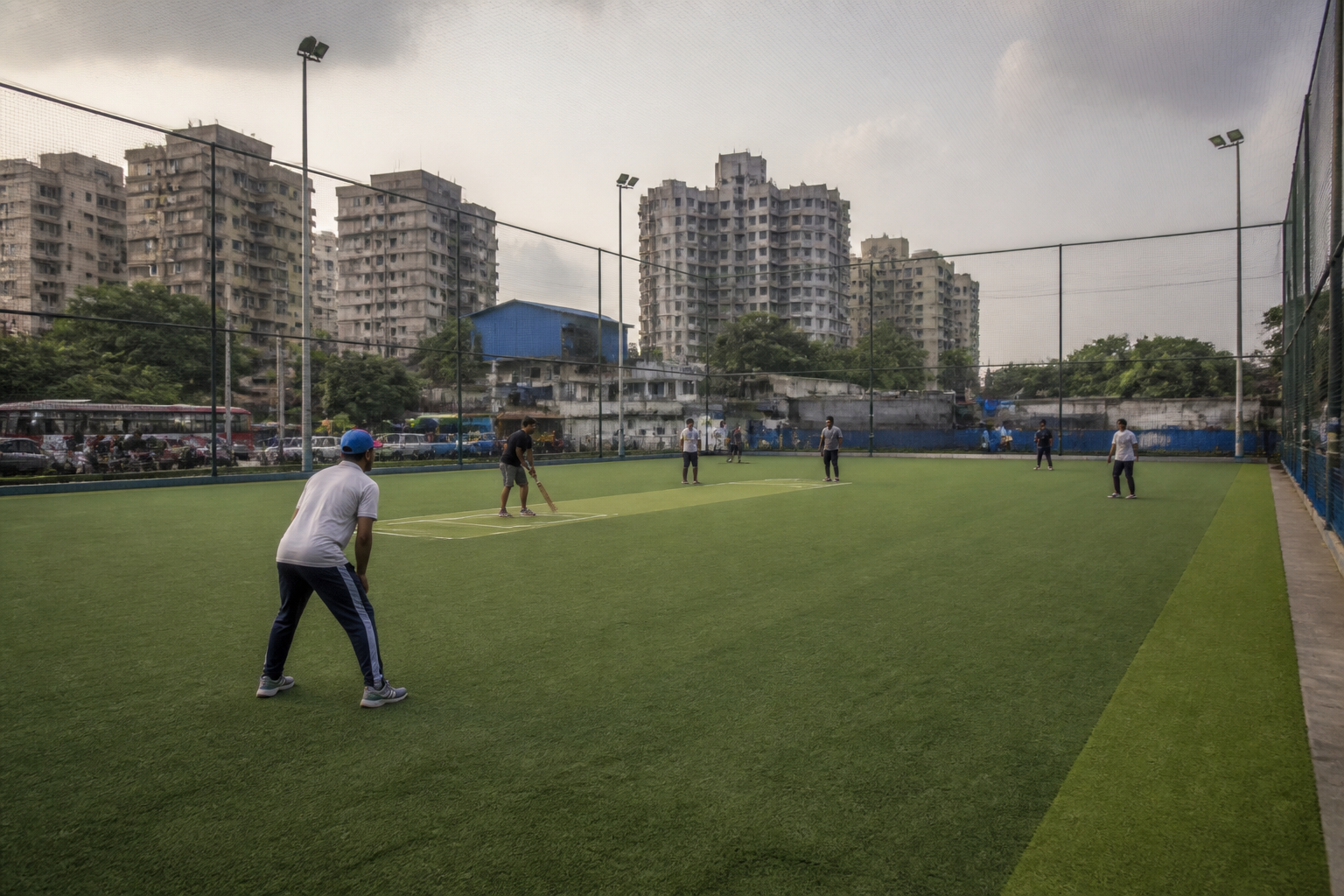
The Brihanmumbai Municipal Corporation has framed its first policy to regulate commercial cricket, football and other sports turfs operating on municipal leasehold plots, proposing an annual licence fee linked to Ready Reckoner land rates and penalties for facilities operating without permission.
The policy follows the civic administration’s finding that a considerable number of sports turfs are being commercially operated on municipal land without the required permission or No Objection Certificate. Many of these facilities are booked online and offline, generating revenue for lessees, occupants or third-party operators without a share being paid to the BMC, according to the report based on the civic body’s circular.
Under the proposed framework, the annual Turf Licence Fee will be calculated at 1% of the applicable land rate multiplied by the turf area. The land rate will be based on the Ready Reckoner rate prevailing in the year in which approval is granted. The same principle will apply when permission is renewed.
The BMC Estates Department has cited the scale of its landholdings as a reason for introducing the policy. The department has allotted around 4,177 plots on lease for periods ranging from 30 years to 999 years, as well as leases in perpetuity. Some of these plots are currently being used by lessees or third parties for cricket, football and other sports turfs.
Permission will be considered only when sports use is permissible under the original lease conditions, the Development Plan and the Development Control and Promotion Regulations 2034. The approval will not amount to a change in land use. The policy also allows sports turfs on municipal leasehold land where the activity is permissible, including vacant land under Vacant Land Tenancy.
The framework will not permit permanent, covered or reinforced cement concrete construction. The BMC’s definition of a sports turf includes a demarcated play area with artificial or natural surfaces, along with removable fixtures such as nets, poles and lighting. Applicants will have to submit a detailed layout and turf area plan, a stability certificate, PAN and GST registration, lease or third-party agreements and a registered undertaking to comply with the policy conditions. Applicants who are not lessees will also require a No Objection Certificate from the lessee.
Permissions will be issued for one or three years, subject to renewal and the remaining lease period. The BMC can cancel an approval if its conditions are violated, recover or forfeit the licence fee, and direct the removal of a turf within one month at the applicant’s cost. No refund will be made in such cases.
To bring existing unauthorised turfs into the regulatory framework, the civic body has proposed a one-time amnesty scheme. Existing and newly proposed turfs that apply during the one-year amnesty period will be eligible for a 40% concession on the applicable Turf Licence Fee, subject to the municipal commissioner’s approval. Eligible applicants would therefore pay 60% of the calculated fee during the amnesty period. The concession will apply only to the initial approval period and not to subsequent renewals.
The BMC has warned that turfs continuing to operate without permission after one year from the circular’s issuance will face a penalty equivalent to five times the applicable Turf Licence Fee. The civic body will also have the power to seal the premises and discontinue the activity.
The administration plans to eventually move applications, scrutiny, approvals, fee payments, demand notices and renewals online. Until a dedicated portal becomes operational, applications will continue to be processed through the existing offline system.
