


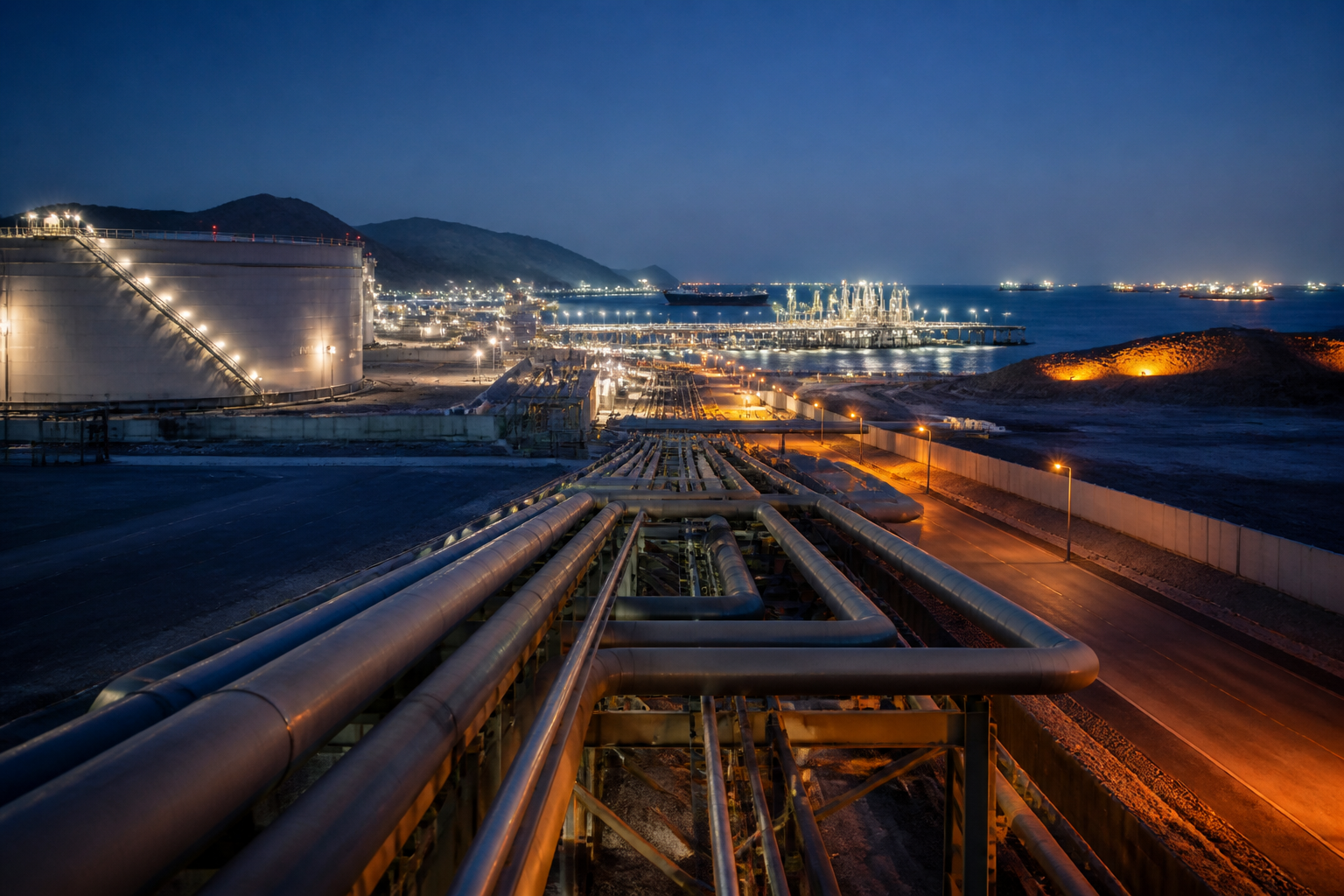
Engineers India Ltd’s discussions with Saudi Arabia and the United Arab Emirates over roughly $1 billion of pipelines, storage facilities and oil terminals point to a larger shift in Gulf energy planning: infrastructure is being redesigned not only for capacity and efficiency, but also for resilience against disruption at the Strait of Hormuz.
The discussions remain at the planning stage, according to EIL chairman and managing director Atul Gupta, who spoke to reporters after the company’s annual general meeting. EIL is seeking consultancy and feasibility-study mandates for the projects. The proposed facilities would create alternative routes for moving crude and petroleum products to international markets, reducing the Gulf producers’ dependence on the maritime passage that connects the Persian Gulf with global shipping networks.
The immediate trigger is the conflict involving Iran and the United States, which has severely disrupted shipping through the Strait of Hormuz, according to the report. The disruption has led Saudi Arabia and the UAE to examine investments in pipelines, storage infrastructure and oil terminals that could provide greater flexibility if maritime movements through the strait remain interrupted.
This is important because the proposed projects are not simply additional oil infrastructure. They represent an attempt to change the geography of export security. A pipeline, terminal or storage facility located away from the chokepoint can give an energy producer more options over where crude is stored, how it is moved and which route it takes to reach international markets. The infrastructure therefore becomes part of a wider risk-management system rather than only a production-support asset.
For EIL, the opportunity is emerging alongside a near-term slowdown. Gupta said order inflows from the region had slowed after the conflict because energy companies were focused on securing and restoring existing installations. The company expects order inflows to improve in the third and fourth quarters, but the report does not establish whether the proposed projects have received final approvals, financing commitments or construction schedules.
That distinction matters. Planning-stage infrastructure can generate demand for feasibility studies, engineering design and project-management services, but it does not yet represent a confirmed construction pipeline. EIL’s immediate role is therefore likely to be advisory and preparatory. The company is seeking mandates that could help Gulf producers decide the alignment, technical configuration and commercial viability of alternative export systems.
The UAE’s plans for additional underground oil-storage facilities at Fujairah illustrate the type of infrastructure being considered. Fujairah, on the Gulf of Oman, provides a route outside the Strait of Hormuz. Storage capacity there could allow oil companies to hold crude and petroleum products closer to an alternative maritime outlet, although the supplied report does not provide the proposed capacity, project cost or completion timeline.
The possible investment also shows why storage is as important as transport. Pipelines can move crude away from vulnerable routes, but storage can provide operational flexibility when shipping schedules are disrupted or terminals are temporarily unavailable. Terminals, meanwhile, connect inland or offshore supply systems to tankers and international markets. Together, these assets form an integrated chain in which a weakness at one point can affect the performance of the entire export network.
The projects would also require coordination across multiple institutions. Energy companies would need to determine their capital commitments and operating requirements; governments would have to support land, permitting and strategic planning; and engineering firms would translate those requirements into technical and commercial plans. EIL’s pursuit of consultancy and feasibility work places it at the point where policy objectives become project definitions.
The company’s exposure to this shift is significant. Overseas projects account for 43 per cent of EIL’s order book, while international consultancy contributed about ₹4,929 crore, or nearly 62 per cent, of the fresh business secured during 2025-26. EIL secured fresh business worth ₹7,978 crore during the year ended March 2026, taking its order book to ₹15,109 crore on March 31. Gupta said the order book had since risen to around ₹17,000 crore.
The Gulf has already contributed to that expansion. EIL secured ₹510 crore of orders from the region after the Iran conflict began, even as the broader flow of new orders slowed. The figures suggest a mixed transmission mechanism: geopolitical instability can delay routine projects while simultaneously creating demand for new infrastructure intended to reduce future exposure to the same risk.
That pattern changes the nature of engineering demand. In a stable environment, investment may be driven by additional production, export growth or routine modernisation. Under conditions of disruption, spending can instead be driven by redundancy. Producers may commission parallel routes, larger storage buffers and alternative terminals even when these assets are not required for day-to-day throughput. The economic justification is the value of continuity when the primary route is unavailable.
EIL’s existing regional presence gives it a platform from which to pursue this work. The company has projects and engagements in Saudi Arabia, the UAE, Bahrain and Kuwait, has opened an office in Saudi Arabia and has a long-term in-Kingdom services agreement with Saudi Aramco. These arrangements may help it compete for planning and engineering assignments, although the supplied information does not indicate whether EIL has been shortlisted for any specific project.
The company is also attempting to reduce its dependence on traditional hydrocarbons by expanding into infrastructure, renewables, green hydrogen, biofuels, nuclear energy and defence. Its international work includes activity in Algeria, Guyana and Mongolia, while in Nigeria it has secured an engineering, procurement and construction management mandate for the expansion of the Dangote refinery, valued at about $360 million, along with a separate fertiliser-project assignment.
This diversification provides context for the Gulf discussions. EIL is not treating the regional opportunity only as a crude-export story; it is seeking a broader role in engineering, project management and construction management. However, the proposed Hormuz-related work remains closely tied to hydrocarbon infrastructure, and the company’s ability to convert it into revenue will depend on whether Gulf producers move from planning to sanctioned projects.
The wider urban and infrastructure question is how energy-security decisions reshape the places through which oil moves. Pipelines, terminals and storage sites create industrial corridors, require access roads and utilities, and influence the location of logistics, maintenance and support services. Underground storage facilities can reduce the visible footprint of oil infrastructure, but they still depend on surface connections, safety systems and port or pipeline interfaces.
The report does not provide details on land requirements, environmental approvals, construction schedules, financing structures or the distribution of the proposed $1 billion investment between Saudi Arabia and the UAE. Those gaps prevent a firm assessment of the projects’ eventual scale or local impact. They also underline the difference between a strategic intention and an executable infrastructure programme.
What the evidence confirms is that the Strait of Hormuz disruption has already affected the timing of energy-sector orders and has encouraged Gulf producers to consider alternative export infrastructure. For EIL, the conflict is simultaneously a short-term business constraint and a possible source of future consultancy and engineering work. The next meaningful milestones will be project approvals, feasibility mandates, financing decisions and the movement of the proposed facilities from planning into construction.
