


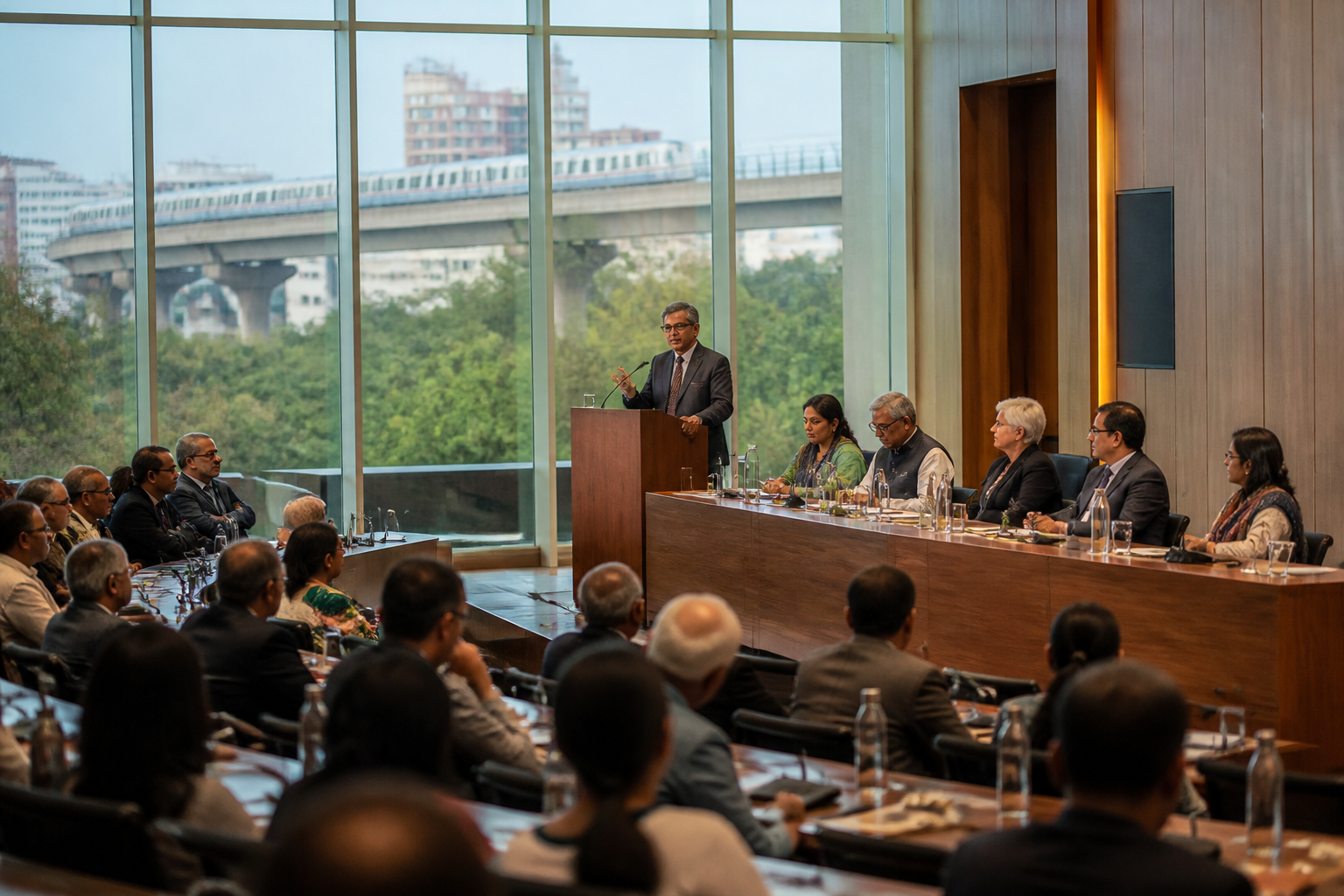
The international conference convened by the National Green Tribunal has placed climate justice at the centre of a question that Indian cities can no longer treat as separate from development: who bears the cost of growth, who receives its benefits and which institutions are responsible when environmental damage affects everyday urban life.
Speaking at the two-day conference, The Future of Environment and Climate Dynamics, Prime Minister Narendra Modi argued that the responsibility for carbon emissions should not be placed on developing countries alone. He said India’s per-capita carbon emissions are less than half the global average, while emissions in developed countries are six times higher than India’s. His intervention framed climate policy not only as an environmental issue but also as a question of fairness between countries at different stages of economic development.
That distinction matters for cities because the consequences of climate change are experienced locally even when the causes and responsibilities are distributed globally. Urban residents encounter heat, water stress, flooding, pollution and unreliable services through homes, roads, public transport, drainage systems and public spaces. Yet the policy choices that shape these risks are made across several levels of government and often through institutions with different mandates.
The conference’s significance therefore lies less in a single announcement than in the institutional problem it exposed. Environmental protection, infrastructure expansion, housing, energy security, food security, health and economic opportunity are usually administered through separate departments and legal frameworks. The remarks at the conference pointed towards the need to treat them as connected parts of one urban system.
Modi presented India’s approach as one in which economic growth and sustainability can advance together. He cited the expansion of solar energy, the PM Surya Ghar scheme, electric vehicles, railway electrification, metro systems, waterways and water conservation as examples of this approach. He also referred to more than 70,000 Amrit Sarovars and approximately 1.5 crore water-harvesting structures built across the country.
These examples span very different types of intervention. Solar power addresses energy generation and household electricity. Electric vehicles and railway electrification concern the carbon intensity of mobility. Metro systems affect how people move through dense urban regions, while water bodies and harvesting structures relate to storage, recharge and local water security. Their common thread is that environmental policy is increasingly being implemented through physical systems that shape how cities function.
However, listing infrastructure programmes does not by itself establish whether climate goals are being achieved equitably. The urban question is how these projects are planned, financed, maintained and accessed. A new transport system can reduce emissions while remaining difficult to use for households located far from stations. A water body can improve resilience only if it is protected from encroachment, connected to local drainage and maintained after construction. A household energy programme depends not only on installation but also on affordability, reliable supply and the ability of residents to participate.
The supplied report does not provide performance data on these projects, nor does it establish how benefits are distributed between cities, neighbourhoods or income groups. That limitation is important. Climate justice requires more than measuring aggregate capacity or the number of assets created. It also requires examining who is protected from climate risks, who pays for the transition and whether vulnerable communities receive adequate access to basic services.
Chief Justice of India Justice Suryakant placed this question within India’s constitutional framework. He referred to Article 48A, which directs the State to protect and improve the environment, and Article 51A, which calls on citizens to protect the natural environment. He also cited the Supreme Court’s development of environmental principles including the right to a clean environment, the precautionary principle, the polluter pays principle and the public trust doctrine.
These principles provide a legal basis for treating the environment as a public concern rather than a private externality. The public trust doctrine, for example, is relevant to urban lakes, wetlands, riverbanks, forests and other resources whose loss can affect entire communities. The precautionary principle becomes important where projects may create long-term environmental risks that cannot easily be reversed. The polluter pays principle raises the question of who should bear the cost of contamination, restoration and compensation.
For urban administration, the challenge is translating these principles into routine decisions. Environmental protection is often considered at the approval stage, while the consequences of land-use change, construction, transport expansion and industrial activity continue through the life of a project. Local authorities must then deal with the practical effects through drainage upgrades, water supply planning, waste management, public health measures and emergency response.
The conference also highlighted the role of the National Green Tribunal as part of this institutional structure. The NGT organised the event, while its chairperson, Justice Prakash Srivastava, said discussions should consider the planet available to future generations rather than only present environmental conditions. That emphasis connects adjudication with long-term planning, although the report does not detail any new directions, orders or enforcement measures issued at the conference.
Attorney General R Venkataramani argued that environmental problems cannot be solved only through treaties and declarations. He called for effective global institutions and rules that can address both the prevention of environmental damage and its remediation. He also linked environmental justice with poverty and inequality, and said energy and food security, housing, health, water, natural resources and economic opportunity must be considered alongside environmental policy.
This is a particularly consequential framing for Indian cities. Housing is not only a question of shelter; its location affects commuting distances, exposure to heat and flooding, access to water and the cost of household energy. Mobility is not only a transport issue; it influences emissions, access to jobs and the time residents spend travelling. Water conservation is not only a resource-management task; it affects public health, household expenditure and the resilience of informal settlements and peripheral urban areas.
The evidence cited at the conference shows the scale at which the government wants to present India’s environmental transition. India’s per-capita emissions, according to the Prime Minister’s remarks as reported, remain below the global average, while the country has expanded or promoted multiple clean-energy, mobility and water initiatives. The report also says India has achieved its climate targets under the Paris Agreement ahead of schedule, although it does not specify which targets, the baseline years or the assessment method.
That missing detail matters for public accountability. Climate claims become more meaningful when accompanied by clear baselines, time periods, sector-wise data and information on implementation. The same applies to water-harvesting structures, Amrit Sarovars, electric vehicles and public transport systems. Asset counts indicate activity, but they do not by themselves show whether emissions have fallen, groundwater has improved, flooding has reduced or access has become more equitable.
The conference’s broader message is that environmental governance is moving towards a more integrated model, at least in principle. The legal system is expected to protect environmental rights; governments are expected to deliver infrastructure and services; global institutions are expected to address unequal responsibility; and citizens are expected to participate in environmental protection. The difficulty lies in aligning these responsibilities when budgets, jurisdictions and political priorities do not match.
For city governments, this alignment will increasingly determine whether climate policy produces durable public benefits. Transport planning must connect emissions goals with affordable access. Water planning must connect conservation with land use and drainage. Housing policy must account for heat, flooding and service availability. Environmental regulation must be supported by monitoring and enforcement rather than treated as a one-time clearance process.
The NGT conference confirms that climate justice is being discussed in India through the combined language of constitutional rights, global equity and infrastructure-led development. It does not, on the evidence supplied, establish a new global rulebook or announce a new urban climate programme. What it does reveal is the scale of the unresolved governance task: converting broad environmental principles and infrastructure commitments into measurable protection for people, neighbourhoods and future generations.
The next test will be whether these principles appear in specific rules, project decisions, enforcement actions and publicly available performance data. Until then, the conference has clarified the direction of the debate, while leaving open the harder question of how climate justice will be delivered on the ground.
