


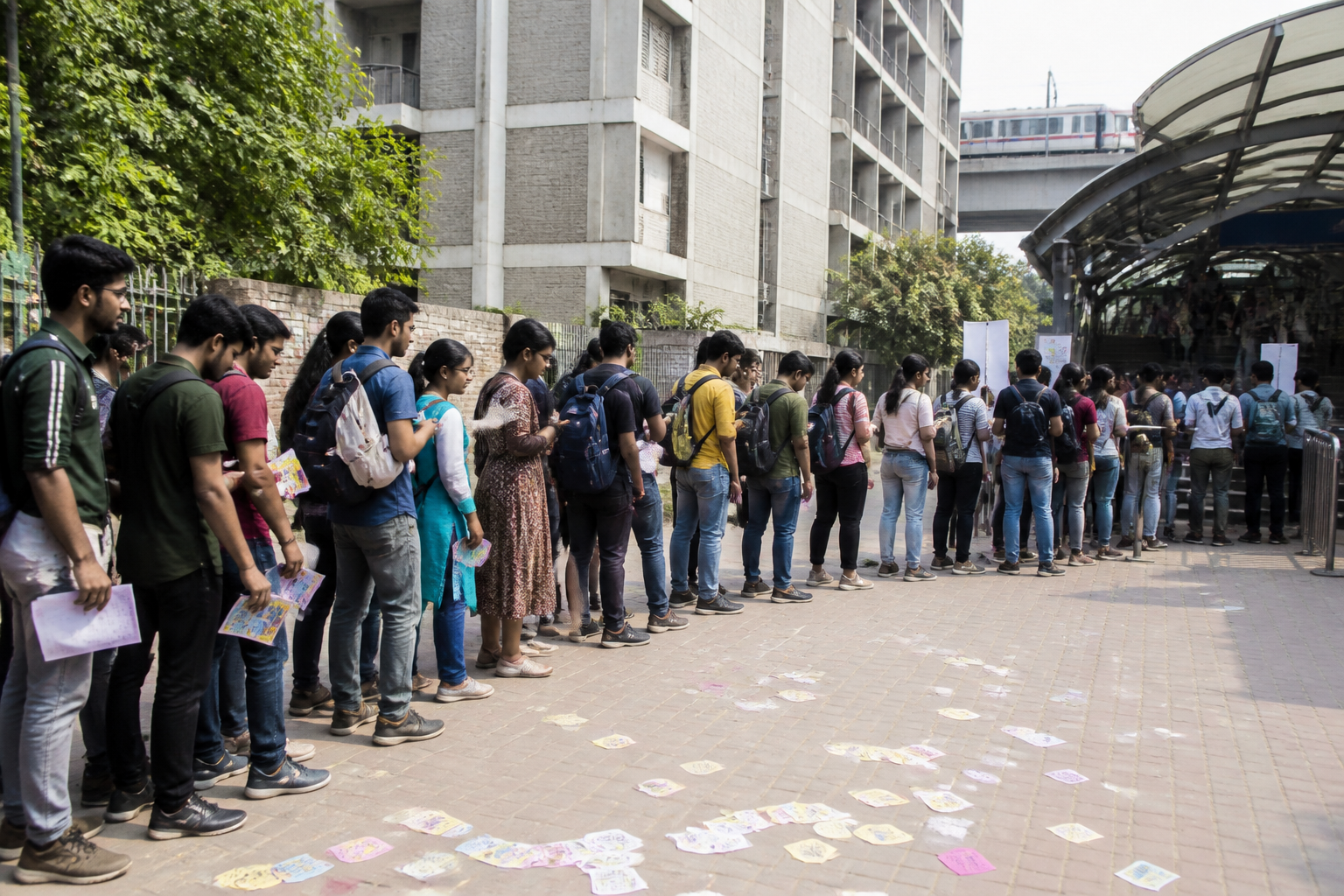
The DUSU elections were supposed to be a contest over student representation, but the polling day conversation at Delhi University also became a test of what campus politics can do with the city’s most immediate failures. Outside Durgabai Deshmukh South Campus Metro Station, students walked past campaign slips to vote just 12 days after a PG hostel building in nearby Satya Niketan collapsed, killing seven people, including five DU students. The incident remained visible in campaign messaging, yet students questioned whether visibility would lead to accountability.
That tension is central to understanding this year’s election. The 40.46% turnout was higher than the 35.2% recorded in 2024 and the 39.36% recorded in 2025, but below the 42% turnout of 2023. The numbers suggest a contest that attracted more participation than the previous two years without returning to the recent high. The more important question, however, is what students were being mobilised around: a specific safety failure, long-standing infrastructure concerns, online familiarity, freebies, gender representation or college-level issues.
The polling-day account shows that these concerns did not carry equal weight across the university. At Miranda House, a first-year student said many friends had decided to vote after repeatedly seeing a candidate on Instagram. The same student also pointed to the lack of women’s representation and said campaigning remained largely male-dominated, with major parties fielding male candidates for the president and vice-president posts. This connects electoral visibility to institutional representation: students may encounter candidates frequently online while still seeing a narrower field of leadership in the formal contest.
Digital campaigning also changed how the election was experienced. Students referred to Instagram reels, movie tickets, dinners and hampers containing make-up kits and chocolates. These methods did not necessarily create a common political agenda. Instead, they made candidate recognition a campaign asset. The report records one student saying that a candidate’s repeated presence on Instagram influenced voting, even when the student’s stated concern was representation. In this environment, familiarity can become more decisive than a clearly articulated position on campus administration.
The Satya Niketan collapse exposed the limits of that visibility. A first-year law student said political groups had been active online after the incident, but questioned the genuineness of that activity because it was conducted through reels and other digital formats. Students at Sri Venkateswara College were more direct about their scepticism. One third-year student said that issues raised by parties had produced little result over time and that Satya Niketan might be no different. The supplied report does not establish what action, if any, has followed the collapse beyond the protests and campaign references. That absence is itself part of the political problem described by the students: a safety event can become highly visible without becoming an institutional commitment.
The different emphasis between campuses also shows why a university-wide election does not produce a single urban agenda. At Campus Law Centre in North Campus, a student said candidates were focusing largely on infrastructure concerns rather than student housing because the issues affecting that campus were different from those in South Campus. In South Campus, the collapse of a PG hostel building made housing safety more immediate. The contrast matters because student housing is not only an accommodation issue. It is tied to the safety of buildings outside university campuses, the regulation of private or paying-guest facilities and the responsibilities of institutions when students depend on surrounding neighbourhoods.
The reported campaign focus therefore reflects an administrative geography. Students experience the university through colleges, metro stations, roads, hostels, paying-guest buildings and local markets, but responsibility is divided among different authorities. College administrations manage elections and campus arrangements. The safety of a private or external hostel building may involve building regulation, local administration and other agencies. Student organisations can raise the issue politically, but the report does not show that they control enforcement or structural safety decisions. This division can make a visible incident politically powerful while leaving the underlying accountability chain unclear.
Polling logistics offered a contrasting picture of institutional capacity. Sri Venkateswara College said it deployed all 215 teaching staff, 150 non-teaching staff and around 50 to 60 contractual staff, including security personnel, for election duty. The college also created ground-floor booths for its 79 students with disabilities. At Ramjas College, 2,578 of 5,973 students had voted in both the college and DUSU elections, producing a turnout of about 43%. Miranda House recorded 32% turnout and set up two Walls of Democracy for posters and banners.
These arrangements show that colleges can mobilise substantial administrative resources for a time-bound public process. They also indicate the practical scale of conducting elections across a dispersed university system. Accessibility measures, security deployment and designated spaces for campaign material are not minor details. They determine who can participate, how easily students can reach a booth and whether the election is experienced as an organised institutional process rather than only as a political spectacle.
The shift to electronic voting machines added another layer to that administrative transition. Around 960 EVMs were deployed, with 40 kept in reserve for technical glitches, according to Chief Electoral Officer Prof Raj Kishore Sharma. This was the first year EVMs were used in almost all DU colleges, except a few where technical problems prevented their deployment. Earlier, most colleges used ballot papers for their college-level elections.
The move changes more than the mechanics of voting. It creates new requirements for equipment, contingency planning and confidence in the process. Keeping reserve machines acknowledges the possibility of technical failure, while the colleges that could not deploy EVMs show that a university-wide system can still encounter uneven implementation. The supplied report does not record disputes about the machines or provide a comparison of counting times and error rates. What it does establish is that DUSU elections are being administered through a hybrid arrangement in which technological modernisation has not yet produced uniformity across all colleges.
The turnout figures provide a limited but useful measure of engagement. Participation rose from 35.2% in 2024 to 39.36% in 2025 and 40.46% this year. It remains below the 2023 figure of 42%. These numbers cannot, by themselves, explain whether students voted because of the Satya Niketan collapse, social media campaigning, college-specific concerns or stronger mobilisation by parties and independents. The polling-day observations suggest that all of these factors coexisted, rather than one issue defining the election.
The role of independent candidates further complicates the contest. An NSUI worker at Sri Venkateswara College said the presence of independent candidates had made the election closer, while suggesting that votes could move to independent candidate Deepanshu Shokeen after he was denied a party ticket. This indicates that party labels did not fully determine the field. At the same time, the report does not provide final results for the DUSU contest, so the effect of independent candidates cannot yet be measured.
What the election reveals is not that students are indifferent to urban safety or infrastructure. Rather, it shows how those concerns compete with the conditions through which politics is now conducted. A collapsing hostel building, a long queue outside a college, a campaign reel and a new EVM system belong to different parts of the same institutional experience. Students move between them without necessarily seeing a single authority responsible for the whole system.
The immediate evidence confirms three things. Campus infrastructure remains a live electoral concern, but its priority varies by location. Digital visibility has become an important route to recognition, even as students question whether online campaigning produces genuine accountability. And the university’s election machinery is expanding technologically and administratively while still operating unevenly across colleges. The DUSU results and subsequent institutional responses to the Satya Niketan collapse will determine whether the issues raised during polling become formal demands or remain campaign-day references.
