


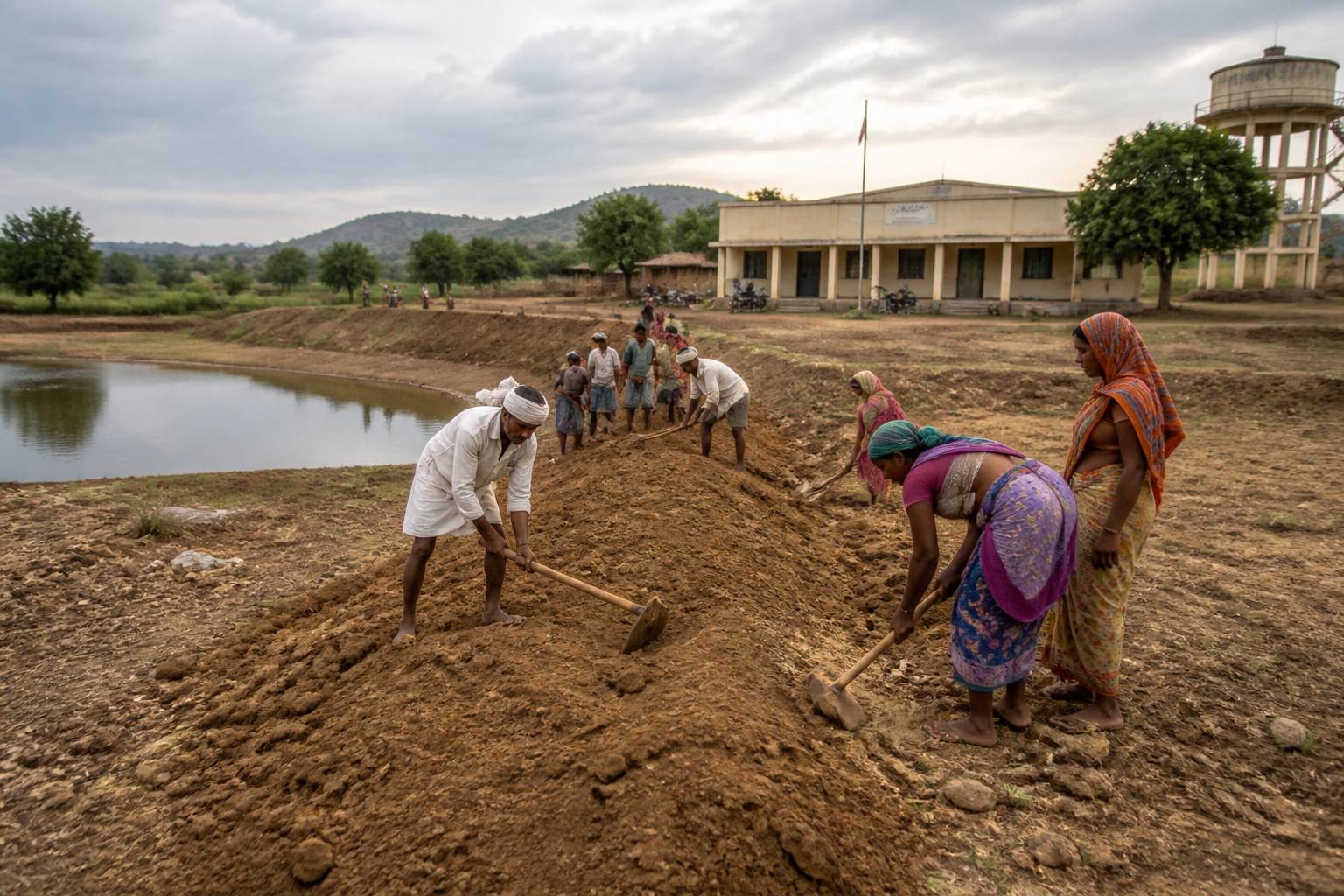
Karnataka’s implementation of the VB-G RAM G rural employment scheme is facing an administrative and operational impasse, with the state yet to notify the mandatory 60-day agricultural break while village panchayats struggle to generate enough work for rural labourers. The problem exposes a wider weakness in how a centrally structured employment programme is being translated into local plans, staffing responsibilities and payment safeguards.
The scheme, formally called Viksit Bharat–Guarantee for Rozgar and Ajeevika Mission–Gramin, replaced the Mahatma Gandhi Rural Employment Guarantee Scheme from the 2026–27 financial year. According to the Prajavani report, it officially began in Karnataka on July 1. It promises up to 125 days of work a year to every wage worker who applies for employment, but it also requires work under the scheme to be suspended for 60 days during the agricultural season.
That seasonal provision creates an immediate administrative obligation for states. They must identify and reserve the break according to the nature and timing of agricultural activity in their respective areas. Prajavani reported that Karnataka had not issued the required notification by the time of publication. If a state does not specify the period, the Union government may treat any two months of the year as the agricultural break.
The financial consequence is not merely procedural. If works are undertaken during the two months treated as the break, the wages and other expenditure for those works may not be reimbursed, according to the report. This places village panchayats in a difficult position: they must respond to rising demand for employment while also avoiding expenditure that could later become ineligible.
The tension is particularly sharp because the report describes a weakened monsoon and drought conditions in the state. With agricultural livelihoods under pressure, more workers are seeking employment through the rural guarantee programme. The state government therefore faces two competing administrative demands. It must designate a 60-day agricultural pause, but it is also under pressure to provide more work to prevent distress migration at a time when rural households may have fewer agricultural opportunities.
This is the first major implementation question raised by the Karnataka experience: whether a uniform national employment framework can be executed effectively without a clear state-level calendar. Agricultural activity does not begin and end at the same time across all parts of a state. Yet the absence of a notification leaves local officials without a dependable basis for scheduling works, approving labour and protecting payments.
The programme is also reported to lack clarity on who should receive individual works on beneficiary-owned land. A panchayat development officer quoted by Prajavani said that, although such works were allowed under the earlier employment guarantee system, the new programme had not clearly established the basis for selecting beneficiaries or fixed eligibility criteria. The same official said that works were expected to be selected through the Viksit Gram Panchayat plan, but district panchayat chief executive officers were instead deciding and approving works.
That reported shift in decision-making matters because local employment schemes depend on a chain of responsibilities. Village panchayats identify needs and workers, technical staff prepare estimates, and higher authorities approve or supervise works. If the criteria for selecting beneficiaries are unclear and the authority for approving projects is concentrated elsewhere, local bodies may have less control over the programme while still carrying much of the execution burden.
The absence of a standard operating procedure has compounded the problem. Prajavani reported that, even after the scheme had been in operation for about two and a half months, Karnataka had not prepared an SOP. The PDO quoted in the report described the implementation as confused and said that responsibilities needed to be fixed.
An SOP would not by itself resolve the scheme’s financial or employment pressures, but it would define how the system is expected to work. It could establish the process for selecting beneficiaries, preparing works, approving projects, recording labour, handling seasonal suspension and assigning responsibility when a work or payment is delayed. Without such a document, individual panchayats and officials may interpret the same provision differently, increasing the possibility of inconsistent decisions across districts.
The reported restrictions on water conservation works reveal a second structural problem: the programme’s stated labour orientation may not align with the types of works that rural communities need. The scheme lists 318 intermediate works and specifies a 60:40 ratio between labour and materials. Under the earlier employment guarantee programme, desilting of lake embankments reportedly used about 90 per cent human labour. Under the new arrangement, only 10 to 20 per cent labour is reportedly permitted for such work.
For village panchayats, the difference affects both employment capacity and project design. Desilting and related water works can absorb substantial manual labour, particularly during periods when agricultural employment is limited. If the permitted labour component is reduced, the same work may create fewer person-days even if the village’s need for water conservation remains high. The restriction therefore changes not only the accounting structure of a project but also the number of people who can be employed through it.
Prajavani reported that many panchayats have between 500 and 1,000 job cards, but have been unable to provide work to even 50 to 100 people a day. The figures suggest a substantial gap between the number of registered potential workers and the employment that local administrations can currently generate. The report does not establish whether the gap is uniform across Karnataka or how many workers have applied for work in each panchayat, but it does show the operational constraint described by local officials.
This is where the design of the new scheme meets the capacity of rural local governments. A job card creates an administrative record of a household’s eligibility or participation, but it does not automatically create a worksite. The panchayat must have an approved project, a technical estimate, funds for labour and materials, and a system to record attendance and release payments. Any break in that chain can reduce actual employment even when demand exists.
The funding and responsibility issues described in the report extend beyond the new scheme. Panchayat development officers are demanding the immediate release of pending grants under the 15th Finance Commission and financial support for administration and infrastructure maintenance. They are also seeking relief from additional work assigned by other departments, the upgrading of PDO posts to Group B status, and resolution of seniority and promotion disputes.
These demands place the employment programme within the broader institutional condition of gram panchayats. The same local administration is expected to deliver employment works, maintain infrastructure, manage routine civic functions and respond to instructions from multiple departments. When funds are delayed or officials carry additional responsibilities without clearly defined support, a new programme can increase the workload without increasing implementation capacity.
The proposed statewide indefinite strike by PDOs from September 21 adds an immediate administrative risk. The officers are seeking changes to the implementation of VB-G RAM G, including an SOP, defined responsibilities, approval to complete older works and the immediate release of material costs under the employment guarantee programme. If the strike proceeds, the effect would depend on the extent of participation and on whether alternative arrangements are made, neither of which is established in the supplied report.
The reported dispute also highlights a sequencing problem. Karnataka began implementing the scheme on July 1, but key operational decisions remained unresolved after roughly two and a half months. A programme can be formally launched before the machinery required to execute it is ready. In that situation, the launch date signals policy commencement, while the absence of rules, calendars and funds determines what citizens experience on the ground.
The central question is therefore not simply whether Karnataka will issue a 60-day agricultural holiday notification. It is whether the state can align the scheme’s employment promise with local agricultural conditions, project rules, payment protection and the working capacity of panchayats. The notification is essential because it protects expenditure from being treated as ineligible, but it is only one part of the implementation framework described by the report.
The evidence supplied by Prajavani confirms several unresolved issues: the seasonal break had not been notified; the SOP had not been prepared; beneficiary selection for individual works lacked clarity; district-level approval was reportedly shaping project selection; labour use in lake desilting had been restricted; and panchayats were unable to employ as many registered workers as they might need to support. The report does not provide the state government’s response, the number of affected panchayats or a district-wise account of pending payments.
Those gaps are important for assessing the scale of the problem, but they do not diminish the institutional signal. A rural employment guarantee is ultimately delivered through local works, local records and local officials. If the rules governing those functions remain unclear, the formal promise of 125 days of work can remain disconnected from actual access to employment. The next developments to monitor are Karnataka’s agricultural-season notification, the publication of an SOP, clarification of beneficiary and project approvals, release of pending funds and the outcome of the PDOs’ proposed strike.
