


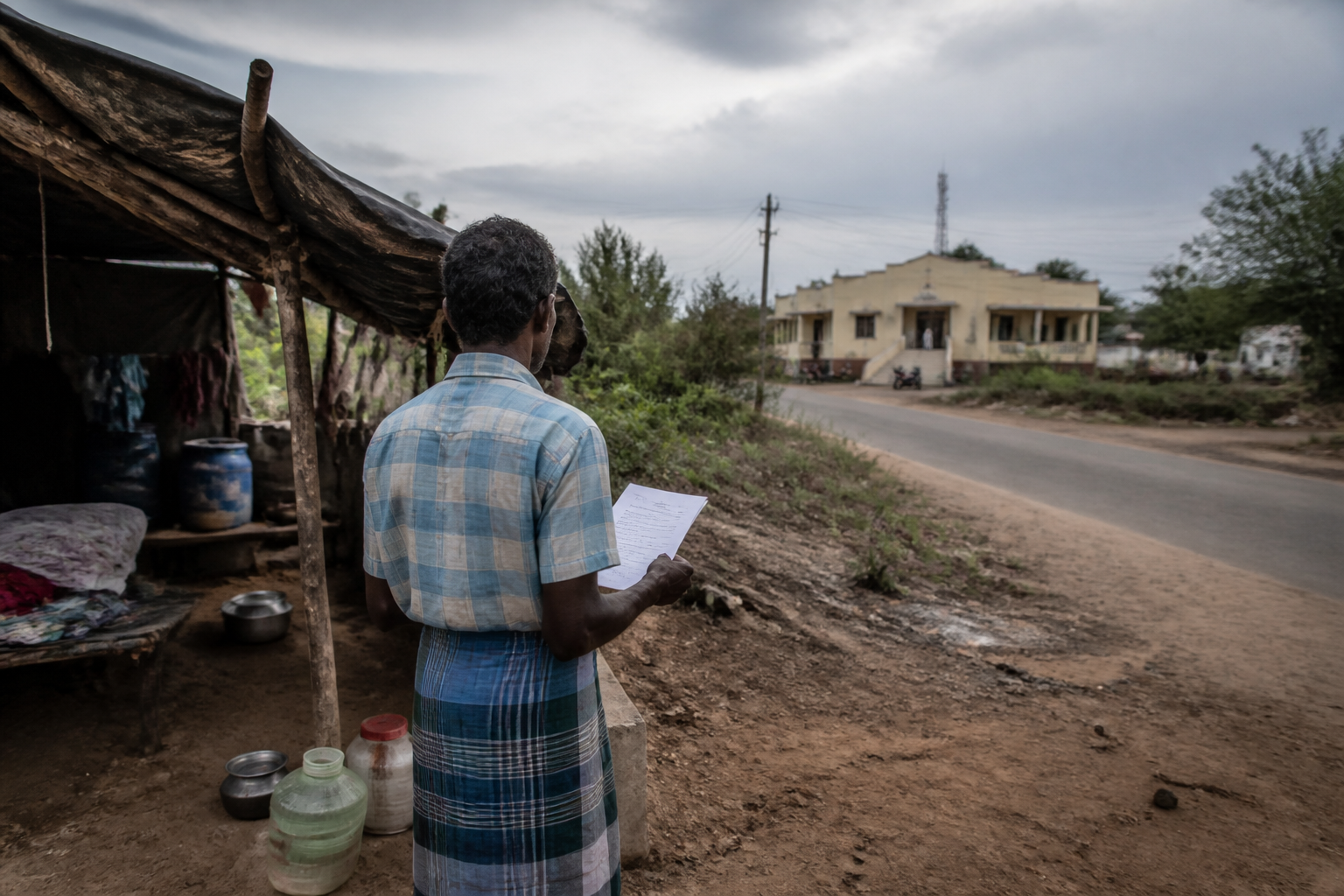
The dispute over a bonded labour release certificate for the family of Thenmozhi, an Irula tribal woman who died with her newborn at a worksite in Kancheepuram district, is not only a disagreement over one administrative document. It exposes how the recognition of exploitation can determine whether vulnerable workers enter the state’s rehabilitation system or remain outside it.
According to a report by the Times of India, the Kancheepuram district administration refused to issue a release certificate to Thenmozhi’s family despite the District Legal Services Authority recommending that revenue officials grant one. The DLSA’s inquiry identified what it described as indicators of bonded labour, including an advance payment, long working hours, low wages and restrictions on movement.
The sub-collector, T Bhuvanesh Ram, rejected that conclusion, saying that Thenmozhi and her family were not bonded labourers. He said the inquiry report had been submitted to higher authorities and that its findings could not be disclosed. The result is an administrative conflict in which the document intended to unlock rehabilitation support has itself become the point of dispute.
The release certificate matters because it is not merely a record of an earlier workplace experience. As described in the report, it recognises that a person has been rescued from bonded labour and enables survivors to access central and state welfare schemes and financial assistance intended for rehabilitation and prevention of re-bondage. The revenue department has also recently recognised the certificate as valid identity proof for accessing services through e-seva centres.
That administrative function gives the certificate importance beyond the immediate question of whether a family meets a legal or official definition. For workers living at worksites, with limited documentation and weak bargaining power, access to public services can depend on whether an authority formally recognises their circumstances. A rejected certificate can therefore affect both assistance linked to rehabilitation and the family’s ability to navigate ordinary state services.
The facts reported from the family’s complaint describe a work arrangement marked by dependence on an advance. Thenmozhi’s husband, Anand, said the family had taken ₹20,000 from the employer, Arumugam. Anand alleged that he, Thenmozhi, their daughter Kaviya and son-in-law Muthu worked from 7am until late evening and lived in a tarpaulin shed at the worksite for six months.
Anand further alleged that when Thenmozhi went into labour, Arumugam refused to let him take her to hospital until the advance was settled. When Anand returned to the shed at about 2pm on September 8, he found Thenmozhi and the newborn dead, according to the report. These claims are allegations contained in the complaint and are not presented here as independently established findings.
The DLSA’s intervention is significant because its inquiry reached a different conclusion from the revenue administration’s decision. A DLSA official quoted in the report said the authority had found elements of bonded labour and had communicated its recommendation to the sub-collector. The report does not provide the full DLSA inquiry or the district administration’s complete report, so the precise evidentiary basis for the conflicting positions remains unavailable in the supplied material.
This absence is central to understanding the dispute. The family has been told, in effect, that the certificate will not be issued, while the official body that examined the matter recommended that it should be. The sub-collector’s statement that the report cannot be disclosed leaves the public record without the reasoning needed to assess how the competing findings were reached.
For a system designed to identify and rehabilitate bonded labourers, the institutional pathway is therefore as important as the initial rescue or complaint. The DLSA can conduct an inquiry and communicate its recommendation, while revenue authorities decide whether the certificate is issued. The case reported from Kancheepuram shows how a vulnerable family can encounter a gap between inquiry, administrative recognition and access to benefits.
The issue also illustrates why documentation can become a form of administrative power. The release certificate is described as a gateway to financial assistance and welfare schemes. Its recognition as identity proof for e-seva access further connects labour protection to routine public administration. In practice, the decision over one certificate can influence whether the family is visible to multiple welfare systems.
The reported circumstances also point to the difficulty of identifying exploitation when work and residence occur in the same place. The family allegedly lived in a tarpaulin shed at the worksite and worked long hours under an advance-based arrangement. Such conditions can make the boundary between employment, debt and control difficult to separate through ordinary paperwork. The report does not establish how the district administration assessed these conditions, but the conflicting findings show that the classification process is contested.
The case is also a reminder that the urban system extends beyond municipal boundaries and formal workplaces. Kancheepuram’s worksite economy connects rural and peri-urban labour, migration, housing conditions, public health access and district administration. A family’s ability to reach a hospital, secure identity documents or obtain welfare support can depend on how several departments interpret the same chain of events.
For Irula families and other vulnerable workers, the question is not limited to wages. It includes where workers live, whether they can leave a worksite, whether they can access health services, and whether the state can identify them when a crisis occurs. The reported allegations involving restricted movement and the refusal of hospital access, if established, would place those administrative questions alongside immediate concerns about safety and labour rights. The supplied report does not state the outcome of any separate investigation into the deaths.
The dispute also raises a transparency question. The sub-collector said the inquiry report had been sent to higher authorities but could not disclose its findings. Without access to the reasoning, it is difficult for the family, legal services authorities or the public to understand whether the rejection was based on a different interpretation of the evidence, a procedural requirement or another administrative ground. The source material does not identify the next legal or administrative step available to the family.
What the evidence confirms is narrower but important. The DLSA identified indicators of bonded labour and recommended issuance of a release certificate. The Kancheepuram sub-collector rejected the claim and declined to disclose the inquiry findings. The family has alleged an advance-linked work arrangement, long hours, residence at the worksite and restrictions affecting access to medical care. The certificate remains denied, according to the report.
What remains unresolved is the basis on which the two authorities reached opposing conclusions, whether the family can access rehabilitation support without the certificate, and what further review will follow. Those questions will determine whether the case represents a one-off administrative disagreement or a broader weakness in how bonded labour claims are documented, recognised and connected to welfare delivery.
The next development to monitor is the response of higher authorities to the conflicting DLSA recommendation and district administration decision. Until that record is made available, the Kancheepuram case stands as a clear example of how the state’s recognition process can become the decisive barrier between a vulnerable family and the services intended to protect it.
