


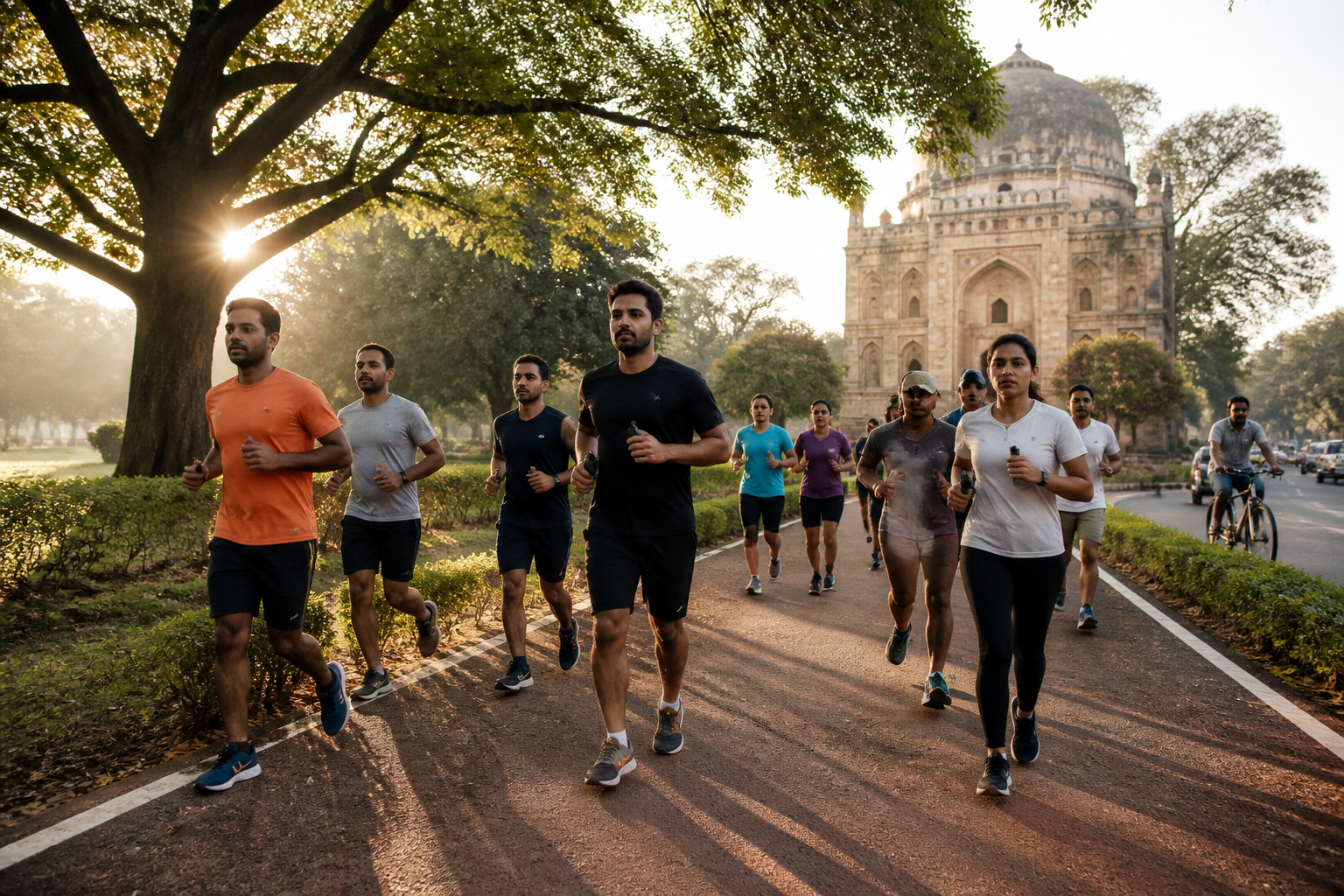
Delhi’s growing run clubs are doing more than organising weekend exercise. By bringing people into Lodhi Road, Nehru Park, Deer Park, Lodhi Garden, Hauz Khas Lake and the India Gate precinct, they are turning familiar public spaces into places for movement, routine and social connection. The accounts of runners and organisers suggest that these gatherings are also revealing a quieter function of the city’s parks and roads: they can operate as informal social infrastructure.
That role matters in a city where many interactions are organised around work, commuting, residential enclaves or commercial venues. The runners interviewed for this report describe a different urban rhythm. They meet early, move through public spaces together and often continue the interaction over breakfast, coffee or other social activities. The run is the entry point, but the larger experience is about belonging, friendship and, for some participants, romance.
The evidence available here is based on conversations with run-club founders, athletes and participants rather than on a citywide survey. It therefore cannot establish how widespread the trend is across Delhi or whether running has measurably increased use of public parks. It does, however, offer a grounded view of how a specific group is experiencing the city and how organised activity can change the meaning of shared urban spaces.
Delhi run clubs make public space social again
The central shift described by the organisers is from public space as scenery to public space as an active setting for community. Soumya Singh, co-founder of Delhi Run Collective, says the city’s routes are not merely attractive locations for exercise. In her account, early-morning running through Lodhi Garden, Hauz Khas Lake or Lodhi Road makes participants experience the city gradually and physically.
That distinction is important. A park can be measured through its area, landscaping, facilities or visitor numbers, but those measures do not fully capture how people use it. The runners’ accounts show another layer: the ability of a space to support repeated encounters between people who may otherwise have little reason to meet. The regularity of the run appears to be as important as the route itself. People return to the same places, see familiar faces and develop relationships over time.
Singh describes this process as the creation of “real friendships and support systems”. Her observation is not presented as a formal finding, but it identifies a function often associated with successful public spaces: they allow people to share time without needing to buy access or make a prior personal connection. In the run-club model, the group provides the initial structure, while the park, road or green corridor provides the physical setting.
The source accounts also show that these spaces carry different meanings for different participants. For athletes, they are training grounds. For younger members, they can be social environments. For people new to Delhi, they can provide a route into the city’s social life. For long-time residents, they can offer a new way of seeing places they already know.
Nakul Butta, a long-distance runner and marathon coach, says younger participants are joining runs around places such as Nehru Park not only to exercise but also to spend time together. He points to convenience, parking and bike lanes as factors that help make particular locations attractive. He also describes green spaces as “safe zones”, a phrase that captures the importance of perceived comfort and social presence in determining whether people use public areas.
The interview does not establish that all of these spaces are consistently safe or equally accessible. It does show that participants judge routes through a combination of physical and social conditions. A convenient location, manageable access and the presence of a group can make outdoor activity easier to sustain.
### From exercise route to urban network
The run clubs described in the report function as small networks layered onto the city’s existing infrastructure. They do not build the roads, parks or heritage precincts they use. Instead, they organise time, participation and repeated activity around them. This can alter how people perceive the same environment.
Sachin Surie, a triathlete, says Delhi can be a good place for outdoor exercise when people know where to go and join the right groups. His comment points to the importance of informal knowledge. The availability of a green space does not automatically tell a resident how to use it, when to visit, which route to take or whom to approach. Run clubs supply that practical and social information.
For participants who usually move through Delhi by car, running also changes the scale at which the city is experienced. Surie says that preparing for long runs has required him to cover distances on foot, allowing him to notice details that are missed when travelling quickly by car. This is a personal account, but it highlights a broader difference between mobility modes. Driving connects destinations efficiently while walking and running expose the continuity between them: streets, trees, buildings, crossings, people and changing activity levels.
The routes mentioned by the runners also connect several types of urban space. Lodhi Road is associated with organised races and training. Nehru Park is valued for access and its relationship with cycling infrastructure. Lodhi Garden and Hauz Khas Lake provide green settings. India Gate carries associations of national events, public gatherings and memory. Together, these locations form a mental map of Delhi that is based not only on landmarks but on endurance, routine and collective experience.
Soumya Singh describes running past India Gate and along Lodhi Road as part of a legacy of endurance sport. She also notes that these places have hosted marathons, protests, national celebrations and everyday activity. That range of uses matters because it shows public space as layered rather than single-purpose. The same location can be a ceremonial setting, a political gathering place, a recreational route and an ordinary part of daily life.
The run-club experience adds another layer: organised social participation. It does not replace the other uses, but it gives participants a reason to return and a group through which to interpret the space.
### The social infrastructure after the run
The report repeatedly moves beyond the run itself. Weekend routes lead to breakfasts, café gatherings and wellness activities. Joy Thakur, co-founder of the Bhag Club, says participants who first meet during a run can form friendships, attend dinners and sometimes begin dating. Rajot Garg, founder of 5 am Social Run Club, says events bring together people who may have moved to Delhi from different cities.
These accounts suggest that the run club is not simply a fitness service. It is a social interface for a mobile urban population. The activity offers a low-pressure reason to meet, while the repeated schedule allows relationships to develop gradually. For people who do not have established networks in the city, that can be significant, although the supplied material does not quantify how many participants depend on these groups for social connection.
The organisers are careful not to define their clubs primarily as dating spaces. Thakur says romance can emerge from the wider social environment but is not the formal purpose of the group. That distinction helps explain the appeal of the format. The club’s stated activity is running or wellness, while its secondary effects include conversation, friendship and social discovery.
This is also where the city’s physical form becomes part of the social experience. A café or private gym can host interaction, but the run club begins in a public setting and involves movement through the city. Participants do not only meet across a table; they share a route, pace and effort. The common activity creates an immediate point of connection, while the public landscape supplies a changing backdrop.
The evidence does not support the conclusion that run clubs have transformed Delhi’s public-space system. It supports a narrower observation: organised groups can make particular public spaces feel more usable and meaningful to their members. That effect depends on the routes, the time of day, the group’s culture and the facilities available around the location.
### What the accounts reveal about urban access
The story’s strongest urban lesson is that access is not only a question of whether a park or road exists. It is also shaped by convenience, confidence, social familiarity and the ability to reach the location. Butta mentions parking and bike lanes around Nehru Park, while Surie speaks about knowing where to go. These details show that the usability of outdoor space is connected to transport and local infrastructure.
The accounts also reveal a tension between the city’s abundance of green and historic spaces and the knowledge required to use them. The runners describe Delhi as fortunate to have open green areas, but they also emphasise route selection and group participation. This means that a space can be physically available while remaining socially underused by people who do not know the area or do not feel comfortable visiting it alone.
Run clubs address that gap through coordination. They establish a time, a meeting point and a collective purpose. In doing so, they reduce some of the uncertainty associated with entering an unfamiliar public environment. The group becomes a form of informal guidance, although it cannot resolve larger questions about maintenance, universal accessibility, pedestrian safety or equal access across the city.
There is another limitation in the evidence. The people quoted are runners, organisers and athletes already connected to outdoor activity. Their experiences may not represent older residents, people with disabilities, women who do not feel comfortable in particular locations, shift workers, residents far from these routes or people unable to participate in organised fitness. The popularity of a run club in one part of Delhi cannot be treated as proof that the city’s public spaces work equally well for everyone.
Still, the accounts provide a useful ground-level perspective. They show how residents create value around existing infrastructure without waiting for a new facility or formal programme. The clubs’ contribution is organisational: they assemble people around routes and give those routes a recurring social purpose.
### The larger question for Delhi’s public spaces
Delhi’s run-club culture raises a broader question about how cities support repeated, low-cost and socially inclusive activity. The source material does not provide attendance figures, park usage data, expenditure details or policy responses. It therefore cannot assess the scale of the phenomenon or its impact on municipal planning. What it does show is how residents interpret and activate public spaces when the physical setting, access conditions and group structure align.
For the runners quoted, Delhi’s green spaces are not decorative assets placed beside the city. They are training grounds, meeting points and ways of understanding the urban environment. The value lies partly in the landscape and partly in the routines that bring people back to it.
That distinction should remain central to any reading of the trend. Public spaces do not become socially useful only through design or location. They also require regular users, shared norms and conditions that make people willing to stay. In this account, run clubs provide one mechanism for building that use. Whether the model can serve a broader section of Delhi’s population, and whether it can be sustained across different neighbourhoods and seasons, is not established by the available evidence.
What is clear is that the city’s runners are using familiar roads, parks and heritage landscapes to create a new layer of urban life. Their experience suggests that Delhi’s public spaces are not only places people pass through or visit occasionally. With the right combination of access, routine and collective activity, they can become places where residents learn the city, build relationships and develop a stronger sense of belonging.
