


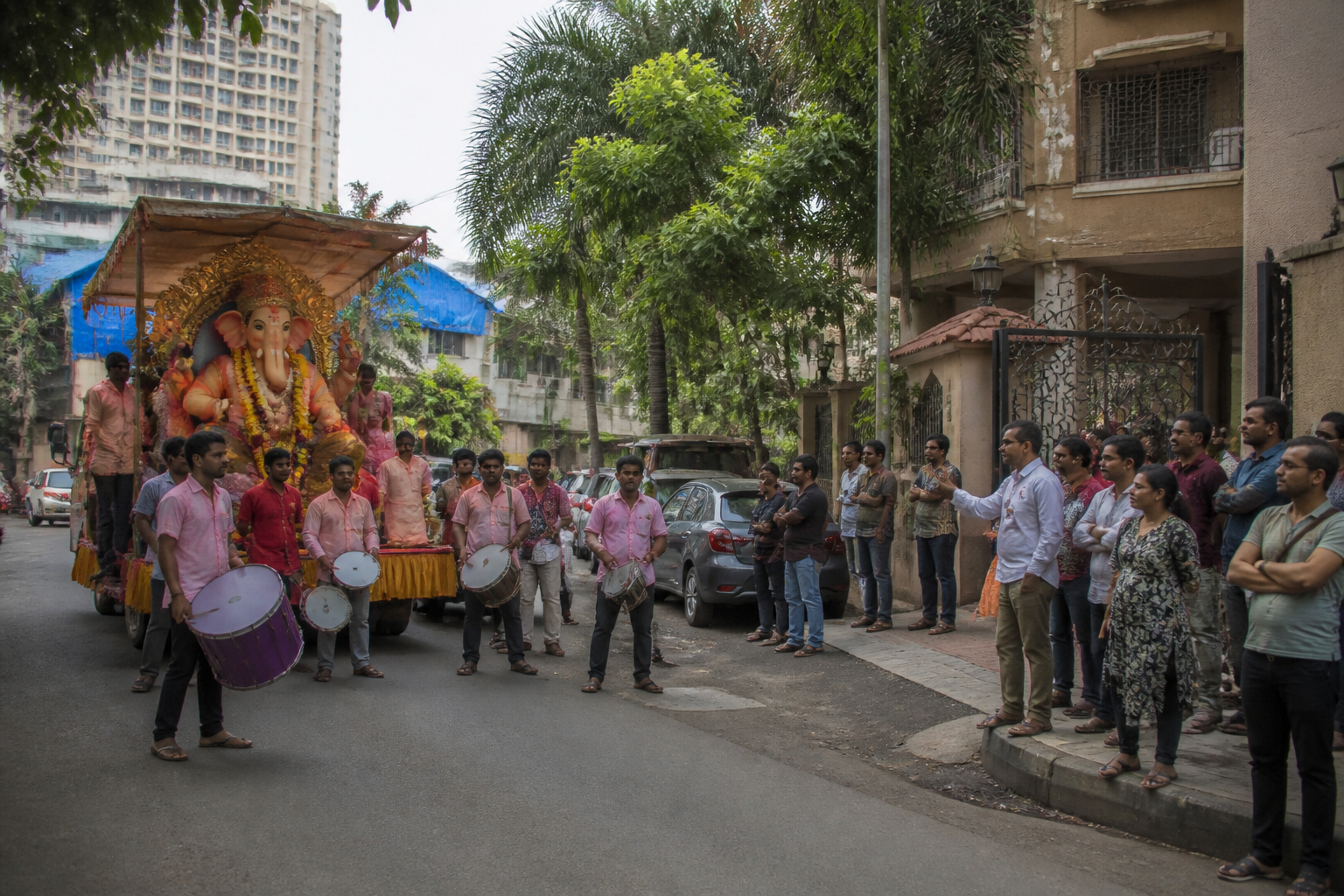
The reported assault of a Goregaon resident after he objected to noise during a Ganpati immersion procession is not only a case of alleged violence. It also brings into view a recurring urban governance problem: how Mumbai manages competing claims over residential peace, religious celebration, public roads and police intervention when they meet at street level.
According to The Indian Express, 29-year-old Advait Arun Madkaikar suffered a serious nose injury requiring surgery after an argument outside Pradhan Society on Gotewadi Road in Goregaon East. The incident took place at around 10.20 am on September 15, when a group involved in an immersion procession was allegedly playing dhol-tasha and bursting crackers outside the residential society.
Police said Madkaikar had objected to the noise and was also taking photographs of the vehicle and people participating in the procession. The argument escalated, and one of the men allegedly punched him on the nose. The other three allegedly assaulted him with kicks and punches. Madkaikar later sought medical treatment and underwent surgery.
The Vanrai police registered a first information report after Madkaikar approached them on Wednesday. The case was registered under Sections 117(2), 352 and 3(5) of the Bharatiya Nyaya Sanhita, according to the report. Police identified four suspects, including the driver of the four-wheeler used in the procession, and said they would be called for questioning and further legal action.
The immediate legal question is therefore whether the alleged assault can be established through the police investigation. The wider urban question is how a disagreement over noise and the use of the road moved from a neighbourhood complaint to a physical confrontation. The supplied account does not establish whether permissions, route conditions or any prior complaint had been recorded. It does, however, show how quickly a shared public space can become contested when different users have no effective mechanism for resolving a dispute in real time.
A procession outside a housing society involves several overlapping systems. The road is a circulation space, but it can also become a temporary venue for religious activity. Residents experience it as the immediate edge of their homes. Participants experience it as part of a collective celebration. Police are expected to maintain public order, while local administration is responsible for coordinating activities that affect movement and neighbourhood life. In the reported incident, the conflict occurred at this intersection rather than in a formally designated private venue.
That distinction matters because urban disputes are rarely limited to the original point of disagreement. A complaint about noise can become a dispute over who has authority to occupy a road. Photographing a vehicle or participants can be perceived as scrutiny by one side and treated as documentation by the other. A request to reduce noise can be heard as opposition to the celebration itself. None of these interpretations, on their own, establishes wrongdoing. They do show why street-level conflicts can intensify when the participants lack a trusted intermediary.
The report attributes the account of the assault to the police and records the allegation that one accused punched Madkaikar while the others kicked and punched him. The accused have not been reported as having given their version. The legal process will therefore have to establish what happened, who was involved and whether the provisions cited in the FIR apply to the conduct alleged. Until that process advances, the facts available are the victim’s reported injury, the police registration of the case and the identification of four suspects.
The injury adds a public-safety dimension to what might otherwise be treated as a routine dispute over festival noise. Madkaikar required surgery for the nose injury, according to the report. That detail shifts the matter from a disagreement about urban convenience to an allegation involving bodily harm in a residential neighbourhood. It also underlines the consequences of allowing public-space conflicts to be settled through confrontation rather than through an identifiable civic process.
The account does not provide data on the number of complaints received during the procession, the sound levels at the location, the permissions granted to the vehicle or whether police personnel were present when the argument began. It also does not state whether the procession had deviated from an approved route or whether any prior agreement existed between organisers and residents. These are not minor details. They would help determine whether the conflict arose from a failure of coordination, an isolated escalation, or both.
That missing administrative information is central to understanding the urban system behind the incident. A procession involving music, crackers and a moving vehicle affects more than the people participating in it. It can influence residents, pedestrians, motorists, emergency access and other street users. Where a route passes a housing society, the management of time, movement and sound becomes part of the practical administration of the neighbourhood. The supplied report does not establish how those elements were planned in this case.
The institutional chain is also important. The police have registered the FIR and are expected to question the suspects. The vehicle has been identified as MH-02-CD-1188. The report names the senior inspector who described the alleged assault. But the account does not identify the civic or event-management authority responsible for coordinating the procession. That leaves an important part of the governance picture outside the available evidence: who had responsibility for preventing a foreseeable clash between procession activity and residential use of the road?
This is where festival administration intersects with the everyday reality of dense cities. Mumbai’s neighbourhoods frequently combine housing societies, narrow roads, commercial activity and public gatherings within the same limited street network. A road may be ordinary infrastructure for most of the year and a temporary event space during a procession. The same physical setting can therefore carry different expectations at different times. Without clear communication and enforcement, those expectations can collide at the level of individual residents and participants.
The reported incident should not be used to generalise about Ganpati processions, religious celebrations or residents who object to noise. The source supports a specific account involving one resident, four identified suspects, one procession vehicle and a police case. It does not establish that similar incidents are widespread, nor does it provide evidence about the broader conduct of the procession. An analysis of the event must retain that boundary, particularly because the central allegations remain subject to investigation.
At the same time, limiting the case to an isolated assault would miss its civic significance. Urban governance is tested not only by large infrastructure projects or formal policy decisions, but also by how institutions handle ordinary conflicts in shared spaces. A resident should have a lawful channel to raise a complaint. Participants in a permitted public event should know the conditions governing its use of roads and sound. Police and civic authorities need a way to intervene before an argument becomes violence. The report does not show whether those channels were available or used effectively in Goregaon.
The next steps are therefore both legal and administrative. Legally, the Vanrai police are to call the identified suspects for questioning and pursue further action under the sections cited in the FIR. Administratively, the available account leaves unanswered questions about event permissions, route coordination, noise management and the presence or absence of police at the location. Those questions matter because they determine whether the incident was managed solely after the alleged injury or whether there were preventive systems in place before the procession reached Pradhan Society.
What the evidence currently confirms is limited but serious: a resident suffered a surgically treated nose injury after an argument linked by police to noise during a Ganpati immersion procession; four men were named as suspects; and an FIR was registered. What remains to be established is the sequence of events, the role of each accused and the administrative circumstances surrounding the procession. The case will show whether Mumbai’s response stops at investigating the alleged assault or also examines how a shared residential street became the setting for it.

