


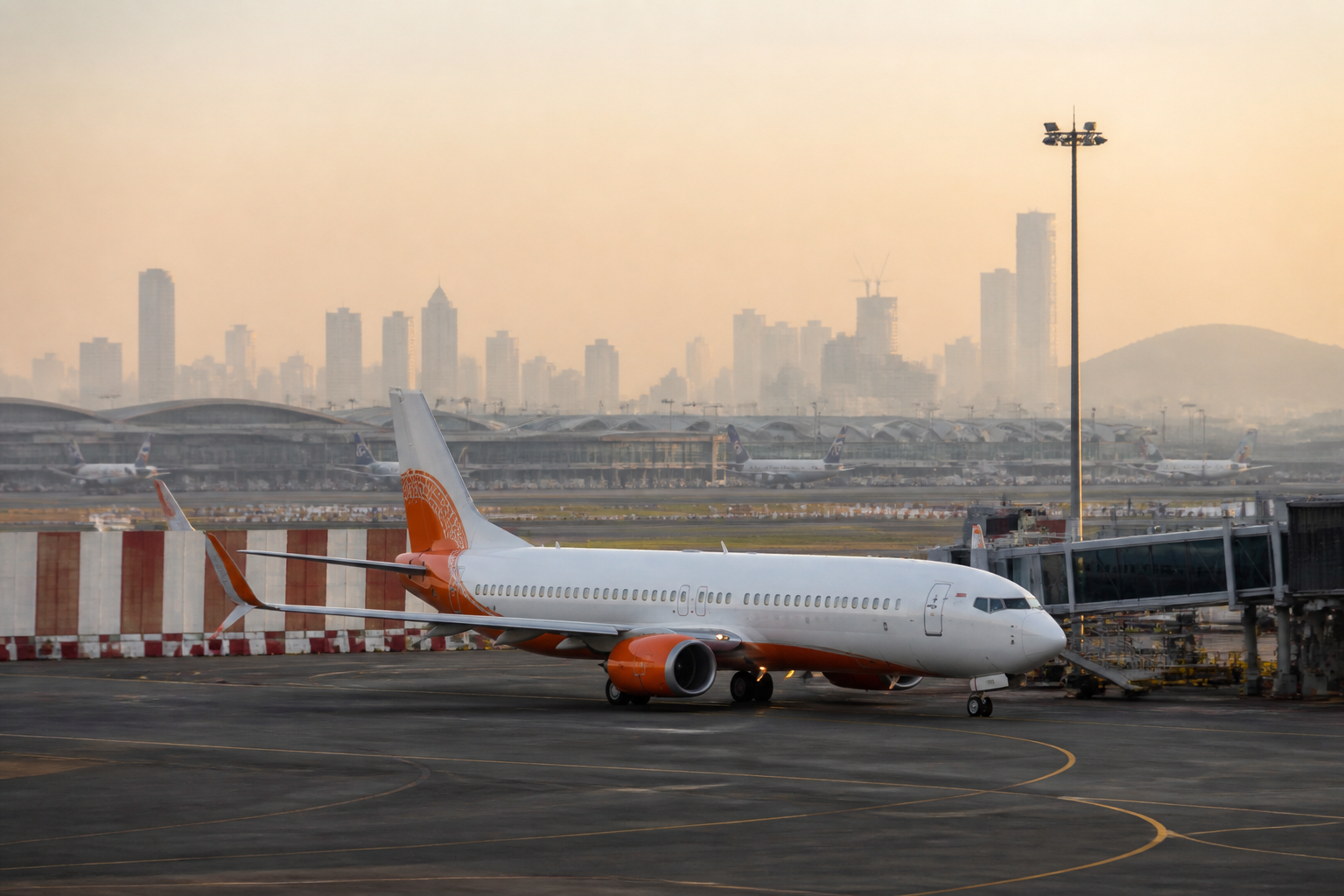
Air India’s evolving route strategy is creating a clearer division within the Tata Group’s aviation portfolio: Air India is concentrating on international, long-haul and major metropolitan routes, while Air India Express is taking a larger role in domestic and regional markets. The change is visible in new services connecting smaller cities with Delhi, Mumbai, Chennai and Hyderabad, but it also raises a larger urban question about which cities receive direct air access and how India’s aviation network will be organised around a few dominant metropolitan hubs.
According to a report by Loksatta – Mumbai, Air India Express has gradually reduced services from smaller and regional cities while Air India has increased its focus on international and major metro routes. At the same time, Air India Express has begun services from cities including Coimbatore, Bhopal, Chhatrapati Sambhajinagar, Madurai, Tirupati, Jodhpur and Jamnagar. The report also states that Air India Express has taken over services on the Mumbai-Kochi and Kochi-Delhi routes that were previously operated by Air India.
The developments indicate that the two airlines are being positioned for different parts of the market. Air India is being aligned with long-distance and international travel, as well as major metropolitan corridors. Air India Express is being assigned a stronger role in domestic aviation and in connecting smaller urban centres to larger cities. This is not merely a change in flight schedules. It is a reorganisation of how the group intends to distribute aircraft, routes and passenger demand across its network.
The distinction matters because air connectivity is closely tied to the hierarchy of Indian cities. Delhi, Mumbai, Chennai and Hyderabad function as major metropolitan gateways in the network described by the report. When smaller cities are linked to these centres, passengers can access larger markets, international airports and broader employment, education, business and tourism opportunities. But the structure also means that the quality of connectivity for smaller cities depends on the frequency, reliability and commercial viability of services routed through these metropolitan nodes.
The report says Air India Express began domestic services from six locations from 1 September, linking them with Delhi, Mumbai, Chennai and Hyderabad. It does not identify all six locations in the supplied material, but the stated pattern is clear: the airline is using major metros as connection points for a wider domestic network. This creates a hub-and-spoke structure in which smaller and regional cities are connected to larger urban centres rather than being served through an equally dense network of direct routes between smaller cities.
That structure can improve network efficiency for an airline because routes are organised around selected high-demand centres. However, the supplied report does not provide passenger-load figures, fares, flight frequencies or details of the aircraft deployed on these routes. It is therefore not possible to establish from the available evidence whether the new strategy will increase overall connectivity for regional cities or mainly redistribute existing services between the two airlines.
The numbers cited in the report show the scale of Air India Express’s current operating footprint. In financial year 2026, the airline operated 474 flights daily across 46 domestic and 17 international stations. The figures underline that Air India Express is not being positioned only as a small-city carrier. Its network already includes a substantial domestic operation and a presence at international stations. The strategic question is how that scale will be used as the airline takes on more domestic and regional responsibility.
For Air India, the emphasis on international and long-haul routes places the airline’s principal role in the movement of passengers between India’s largest urban markets and overseas destinations. The report also refers to a focus on major metropolitan routes within the country. This points towards a network in which the parent airline concentrates on routes with stronger demand from large urban markets, while Air India Express serves a broader domestic footprint.
The transition was initiated, in part, under former Air India chief executive Campbell Wilson, according to the report. The report says the decision to reduce Air India services from some smaller cities was taken during his leadership. It also identifies the continuation of this policy under the new chief executive, Tevolde Gebremariam, as an important question. The supplied material does not include a direct statement from the new chief executive confirming the future strategy, so the extent to which the policy will be modified remains unestablished.
That leadership transition is significant because route planning is not only a commercial exercise. It determines which cities are treated as primary markets, which are connected through another airport and which may experience reduced direct access. A change in airline leadership can therefore affect the balance between network efficiency and geographic reach. In this case, the available report records the existing direction of travel but does not establish whether the new management will retain every part of it.
The network also illustrates the different roles that major airports play in urban economies. Mumbai, Delhi, Chennai and Hyderabad are identified as connection points for Air India Express’s new domestic services. These cities are not simply destinations; they are gateways through which passengers from smaller urban centres can reach other parts of India and, in the case of major international airports, overseas destinations. The concentration of routes in these cities can strengthen their position as aviation hubs while making regional connectivity more dependent on transfers.
For passengers, the immediate effect of the strategy will be determined by practical details that are not included in the report: the number of daily services, the timing of connections, the availability of onward flights and the fares on each route. A route announcement alone does not show whether a city has gained meaningful connectivity. A service may be formally available but offer limited utility if schedules do not support same-day travel or if connections require long waits. Those operational details will be important in assessing the real impact of the shift.
The report’s description of services to Coimbatore, Bhopal, Chhatrapati Sambhajinagar, Madurai, Tirupati, Jodhpur and Jamnagar suggests that the regional strategy covers different types of urban markets. Some are established industrial or commercial centres, while others serve tourism, pilgrimage or regional administrative functions. The supplied material does not provide route-wise passenger data or explain why each city was selected. It does, however, show that the domestic network is being extended across a geographically varied set of cities rather than being limited to a single region.
This is where the strategy intersects with the broader development of India’s urban system. Large metropolitan areas continue to dominate air traffic, but regional cities require dependable connections if businesses, institutions and residents are to participate in national markets. The airline group’s division of roles could support that objective if Air India Express maintains regular domestic services and if the metropolitan hubs provide effective onward connections. It could also leave smaller cities more exposed to service cuts if routes are evaluated mainly through metropolitan demand.
The evidence currently supports a description of strategic repositioning, not a conclusion about its success. The report supplies the airline roles, the newly cited city pairs, the number of stations and daily flights, and the leadership context. It does not establish changes in passenger volumes, profitability, ticket prices, connectivity frequency or airport capacity. Those measures would be needed to determine whether the new arrangement is expanding access or simply reallocating the group’s existing services.
The institutional issue is therefore one of network responsibility. Air India is being shaped around international, long-haul and major metropolitan travel, while Air India Express is being given a larger domestic and regional function. That division may make the group’s brands and operations more distinct, but the urban outcome will depend on how consistently the regional carrier serves smaller markets and how effectively the major metros function as connecting gateways.
The next stage of the policy will be visible in route continuity, service frequency and the treatment of smaller-city stations. The report records that Air India Express began services from six domestic locations from 1 September and operated 474 daily flights across 63 domestic and international stations in financial year 2026. Whether this represents a durable expansion of regional aviation or a redistribution of routes within the Tata Group will require further evidence from future schedules, operating data and official statements from the airline’s new leadership.
