


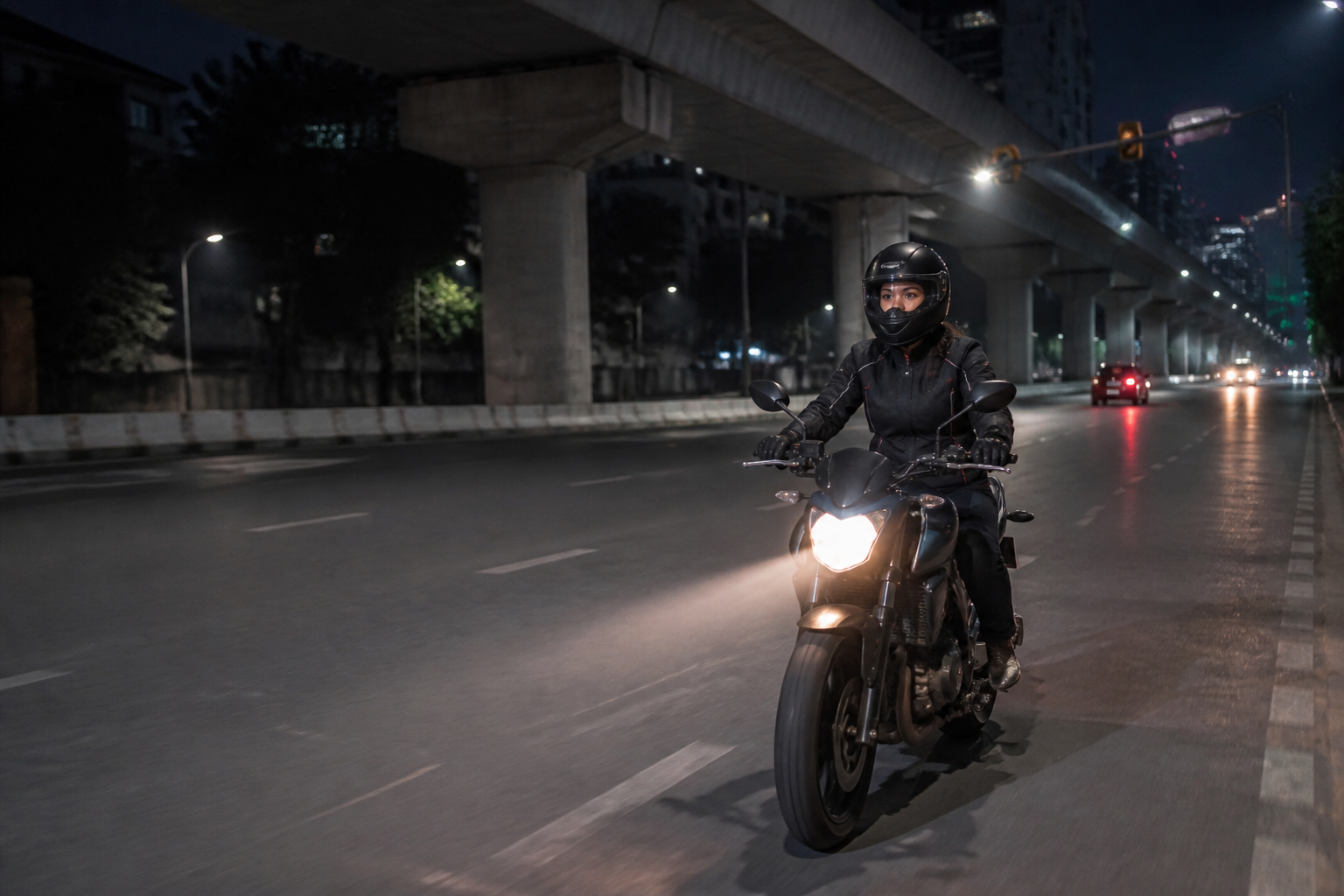
A reported road incident in Gurugram, in which a woman motorcycle rider was allegedly followed and deliberately hit by a car before the driver fled, has brought an everyday urban mobility problem back into focus: for many women, using Delhi-NCR’s roads at night remains an exercise in managing fear as much as travelling from one place to another.
The incident was recorded on the rider’s motorcycle camera, according to Live Hindustan – NCR. The report does not identify the date of the collision or provide details of a police case, but it records the rider’s account that she was followed for a considerable distance before being hit. She later said the experience was frightening and that, although she wanted to ride again, she would be afraid to travel alone.
That account is important not only because of the alleged collision, but because it places the event within a wider pattern described by women riders interviewed for the report. They spoke of cars passing dangerously close, people following them and the need to change riding schedules so they could reach home before nightfall. These accounts point to a gap between formal access to roads and the practical freedom to use them.
For a city-region as large and dispersed as Delhi-NCR, that distinction matters. Motorcycles are often used to bridge gaps between homes, workplaces, markets and public transport. They offer flexibility where bus routes, metro stations and last-mile connections may not align with a commuter’s journey. A woman who stops riding after dark, or who changes her route to avoid isolated stretches, does not have the same mobility as a man making the same trip.
The report’s account of Visishta, a Delhi-based motorcycle rider who has been riding since 2019, illustrates how this restriction operates at street level. She told the publication that riding in Delhi-NCR, especially at night, can be difficult. Main roads may feel more manageable, she said, but local roads can become unsafe. Her description was not limited to poor road conditions. It included the behaviour of other road users, including drivers who appear to react negatively to a woman riding ahead of them.
Visishta described one incident on the Noida Link Road in which men allegedly followed her in a car, drove close to her motorcycle and appeared to be chasing her. She slowed down, after which the vehicle moved ahead. She said the incident made her heart race because she feared that the car might hit her. The report also records her observation that some men stare at women riders and that night-time driving can become particularly unsafe when motorists are driving erratically or may have consumed alcohol.
These are individual accounts, not a statistically representative survey. The supplied report does not establish how frequently such incidents occur across Delhi-NCR, which roads record the most complaints, or how many cases result in formal police action. It also does not provide independent confirmation of the reported Gurugram collision or the Noida Link Road encounter. Their significance lies in the common urban question they raise: who can use a road confidently after dark, and who must calculate the risk before leaving home?
Road safety is often discussed through the language of speeding, crashes, helmets, lane discipline and vehicle engineering. Those issues remain central, but women’s experiences add another layer. A road can be technically open and still feel inaccessible if lighting is poor, pedestrian activity disappears, surveillance is limited or drivers believe they can intimidate another road user without consequence.
The distinction between a main road and a local road is also revealing. Main roads generally carry more traffic and may be better lit, while internal roads can have lower visibility and fewer witnesses. Yet a commuter’s journey rarely ends at the main carriageway. The final stretch to a home, workplace or residential lane can determine whether the entire trip feels safe. This makes last-mile road conditions a core mobility issue rather than a marginal concern.
Delhi-NCR’s geography intensifies this problem. The region crosses several administrative boundaries and includes Delhi, Gurugram, Noida and other urban areas with different local agencies and policing arrangements. A journey may pass from a well-lit arterial road into a poorly monitored local stretch without the rider experiencing any meaningful institutional boundary. Responsibility, however, may be divided between traffic police, local police, municipal bodies, road-owning agencies and private developers.
That fragmentation can make road safety difficult to experience as a single public service. A rider does not care which agency controls a particular road when a car begins following her. She needs the road to be visible, the emergency response to be reachable and the threat to be taken seriously. The report does not examine the response of police or municipal authorities, leaving an important part of the governance picture unanswered.
The story also challenges the idea that the expansion of women’s vehicle ownership automatically produces mobility freedom. Visishta told the publication that her family had gifted her a new sports motorcycle. Her ability to ride is therefore supported by access to a vehicle and, apparently, family acceptance. But the account shows that social permission and road-level safety are separate conditions. A woman may be encouraged to own a motorcycle and still face harassment, intimidation or dangerous driving once she enters public space.
This distinction is relevant to transport planning. Encouraging two-wheeler use can expand access to jobs, education and services, particularly where public transport does not provide a direct or convenient journey. But mobility policies that focus only on vehicle access overlook the conditions under which people actually travel. If women avoid riding after dark, the effective value of that access is reduced.
The available evidence in the report is qualitative. It includes the alleged Gurugram collision, Visishta’s account of being followed on the Noida Link Road and statements from other women riders who said they altered their schedules. It does not include crash data by gender, a count of harassment complaints, road-lighting audits or information on emergency response times. Those missing indicators are precisely what would be needed to move from personal testimony to a region-wide assessment.
Until such evidence is assembled, the accounts should not be used to rank one road or city as definitively more dangerous than another. They do, however, show why official road-safety metrics can miss the lived experience of mobility. A route may not appear in crash statistics if a rider changes her travel time, avoids a road, stops riding or reaches home without reporting harassment. Absence from a police record does not necessarily mean absence of risk; it may also reflect under-reporting or adaptation.
The larger urban question is whether Delhi-NCR’s roads are being planned only for movement, or also for equal access. A transport network is not fully accessible when one group can use it only by accepting greater exposure to intimidation. Street lighting, continuous activity, visible policing, safe junctions, reliable emergency communication and accountable response all shape that access, even though the supplied report does not assess their availability on specific routes.
The report ends with Visishta continuing her journey on her motorcycle, while observing that riding itself is not an extraordinary achievement. The extraordinary part, she suggests, is that ordinary travel can become difficult for women when road users turn the act of riding into a test of control and vulnerability. The evidence currently establishes a set of reported experiences rather than a complete regional measurement. What remains to be examined is how many riders face similar risks, which agencies receive their complaints and whether the roads they use are designed and managed for safe travel after dark.
