


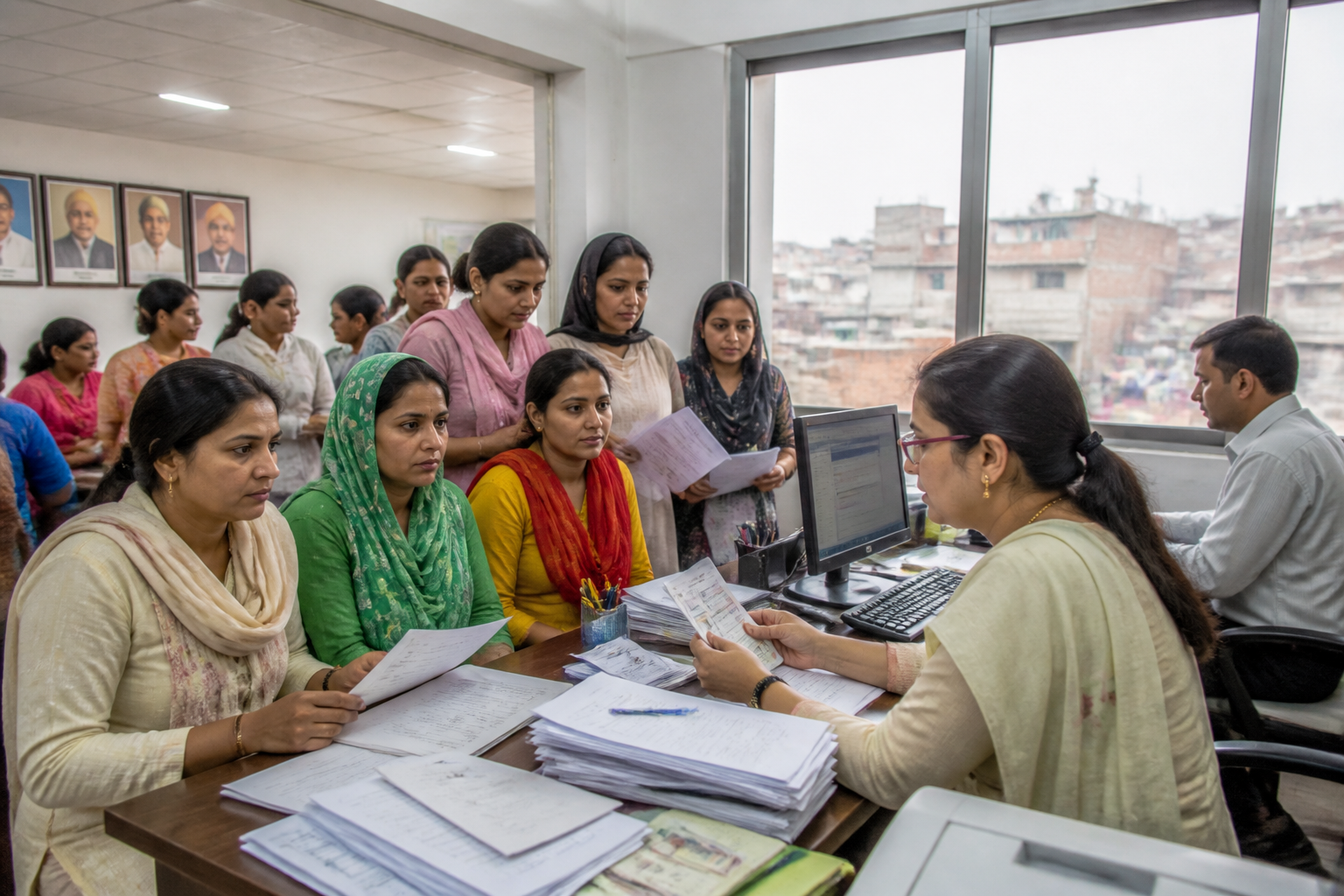
The Delhi government’s defence of an elected representative’s approval requirement for Lakshmi Yojana has placed the design of welfare access before the Delhi High Court. The scheme offers eligible women a monthly benefit of ₹2,500, but the government’s guidelines require applicants to obtain approval from a local Member of Parliament or Member of the Legislative Assembly. The resulting legal challenge is not only about one condition in one scheme. It raises a wider question about how an urban government should identify beneficiaries, distribute public money and keep access to welfare independent of political mediation.
In an affidavit filed through the Women and Child Development Department, the Delhi government said it had received approximately 7,32,814 applications carrying approval from local MPs or MLAs. The government relied on this figure to argue that the requirement had not created difficulty for applicants. The affidavit was filed in response to a petition by former Congress councillor Abhishek Dutt and sitting councillor Vedpal Sheetal Chaudhary, who have challenged the decision.
The government’s position, as reported by Jagran – New Delhi, is that the approval condition was not added informally after the scheme was announced. It said the decision was included when a note was prepared for the Council of Ministers on July 17. Different departments examined the condition and, according to the affidavit, found nothing unusual in it. The Women and Child Development Department then submitted the proposal for the Council of Ministers’ approval. The Cabinet subsequently approved guidelines containing the MP or MLA recommendation requirement and decided to implement the scheme.
That sequence matters because it shifts the government’s defence from administrative convenience to institutional authorisation. The affidavit presents the requirement as part of an approved policy framework rather than as an operational practice created by local officials. In administrative terms, the government is asserting that the condition passed through the prescribed decision-making route and was reviewed by more than one department before implementation.
But procedural approval and ease of access are separate questions. The reported number of applications demonstrates that many people have applied with the required approval. It does not, by itself, establish how applicants obtained that approval, how long the process took, whether all eligible women could approach an MP or MLA equally, or whether any applicant was excluded because the elected representative did not approve the application. The supplied report does not provide those details, and the affidavit’s application figure cannot answer all of them.
This distinction is central to understanding the dispute. A welfare scheme normally requires the administration to establish eligibility through defined documents, databases, verification procedures or departmental scrutiny. Requiring an elected representative’s approval introduces an additional political office into that chain. The government may view the approval as a validation or verification step. Applicants, however, encounter it as another point at which access to a benefit can be delayed, questioned or refused.
The issue is particularly important in a large city such as Delhi, where public services are delivered through several layers of elected and administrative authority. Residents may live in one Assembly constituency, vote in a parliamentary constituency and interact with departments that have their own verification systems. A scheme that places an MP or MLA between the applicant and the implementing department therefore creates a specific institutional relationship: access to a monthly state benefit is connected to the approval of a political representative.
The government’s affidavit appears to rely on uptake as evidence that the system is functioning. More than seven lakh applications with local approval indicate that the requirement has not prevented applications at scale. They also show that applicants and representatives have been able to participate in the process. However, uptake is not the same as universal accessibility. To establish that the condition does not create hardship, the administration would need to show more about rejected applications, pending cases, processing time, geographic variation and the experience of applicants who could not secure approval. None of those measures is included in the supplied report.
This is where the court challenge becomes an important governance test. The petitioners are contesting the condition itself, while the government is defending both its origin and its operation. The court will therefore be dealing with two connected questions: whether the government was entitled to frame the scheme in this manner, and whether the approval requirement is compatible with fair and non-discriminatory access to the benefit. The reported affidavit establishes the government’s position, but the supplied material does not indicate that the court has ruled on the merits of the challenge.
The scheme’s design also illustrates the difference between a benefit announcement and a delivery system. A monthly payment of ₹2,500 is the visible promise made to eligible women. The less visible system includes application intake, eligibility determination, local approval, departmental scrutiny and final disbursal. Each additional stage can affect the time and certainty with which a person receives support. The public impact of the scheme therefore depends not only on the amount promised, but also on how clearly responsibilities are allocated and how applicants can challenge an adverse decision.
The affidavit’s reference to the July 17 ministerial note offers a limited view of that design process. It shows when the requirement was incorporated into the proposal, but the supplied report does not describe the criteria that MPs or MLAs must apply, the documents they must review, or whether they are required to record reasons for approval or refusal. It also does not explain whether applicants have an alternative route if their local representative is unavailable or declines to recommend them.
Those unanswered operational details are significant because political constituencies are not administrative service counters in the conventional sense. Elected representatives have public offices and constituency responsibilities, but the report does not establish whether their offices have been formally equipped, staffed or monitored to process welfare applications. Nor does it indicate whether the government has published service standards for this stage. Without such information, it is difficult to assess whether the requirement is a structured verification mechanism or an additional discretionary gateway.
The government has argued that the large number of approved applications shows that beneficiaries have not faced difficulty. That is a relevant administrative claim, but it needs to be read alongside the possibility that people who faced difficulty may not appear in the application data. A person who could not obtain approval, did not know how to approach the representative or abandoned the process would not necessarily be counted among the 7,32,814 applications cited by the government. The reported figure measures completed applications with approval, not the full universe of potential applicants.
This does not establish that the scheme is inaccessible or that the approval condition has caused systematic exclusion. The supplied material does not provide evidence for either conclusion. It does establish that the government has chosen to defend the condition through two arguments: first, that it was approved through the Cabinet process after departmental examination; and second, that the number of applications shows that it has not caused practical difficulty. The strength of that defence will depend on how the court evaluates the legal basis and the evidence of actual implementation.
The matter also exposes a recurring challenge in urban welfare administration: the balance between political representation and rule-based delivery. Elected representatives can provide local knowledge and help residents navigate government systems. At the same time, when their approval becomes a formal condition for receiving a state benefit, the boundary between representation and eligibility verification becomes less clear. A transparent system would need to specify what the representative is certifying, what evidence supports that certification and what remedy is available to an applicant who is denied approval.
For Delhi’s residents, the immediate significance lies in the uncertainty surrounding the challenged condition. The government has defended the existing guidelines, and the reported application count indicates substantial participation. But the legal status of the challenge, the court’s eventual assessment and the detailed functioning of the approval process remain important to the scheme’s future. The next meaningful developments will be the court’s consideration of the petition and any further submissions or orders concerning the requirement that applicants obtain approval from a local MP or MLA.
