


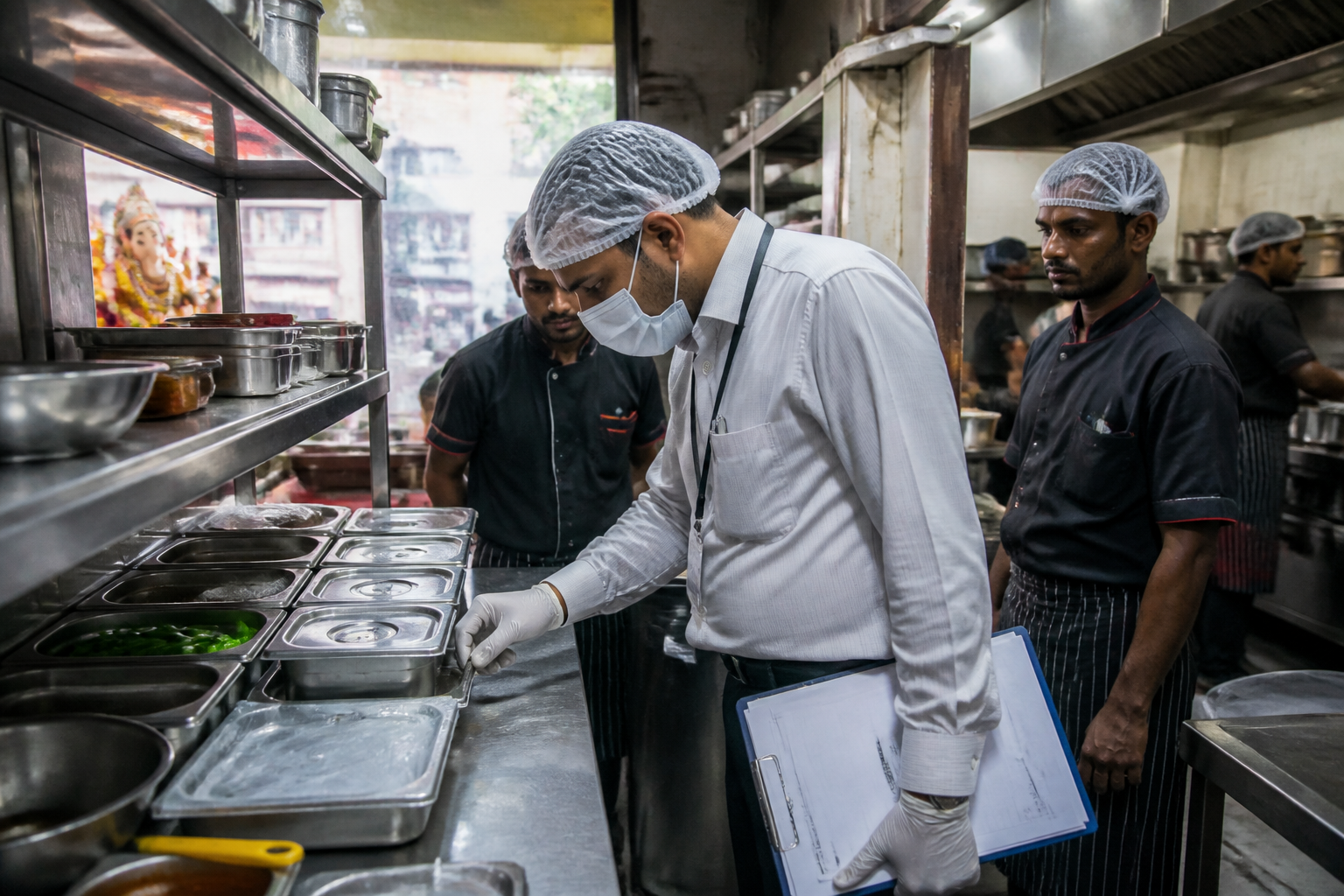
The Maharashtra Food and Drug Administration’s action against Café Mondegar and several other well-known establishments has turned a routine enforcement drive into a broader test of how Mumbai regulates the places where residents eat. The inspections conducted during the Ganeshotsav food-safety campaign found violations across restaurants, clubs, bakeries, branded outlets and food businesses linked to delivery platforms, raising a question larger than the fate of any one establishment: how much can diners know about the conditions in which their food is prepared?
The FDA inspected 38 establishments across Mumbai between September 11 and 14, collected 47 food samples and suspended the licences of nine establishments, according to the Times of India report. Café Mondegar, the 94-year-old Colaba landmark known for its Mario Miranda murals, was among the establishments facing action after an inspection on September 12 flagged food safety, hygiene and structural deficiencies. The action was part of a wider sequence of enforcement measures that had already reached prominent restaurants, clubs, bakeries, branded chains and food delivery-linked outlets.
The significance of the campaign lies partly in the spread of the establishments named in the report. Earlier action included Flint & Waarsa at the National Centre for the Performing Arts, M. K. Bakery, Hotel Shrikrishna, Hotel Gopal Krishna, Karak Enterprises and Madras Diaries. K. Rustom & Co., Parsi Dairy Farm and Poornima Restaurant were also among the establishments facing action. The FDA reportedly found fungal growth on stored vegetables and bananas at Poornima. These cases suggest that regulatory risk is not confined to one type of food business or one neighbourhood, even though the supplied report does not establish how widespread such conditions are across Mumbai as a whole.
The timeline also shows that scrutiny extended beyond small or informal outlets. In July, food licences or registration certificates of several prominent clubs were suspended, including CCI, RK Juhu Gymkhana, MIG Cricket Club, Aparna Juhu Gymkhana, Willingdon Sports Club and Goregaon Sports Club. In August, action included outlets of Domino’s, food businesses linked to Blinkit, Instamart and Zepto, Otters Club, the Bombay Presidency Radio Club, McDonald’s Metro House, Khar Gymkhana and the MCA’s BKC facility.
That spread matters because established names and familiar brands often function as informal assurances of quality for consumers. Diners may assume that a long-running landmark, a private club or a recognised chain has stronger systems than a small eatery. The FDA’s actions do not prove that all such establishments have comparable problems, but they do show why reputation cannot replace visible compliance and regulatory oversight.
The consumer response described in the report reflects this loss of certainty. Madhurima Chatterjee, a media professional from Santacruz, said she had become wary of eating out after seeing what FDA teams were finding in kitchens. Dheeraj Gaur, a corporate professional from Powai, said the presence of clubs and well-known brands among the establishments facing action made him question how much diners know about the food they are served. For Shilpa Somaiya, an entrepreneur from Parel, the concern was sharper when eating with her child, particularly around freshness and basic hygiene.
These reactions point to an information imbalance. Customers can observe some visible conditions, such as cleanliness in dining areas, but they generally cannot see how food is stored, whether frying oil is reused, how ingredients are handled or whether a kitchen is operating with the required registration or licence. The inspection process therefore performs a function that individual consumer vigilance cannot fully replace. It brings conditions inside kitchens into the regulatory field, where violations can be documented and action can be taken.
The report also records an example of corrective action by a Mumbai eatery after FDA scrutiny. The business said it had stopped using artificial colour in its sweet chutney, stopped reusing frying oil and strengthened hygiene measures among staff. The example is limited to one establishment and does not establish that all businesses respond similarly. It does, however, show the practical value of inspections when enforcement produces changes in day-to-day kitchen practices rather than only a temporary public warning.
FDA Commissioner Tukaram Mundhe has urged consumers not to stop eating out but to become more mindful, including by checking cleanliness and sanitation and ensuring that an establishment is properly registered and licensed. That advice places part of the responsibility on diners, but the enforcement record also highlights the limits of that responsibility. Registration and licensing are institutional functions, and customers cannot independently verify every storage, preparation and structural condition before placing an order.
This is where the campaign becomes a governance story. Food safety depends on the interaction between businesses, inspectors and consumers. Businesses control the conditions in which food is stored and prepared. Inspectors determine whether those conditions comply with the relevant requirements and whether violations warrant suspension or other action. Consumers make choices with incomplete information. When inspections are irregular or their findings are difficult to access, the customer is left to rely on appearance, brand recognition and word of mouth.
The supplied report does not provide the FDA’s total inspection target for the campaign, the full list of violations at each establishment, the duration of the suspensions, the results of the 47 food samples or the number of establishments that subsequently restored their licences. Those missing details are important for assessing the scale and effectiveness of the drive. The number of establishments inspected and licences suspended establishes the activity of enforcement, but by itself does not show the overall compliance rate or whether conditions improved across the city.
The timeline nevertheless reveals a sustained pattern of action from June through August, followed by the September Ganeshotsav drive. The establishments named include restaurants, bakeries, clubs, sports facilities, branded chains, delivery-linked kitchens and other food businesses. This breadth makes the campaign more than a single-venue incident. It is an attempt, at least in the cases reported, to apply regulatory scrutiny across the different consumption networks through which Mumbai residents access prepared food.
The larger urban question is whether such scrutiny becomes a predictable part of city administration or remains concentrated in periodic drives. A campaign can identify violations and compel immediate improvements, but the evidence supplied here does not establish how frequently establishments are inspected outside festival-related enforcement, how findings are communicated to the public or how repeat violations are handled. Those are the mechanisms that determine whether consumer confidence is supported by a reliable regulatory system.
For Mumbai’s diners, the immediate lesson is not that every restaurant is unsafe. The evidence does not support that conclusion. It is that popularity, longevity and brand familiarity cannot by themselves establish compliance. The FDA’s actions show the value of inspections, while the questions left unanswered—about sample results, follow-up action, inspection frequency and public disclosure—will determine whether this crackdown produces lasting accountability or only a temporary response to heightened scrutiny.
