


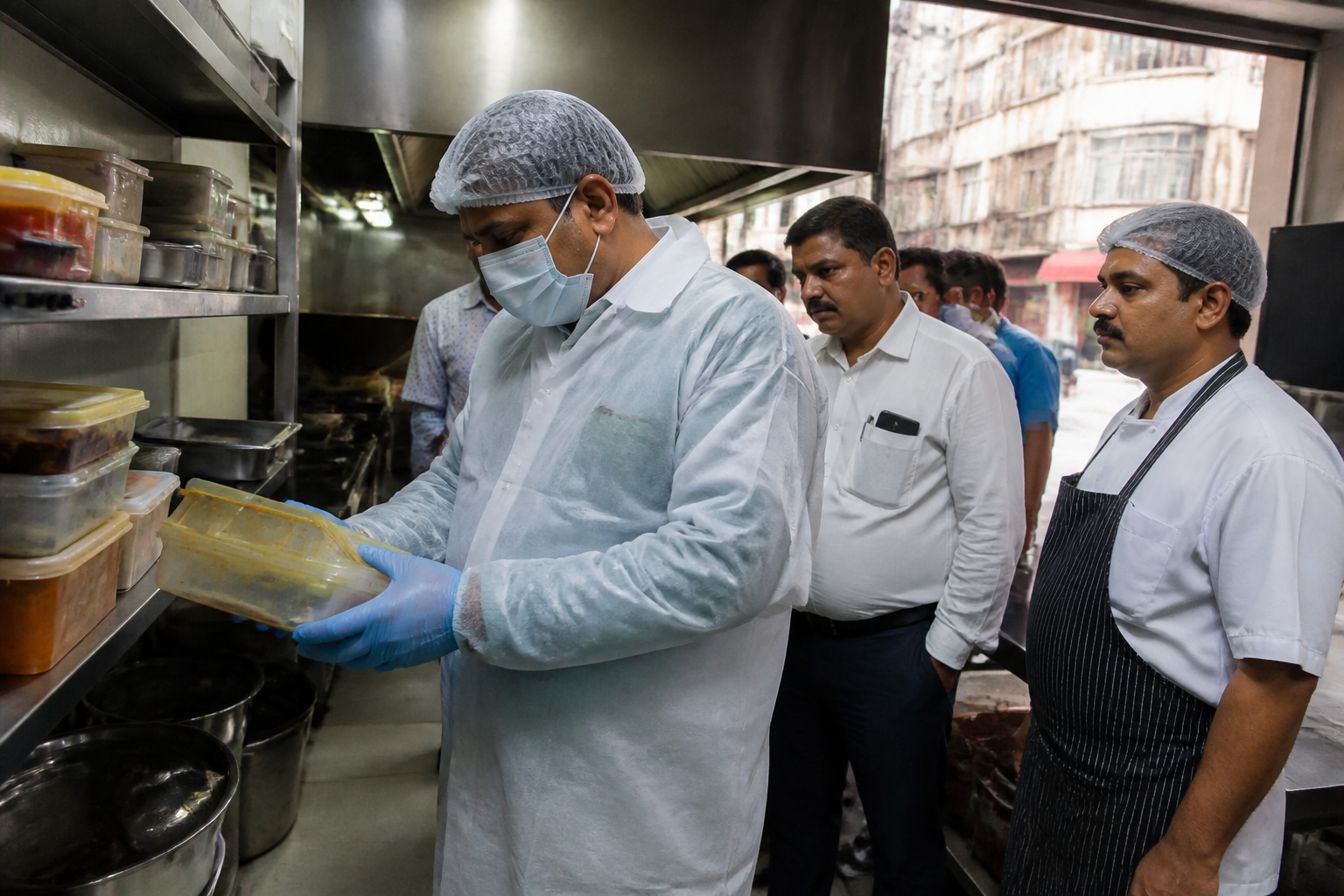
Mumbai’s food safety crackdown has moved beyond the familiar image of roadside eateries and into the city’s iconic cafes, clubs, restaurant chains and institutional kitchens. The Maharashtra Food and Drug Administration’s recent action against Cafe Mondegar, alongside inspections of 38 establishments and the suspension of nine food licences, has made a routine regulatory exercise more visible to the city’s diners. It has also raised a larger question: whether food safety in a large, rapidly eating-out city depends too heavily on periodic enforcement drives rather than consistent compliance throughout the year.
The immediate trigger was the FDA’s Ganeshotsav food-safety drive. According to the Times of India report, FDA teams inspected 38 establishments across Mumbai between September 11 and 14 and collected 47 food samples. Nine establishments had their licences suspended for violations. Cafe Mondegar, the 94-year-old Colaba landmark, was among the establishments facing action after officials identified food safety, hygiene and structural deficiencies during an inspection on September 12.
The significance of the action lies partly in the range of establishments named in the wider crackdown. The reported timeline includes iconic eateries such as K. Rustom & Co. and Parsi Dairy Farm, restaurants and bakeries, clubs and gymkhanas, branded outlets, cloud or delivery-linked kitchens and food businesses associated with Blinkit, Instamart and Zepto. The FDA also acted against facilities connected to the Mumbai Cricket Association and several prominent clubs. This spread complicates the assumption that food safety risks are concentrated in informal or visibly low-cost food businesses.
That distinction matters in Mumbai because eating out is not limited to a single type of neighbourhood or establishment. Residents use cafes, workplace canteens, clubs, bakeries, restaurants and delivery platforms as part of everyday urban life. The report records concerns from diners in Santacruz, Powai, Parel and Matunga, including parents who said they were more cautious when eating out with children. Their responses show how regulatory action travels beyond the inspected premises: it changes how consumers assess the safety of food they cannot see being prepared.
The city’s regulatory challenge is therefore not only to identify violations but also to make compliance legible to the public. Diners generally cannot inspect storage temperatures, kitchen surfaces, oil quality, food handling practices or licence records while placing an order. They rely on reputation, appearance, brand familiarity and, increasingly, delivery-platform visibility. None of those signals necessarily provides a complete picture of what happens inside a kitchen.
The reported violations underline that gap between public image and back-end operations. At Poornima Restaurant, inspectors reportedly found fungal growth on stored vegetables and bananas. The report also lists cases involving prominent clubs and well-known brands, without suggesting that popularity or institutional status guarantees compliance. For consumers, this is the uncomfortable part of the enforcement story: a familiar name can reduce perceived risk, but it cannot substitute for inspection and documented adherence to food-safety requirements.
The action also illustrates how enforcement can produce changes before a case reaches its final administrative outcome. One Mumbai eatery told the Times of India that it had stopped using artificial colour in its sweet chutney, stopped reusing frying oil and strengthened staff hygiene measures after FDA action. These changes are significant not because they prove that every business will respond in the same way, but because they show the practical reach of inspection. A regulatory notice can alter procurement, preparation and staff practices inside a kitchen that customers rarely see.
At the same time, suspension of a food licence is only one stage in the regulatory process. The supplied report does not establish how long each suspension will remain in force, whether all establishments will comply with corrective directions, or how follow-up inspections will be conducted. It also does not provide a complete breakdown of the alleged deficiencies at every establishment named in the timeline. That limits what can be concluded about the relative seriousness of individual cases.
What can be established is the scale and continuity of the reported enforcement campaign. The timeline begins with action announced on June 30 against establishments including Flint & Waarsa at NCPA, M. K. Bakery, Hotel Shrikrishna, Hotel Gopal Krishna, Karak Enterprises and Madras Diaries. Further action was reported in July against K. Rustom & Co., Shalimar Hospitality, Noor Mohammadi Hotel, Rehmania Restaurant, Parsi Dairy Farm and Poornima Restaurant. Later in July, licences or registration certificates of several clubs were suspended.
The reported August actions extended the campaign to Domino’s outlets in Vile Parle West, Borivali West and R-City Mall, as well as food outlets linked to quick-commerce platforms and several restaurants, clubs and bakeries. The FDA also acted against establishments including the Bombay Presidency Radio Club, McDonald’s Metro House, Khar Gymkhana and the Mumbai Cricket Association’s BKC facility. The sequence suggests that the September inspections were not an isolated intervention but part of a wider enforcement cycle that has continued across different types of food businesses.
This is where the institutional question becomes more important than the reputation of any one outlet. Food safety regulation in a city is difficult to observe because responsibility is distributed across inspectors, licensed businesses, kitchen managers, food handlers, suppliers and consumers. A licence creates a formal compliance relationship, but it does not make the regulatory system permanently visible. Inspections, sampling, notices, suspensions and follow-up action are the mechanisms through which that relationship becomes operational.
The numbers in the latest drive also show the difference between inspection activity and the wider universe of food businesses. Forty-seven samples were collected from 38 establishments, and nine licences were suspended. Those figures demonstrate enforcement activity, but by themselves they do not show the overall compliance rate across Mumbai or whether violations are concentrated in a particular business category. The supplied report does not provide the total number of licensed establishments, the selection criteria for inspections, the results of the food samples or the number of establishments that have since resumed operations.
That missing information is important for public understanding. Consumers need to know not only which establishments faced action but also what standards were breached, what corrective steps were ordered and whether those steps were verified. Businesses, meanwhile, need predictable and transparent enforcement so that compliance is not treated as a seasonal response to a festival drive. The report records FDA Commissioner Tukaram Mundhe advising consumers not to stop eating out, but to be more mindful by checking cleanliness and sanitation and ensuring that establishments are properly registered and licensed.
That advice places part of the monitoring burden on diners, although consumers can only assess what is visible to them. Clean dining areas may indicate attention to hygiene, but they do not reveal every condition in a kitchen or storage area. Registration and licensing checks can provide a basic safeguard, but they do not replace inspection. The regulatory system’s purpose is precisely to examine conditions that ordinary customers cannot verify for themselves.
The Mumbai crackdown therefore exposes a tension at the centre of urban consumption. The city’s food economy depends on convenience, speed, established brands and dense networks of restaurants and delivery kitchens. Its safety depends on routine administrative oversight that is often invisible until a popular establishment is named in an enforcement action. When the FDA acts against recognisable institutions, it may strengthen accountability, but it can also reveal how little information consumers ordinarily have about compliance.
The evidence supplied in the report confirms a broad enforcement campaign and a measurable response from businesses and diners. It does not establish that Mumbai’s food system as a whole is unsafe, nor does it show how the inspected establishments compare with the wider market. The next important indicators will be the FDA’s follow-up action, the status of suspended licences, the findings from collected samples and whether establishments demonstrate sustained compliance after the immediate crackdown ends.
