


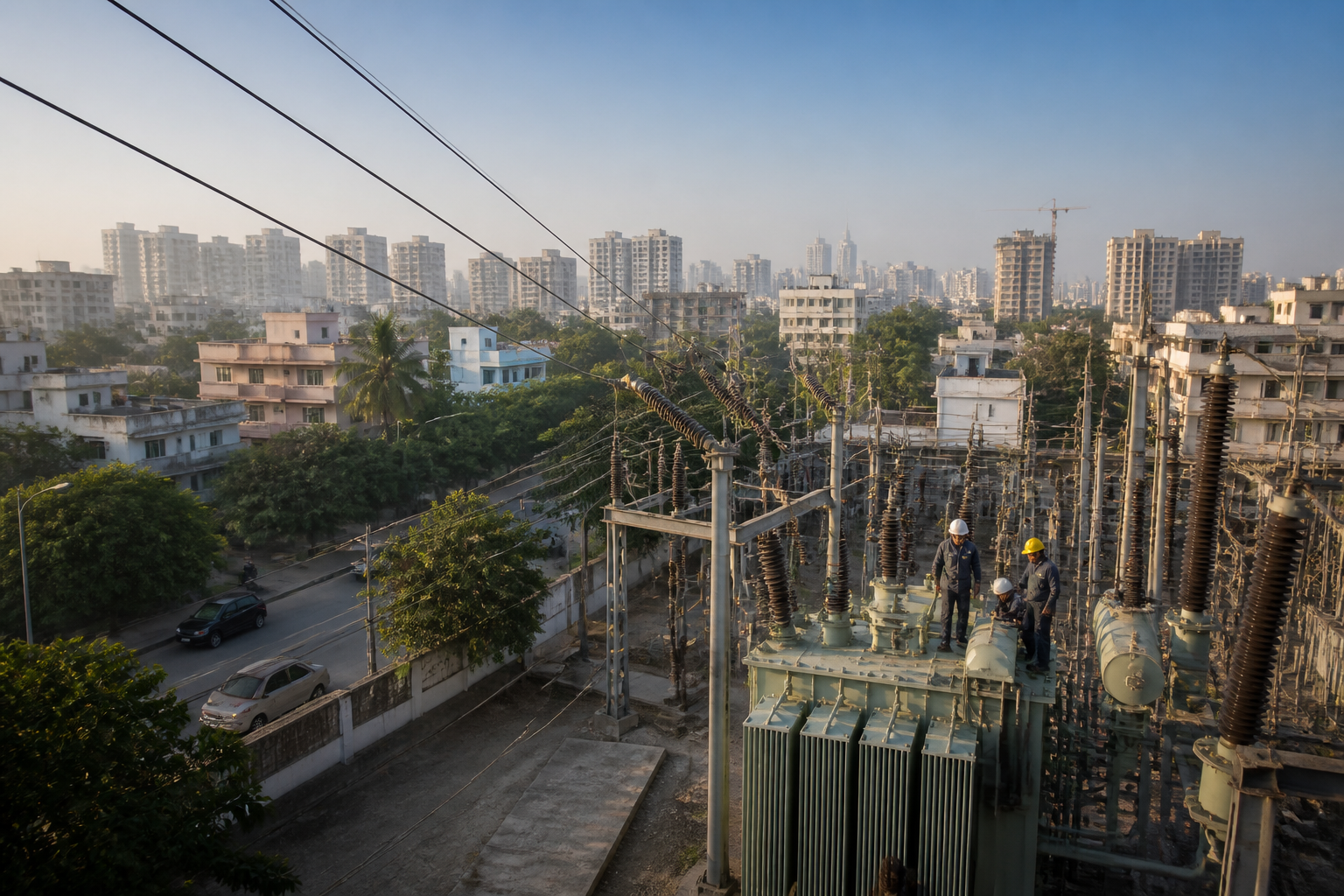
BESCOM’s return to profit after seven years is an important shift in the finances of Bengaluru’s electricity distribution system, but the reported ₹293.62-crore profit for 2025-26 does not erase the utility’s larger financial problem. The company still carries an accumulated loss of about ₹13,000 crore, making the latest result less a clean turnaround than an early test of whether operational improvements can be sustained over time.
The figures, reported by Vijay Karnataka, show the difficult arithmetic facing a major urban electricity distributor. BESCOM supplies power to eight districts, serves more than 20 million consumers and accounts for about half of Karnataka’s electricity demand and financial transactions among the state’s five distribution companies. Its financial performance therefore affects far more than the balance sheet of one utility. It influences the reliability, cost and administrative sustainability of electricity supply across a large and economically important urban region.
BESCOM recorded a profit of ₹568.29 crore in 2017-18, according to the report, before entering seven consecutive years of losses. During that period, the utility faced a combination of debt, high power purchase costs and weaknesses in operational efficiency. The report also says that BESCOM received a C grade and ranked 51st among 54 distribution companies in the 14th annual integrated ratings report released by the Union Ministry of Power.
That history matters because electricity distribution is not simply a billing business. A distribution company must buy power, transmit it through its network, measure consumption, collect revenue, pay suppliers and manage the gap between approved tariffs and actual costs. Failure at any point can weaken the entire financial chain. A utility may supply electricity to a growing city while simultaneously accumulating losses if the cost of procurement, network operation, financing and subsidies is not matched by revenue.
The reported improvement came from several parts of that chain moving in the same direction. The most important factor was a reduction in power purchase costs. The report says power purchase accounts for about 80 per cent of BESCOM’s total expenditure, making procurement the central determinant of its financial position. Lower procurement costs can therefore produce a substantial improvement even without a comparable increase in consumer demand.
BESCOM reportedly reduced its dependence on higher-cost thermal power and increased its allocation of hydropower, renewable energy and long-term contracts. The source describes these arrangements as lower-cost options that helped reduce the utility’s overall purchase expenditure. The report does not provide the absolute reduction in procurement costs or a detailed year-by-year breakdown, so the precise contribution of each source cannot be established from the supplied material. It does, however, identify power procurement as the main area in which the utility improved its cost structure.
The result also reflects the role of the Karnataka Electricity Regulatory Commission. According to the report, tariff revision orders, approved fuel and power purchase adjustment charges, and regular tariff collection contributed to higher revenue. These mechanisms are significant because distribution companies operate within a regulated framework. Their ability to recover costs is shaped not only by internal efficiency but also by regulatory decisions on tariffs and adjustment charges.
This regulatory structure becomes especially important in the context of Gruha Jyothi, the household electricity scheme mentioned in the report. The source describes the scheme as a challenge for BESCOM while noting that the company still recorded a profit. It does not provide the scheme’s financial impact on BESCOM or explain the precise compensation mechanism involved. What the reported result establishes is narrower: BESCOM’s financial performance improved despite operating in an environment where household electricity policy created an additional challenge for the utility.
BESCOM’s consumer base also shows why its financial management has a direct urban consequence. The utility has about 9.83 lakh agricultural pump-set connections, 1.78 lakh industrial connections and 91.47 lakh domestic connections, according to the report. These categories carry different demand patterns and revenue implications. A large domestic base links the utility closely to household affordability and service expectations, while industrial consumers connect electricity distribution to production and employment. Agricultural connections add another layer of policy and subsidy complexity.
The second major improvement was in distribution losses. BESCOM’s losses had earlier exceeded 11 per cent, but the report says technical improvements over two consecutive years brought them down to 9.13 per cent. In a distribution network, lower losses mean that a greater share of purchased electricity can be accounted for through billed consumption. Even a reduction measured in percentage points can have a meaningful financial effect when applied across a system supplying power to more than 20 million consumers.
The report also points to changes in billing and revenue collection. BESCOM introduced probe devices to transfer data from spot billing devices, or SBDs, during the billing process. The stated purpose was to prevent leakage in revenue collection. This is an example of how relatively narrow administrative and technological interventions can affect the finances of a large utility: better data transfer can improve the connection between electricity consumed, bills issued and money collected.
Debt management provided another source of savings. The report says that BESCOM shifted older loans to lower interest rates, reducing its interest burden by between 1.5 and 2 per cent and saving hundreds of crores. It also used early payment discounts offered by electricity suppliers. Vendors reportedly gave a 4 per cent discount when invoices were paid on the day of submission, allowing BESCOM to save about ₹100 crore through faster payments.
These measures point to a broader institutional lesson. A utility’s financial health is determined not only by the tariff charged to consumers but also by procurement strategy, loss reduction, debt refinancing, payment discipline and collection systems. BESCOM’s reported profit appears to have resulted from a combination of these measures rather than from a single intervention. The improvement is therefore operational as well as regulatory.
At the same time, the accumulated loss of about ₹13,000 crore changes how the result should be interpreted. A profit is a measurement of performance during one financial year. An accumulated loss records the financial burden built up over several years. The two figures can exist together: BESCOM can generate a positive result in 2025-26 while still carrying a large historical deficit on its balance sheet.
The scale of that deficit also places limits on what one profitable year can achieve. The report cites an assessment that even if BESCOM earns ₹1,000 crore annually, it could take more than a decade to recover from the accumulated loss. That calculation is presented as a long-term indication rather than a formal repayment schedule. It also does not account for future changes in procurement costs, tariffs, demand, subsidy arrangements, financing costs or network requirements.
For Bengaluru and the districts served by BESCOM, the central question is therefore whether the reported improvements can become a stable operating pattern. The supplied report confirms progress in procurement costs, distribution losses, debt servicing, supplier payments and revenue collection. It does not establish whether these gains will continue across future financial years or how the accumulated loss will be addressed in detail.
BESCOM’s result is best understood as a sign of financial recovery, not financial resolution. The utility has moved from a prolonged period of losses to a reported ₹293.62-crore profit, but its underlying balance sheet remains burdened by approximately ₹13,000 crore in accumulated losses. The next milestones will be whether lower procurement costs, reduced distribution losses and improved collections are sustained, and how the company reports progress in reducing its historical deficit.
