


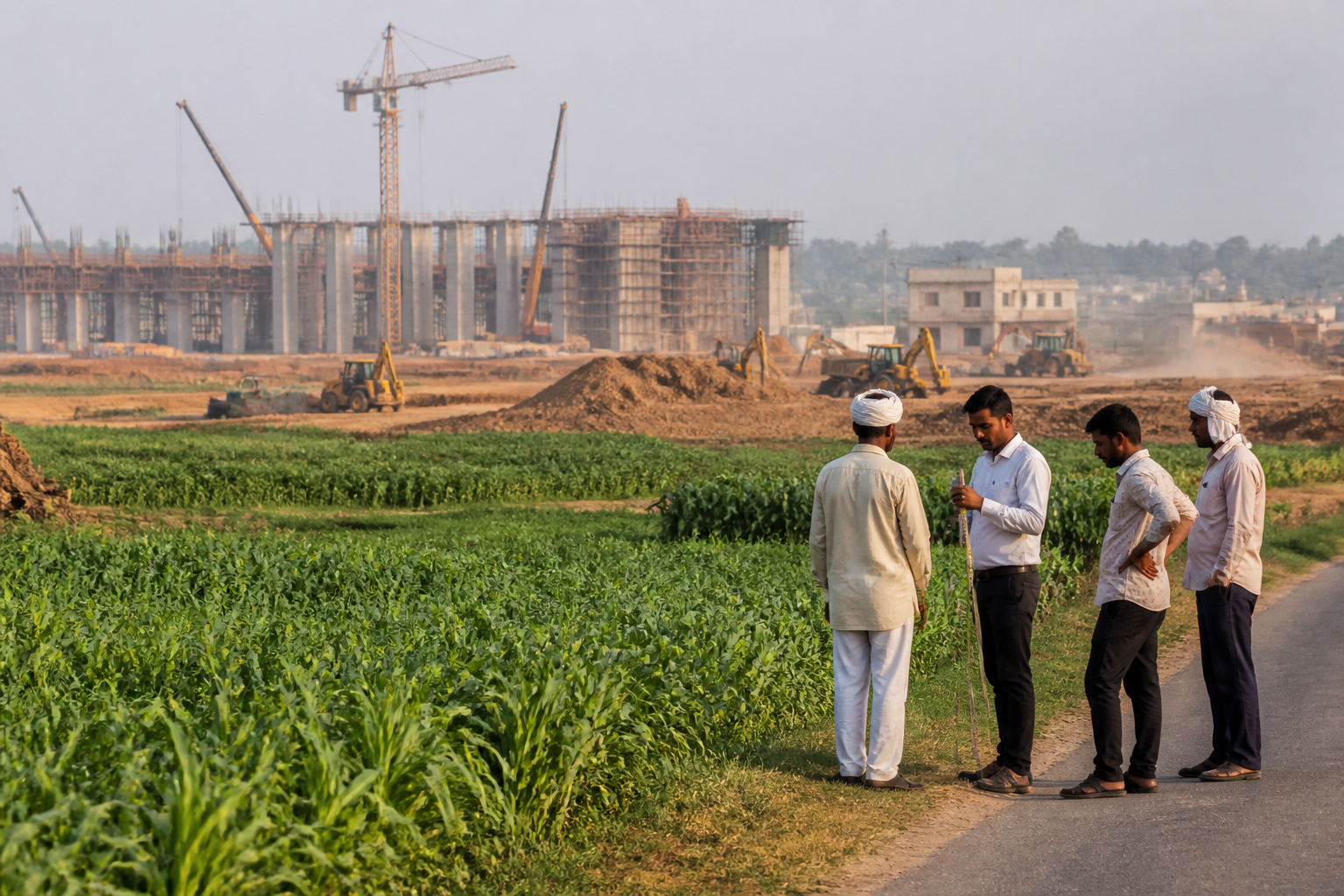
Jewar land prices have risen three to five times since the Noida International Airport began reshaping the area, creating a difficult choice for farmers whose land was acquired for the project: accept a shift away from cultivation or spend far more of their compensation to buy agricultural land elsewhere. The change shows how infrastructure-led growth can alter not only the value of land, but also the economic options available to the people who previously worked it.
A report by Navbharat Times – Noida says land prices around Jewar have risen sharply as the airport and associated development projects have increased demand. Farmers whose land was acquired and who want to continue farming are finding that the compensation received for their original holdings no longer allows them to purchase an equivalent agricultural area in or around Jewar.
The report describes this as a fundamental change in the local land market. Land that remains outside planned development areas and land not acquired for projects is being offered at substantially higher rates, particularly near populated areas. As a result, compensation that might once have supported the purchase of replacement farmland now has to compete with an investment market driven by airport-linked industrial, residential, commercial and logistics activity.
The central tension is between the purpose of compensation and the behaviour of the land market. Compensation is intended to address the loss of land and livelihood associated with acquisition. But when the project itself increases surrounding land values, the amount needed to restore the earlier livelihood can rise faster than the value received by the affected household. In that situation, a farmer may receive payment for land that has been acquired while losing the practical ability to buy comparable land for cultivation.
The figures cited in the report illustrate the scale of this gap. During the third phase of airport-related acquisition, and alongside land purchases being undertaken with farmers’ consent for projects linked to the Yamuna Expressway Industrial Development Authority, prices are being settled at between Rs 33 lakh and Rs 41 lakh per bigha. At the same time, land outside planned development and acquisition areas is reportedly being demanded at between Rs 1.25 crore and Rs 1.5 crore per bigha.
These are not simply different price points within one market. They reflect the way planning status, access and development expectations divide land into sharply unequal categories. Land being purchased for planned industrial, commercial, residential and logistics projects has one value in negotiated transactions. Land that remains available for private purchase, especially near populated areas or roads, can command a much higher market price because buyers expect it to benefit from the wider transformation around the airport.
For an affected farmer, that difference has a direct livelihood consequence. The farmer may want to use compensation to acquire replacement agricultural land, but the most accessible or strategically located parcels are also the ones attracting buyers connected to future development. Once prices reach the reported levels, buying the same area of farmland may require substantially more capital than the compensation provides. The result is not necessarily an immediate loss of money; it is a loss of choice.
The pressure is also spreading beyond Jewar. According to the report, some farmers have looked towards Bulandshahr, Aligarh and Mathura for agricultural land. But those markets are not insulated from the wider increase in demand. Agricultural land in these districts is reported to cost between Rs 15 lakh and Rs 25 lakh per bigha, while land close to roads and populated areas can cost between Rs 30 lakh and Rs 50 lakh per bigha.
The comparison requires care because a bigha does not represent the same area across the districts mentioned. In Jewar, one bigha is described as approximately 843 square metres. The corresponding area is about 767 square metres in Aligarh and 632 square metres in most parts of Bulandshahr. Even with these differences, the reported price ranges show that moving out of Jewar does not automatically restore the ability to buy an equivalent agricultural holding.
This makes land measurement an important part of the compensation question. A comparison based only on the number of bighas can obscure the actual area available to a farmer. The price of a unit of land, the size of that unit, its access to roads and settlements, and its potential exposure to future development all affect whether replacement land can support the same livelihood. The report’s district-wise measurements underline why compensation assessments and resettlement planning cannot treat land as a uniform commodity.
The airport is therefore functioning as more than a transport project. It is also a powerful land-market trigger. The report links the price increase to the airport, its third phase of acquisition and the projects planned around the Yamuna Expressway. These include industrial, commercial, residential and logistics uses. Each category can create demand for land, workers, services and access, while also changing expectations about what presently agricultural land may be worth in the future.
That change in expectations can make agricultural continuity increasingly difficult even where farmland has not been acquired. Owners of remaining parcels may prefer to sell at elevated prices, while farmers seeking land for cultivation face competition from buyers with different objectives. The report specifically notes stronger demand for land near populated areas, where connectivity and development potential make parcels more valuable than their current agricultural use alone might suggest.
The institutional landscape is consequently wider than the airport authority or the land-acquiring agency. The account refers to the Yamuna Expressway Industrial Development Authority’s land purchases for multiple development purposes, as well as the airport’s third-phase acquisition. The experience of affected farmers depends on how acquisition compensation, negotiated purchases, land-use planning and future development are coordinated across these processes.
The available report does not provide the individual compensation amounts received by farmers, the valuation method used for each parcel, or the terms attached to rehabilitation and resettlement. It also does not establish how many affected farmers have abandoned agriculture, how many have moved to neighbouring districts, or whether alternative livelihood programmes have reached them. Those gaps matter because rising land prices alone cannot measure the full effect on household income, debt, employment or land ownership.
The report does, however, identify a clear structural risk. If compensation is calculated for the land acquired but not adjusted to the cost of securing a viable agricultural future, acquisition can produce a permanent occupational transition. Farmers may be pushed towards other forms of employment or towards cities not because they have chosen to leave agriculture, but because replacement land has become unaffordable.
That distinction is important for understanding infrastructure-led urbanisation. A project can create regional economic activity while simultaneously reducing the ability of displaced landowners to continue their previous work. The gains associated with an airport may therefore be distributed through new construction, logistics, property and services, while the costs are concentrated among households whose productive asset was land.
Jewar’s experience also shows why a land acquisition process cannot be evaluated only at the point when possession is taken or compensation is paid. The surrounding market may change after the project is announced and before later phases are completed. The value of replacement land may rise during that period, especially when industrial, residential and logistics projects are announced around the main infrastructure. The practical adequacy of compensation must therefore be understood against the changing geography of land demand.
What remains established from the report is that Jewar land prices have increased sharply, that reported rates differ substantially between project-linked purchases and privately demanded land, and that farmers seeking to remain in agriculture are finding replacement land difficult to secure. What is not established is the scale of the affected population, the adequacy of individual compensation packages, and the formal response of the relevant authorities.
The next important evidence will come from the implementation of further acquisition and development phases, the terms of negotiated land purchases and the livelihood outcomes of farmers who have already received compensation. For Jewar, the larger urban question is whether airport-led growth can expand regional opportunity without making the original land-based livelihoods of displaced households impossible to rebuild.
