


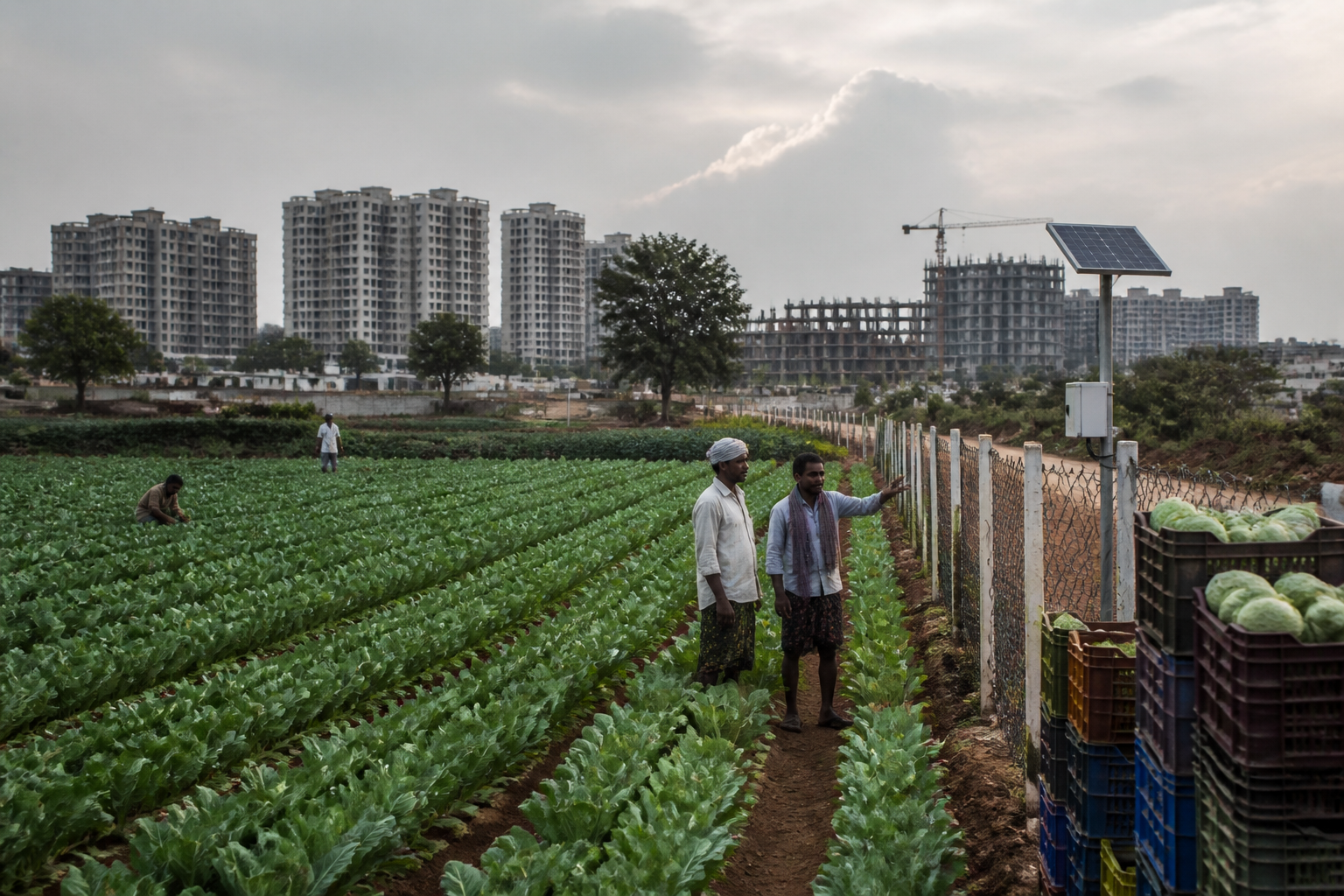
The Telangana Assembly discussion on crop diversification has revealed a problem that extends beyond farm policy: the weakening of the state’s peri-urban agricultural system. Congress MLAs said vegetable cultivation is declining, farmers lack adequate market and storage support, monkey attacks are damaging crops and oil palm growers face a shortage of saplings. Together, the concerns show how land-use change, farm economics and missing infrastructure are converging around Telangana’s expanding towns and cities.
During Question Hour, Achampet MLA C Vamshi Krishna said very few farmers were taking up crop diversification across the state. He linked the decline in vegetable cultivation mainly to the growth of real estate activity in peri-urban areas. His remarks place agricultural change within a wider land-use transition, in which areas near expanding urban settlements are increasingly exposed to development pressures.
The source report does not establish how much agricultural land has been converted, identify the districts most affected or quantify the decline in vegetable cultivation. It does, however, record a direct legislative concern that real estate activity is influencing farming choices and land use. That distinction matters. The issue raised in the Assembly is not simply whether farmers have been trained to grow more crops; it is whether cultivation remains financially and physically viable near growing urban markets.
Vamshi Krishna sought a committee to create awareness among farmers and conduct training sessions on crop diversification. He also said the National Bank for Agriculture and Rural Development was extending support for the activity and urged the government to provide subsidies to farmers cultivating vegetables. These demands point to two separate gaps: knowledge and incentives. Training may address what farmers can grow, but subsidies and dependable market support affect whether they can sustain that choice.
The absence of a Minimum Support Price for vegetables and horticultural crops was identified as another deterrent. “Due to the lack of Minimum Support Price, many farmers are not keen on cultivating vegetables and horticultural crops,” Vamshi Krishna said. The statement highlights a mismatch between the importance of vegetables in urban food consumption and the safeguards available to producers. Farmers may be close to cities and their markets, but proximity alone does not guarantee stable returns.
Perishable crops also expose the limits of a food system built around production without adequate post-harvest infrastructure. Congress MLA Gandra Satyanarayana said the state needed more cold storage units so farmers could safeguard their stocks. The Assembly discussion did not provide a number for existing facilities, a target for new units or details of their proposed locations. It nevertheless identifies storage as a critical link between cultivation and sale.
For vegetables and horticultural produce, the absence or insufficiency of cold storage can narrow the time available for farmers to find buyers. When crops cannot be safely held, producers have less flexibility in responding to market conditions. The supplied report does not quantify losses or establish how frequently farmers are forced to sell immediately. But the demand for cold storage indicates that the concern is not limited to production; it includes the infrastructure needed to move food through the supply chain.
This is where the farm question becomes an urban question. Cities depend on regular supplies of fresh produce, yet the land and infrastructure supporting that supply often sit outside municipal boundaries. Peri-urban farmland can be treated as developable land, while cold storage, aggregation and market systems may remain fragmented across departments and jurisdictions. The Assembly discussion brings those connections into view without providing evidence of a coordinated peri-urban framework.
The concerns raised by the MLAs also show that crop diversification is not a single policy intervention. A farmer deciding whether to cultivate vegetables, horticultural crops, maize or oil palm must contend with different risks, input requirements, market arrangements and physical threats. The discussion covered all of these dimensions: the absence of a price assurance mechanism, a shortage of storage, damage caused by monkeys and a lack of oil palm saplings.
K Jayaveer Reddy, the MLA from Nagarjunasagar, said sweet lime farmers in his constituency were shifting to oil palm cultivation. He also said oil palm saplings were in short supply and urged the government to address the problem. The report does not state how many farmers have changed crops, whether the shift is temporary or permanent, or whether oil palm is being promoted through a specific government programme. What it does show is that diversification is shaped by the availability of planting material as much as by official advice.
The choice to move from sweet lime to oil palm also raises an institutional question about how crop transitions are managed. If farmers are encouraged to adopt an alternative crop but cannot obtain sufficient saplings, the policy signal and the delivery system are out of alignment. The supplied material does not identify the agency responsible for the shortage or provide a timeline for resolving it. Those details will be important in assessing whether the problem is one of procurement, distribution or supply capacity.
Crop protection emerged as another obstacle. Jayaveer Reddy said monkey attacks were forcing farmers to avoid vegetable and horticultural cultivation and were significantly affecting maize farmers. He added that residents of Nandikonda Municipality were facing severe hardships because of monkeys. His demand was for subsidies to help vegetable and horticultural farmers install solar fencing.
The reference to Nandikonda Municipality is significant because it places the conflict across the rural-urban boundary. The same wildlife-related problem is described as affecting agricultural production and municipal residents. The report does not establish the cause of the monkey menace, the scale of crop damage or whether solar fencing has been tested locally. It does establish that the issue is being experienced both as a livelihood problem for farmers and as a public hardship for residents.
This combination complicates the usual division of administrative responsibility. Farmer subsidies, horticulture support, crop protection, municipal complaints and land-use change may involve different government departments and local institutions. The Assembly discussion recorded demands directed at the government, but it did not specify a joint mechanism for handling them. Without such coordination, individual measures may address symptoms separately while leaving the connected system unchanged.
The proposed solutions therefore cover several policy instruments: awareness committees and training, subsidies for vegetable and horticultural farmers, cold storage units, solar fencing and improved access to oil palm saplings. These are not interchangeable interventions. Training addresses capability; subsidies address cost; storage addresses timing and market access; fencing addresses crop protection; and sapling availability addresses the feasibility of a crop transition.
The evidence supplied does not show which of these measures the Telangana government has accepted, funded or scheduled. It also does not provide budget figures, implementation deadlines, district-wise targets or monitoring arrangements. Those omissions prevent a firm assessment of how far the Assembly discussion will translate into policy. For now, the significance lies in the range of constraints identified by legislators from different constituencies.
The discussion also challenges a narrow understanding of crop diversification. Diversification is often presented as a way to reduce dependence on a limited number of crops. In the Telangana debate, however, it is tied to land conversion, price risk, post-harvest infrastructure, animal-related crop damage and access to planting material. A farmer may be willing to diversify but still avoid doing so if the expected return is uncertain, produce cannot be stored, crops cannot be protected or the required saplings are unavailable.
For urban policymakers, the main lesson is that food resilience cannot be separated from the management of the peri-urban edge. The source report does not claim that Telangana faces a food shortage, nor does it provide data on urban supply or consumer prices. It does show that legislators see declining vegetable cultivation and expanding real estate activity as linked developments. That makes land-use planning relevant to agricultural policy, even though the Assembly discussion did not outline a specific planning instrument.
The next question is whether the government will respond through isolated schemes or a coordinated programme connecting land, markets, storage and farm protection. The immediate evidence is limited to the demands raised during Question Hour. It confirms a set of pressures but not the scale of each pressure, the government’s response or the implementation pathway.
What the Assembly discussion makes clear is that Telangana’s crop diversification challenge is not only about persuading farmers to grow different crops. It is also about whether the surrounding urban system preserves agricultural land, supports viable prices, provides storage, protects fields and delivers the inputs needed for transition. The government’s follow-up on the proposed committee, subsidies, cold storage, solar fencing and oil palm saplings will determine whether these concerns remain legislative warnings or become an integrated policy response.
