


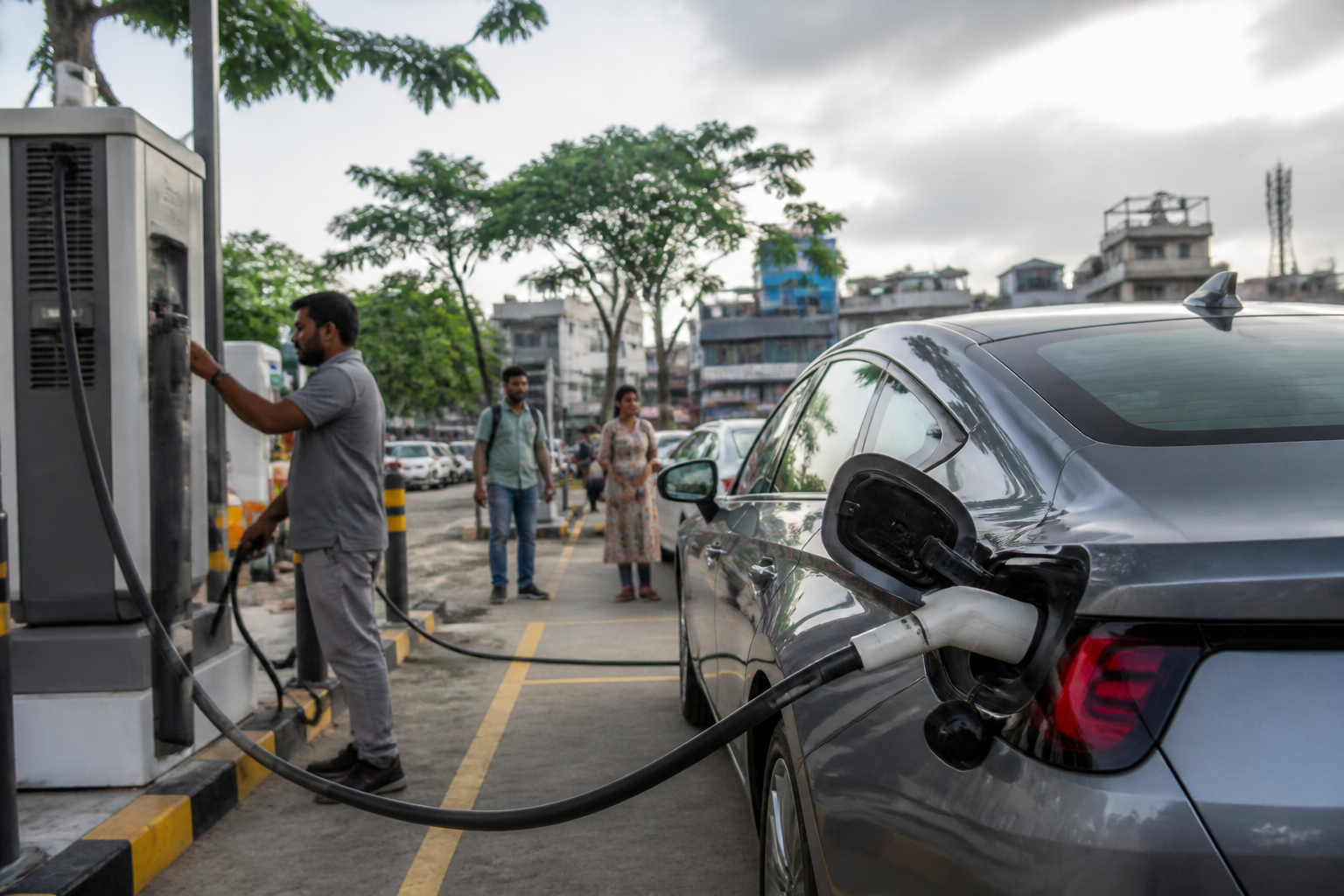
India’s electric vehicle transition is entering a more demanding phase. As EVs move beyond major cities and early adopters, the question is no longer only whether buyers can afford an electric vehicle. It is whether the wider urban and regional mobility system can support one after it leaves the showroom.
That system includes roadside assistance, charging infrastructure and trained service personnel. These are often treated as supporting services, but they increasingly determine whether an EV feels practical for daily use, intercity travel and ownership outside India’s largest urban markets.
The issue is particularly important because EV adoption changes the relationship between the vehicle and the infrastructure around it. A petrol or diesel vehicle can usually rely on a long-established network of fuel stations, mechanics and roadside assistance providers. Electric vehicles require a different combination of hardware, skills, operating standards and digital information.
The evidence cited in the report points to an ecosystem that is expanding but is not yet uniformly dependable. The Ministry of Heavy Industries said in December 2025 that India had 29,151 public EV charging stations. By July 2026, that number had increased to 52,718, including 16,561 fast chargers for cars. The government has also allocated Rs 2,000 crore under the PM E-DRIVE scheme for public charging infrastructure.
Those numbers show a substantial increase in charging capacity. They do not, by themselves, establish whether every charger is operational, conveniently located or suitable for every vehicle. For users, the value of a charging point depends on more than its presence on a government list. It must be available when required, compatible with the vehicle, easy to locate and positioned along routes that people actually use.
This distinction between infrastructure provision and infrastructure reliability is central to the EV transition. A growing network can reduce range anxiety only when drivers can plan around it with reasonable confidence. If a charger is unavailable, difficult to access or located too far from the route, the nominal expansion of the network may not translate into an equivalent improvement in the ownership experience.
The challenge becomes more visible as electric mobility spreads beyond large cities. In metropolitan areas, an EV owner may have access to multiple charging options, authorised service centres and technology platforms that can help locate assistance. In smaller towns and on less familiar routes, the same owner may face fewer alternatives if the vehicle runs low on charge or develops a technical problem.
Varun R, chief marketing officer at ReadyAssist, identified roadside assistance as one of the factors shaping long-term confidence in EV ownership. The company’s position, as reported by NDTV, is that consumers need to know assistance will be available when they travel across unfamiliar routes or into smaller towns.
The comparison with conventional vehicles is instructive. The roadside assistance ecosystem for internal-combustion vehicles has developed over several decades around familiar mechanical failures, widely available replacement parts and a large pool of technicians. EVs do not simply require the same network with a different vehicle category added to it. They require technicians and service providers who understand electric drivetrains, batteries, diagnostics and safety procedures.
For a user, the difference is practical. A breakdown is not only a question of whether a vehicle can be moved. It is also a question of whether the person responding understands the risks associated with high-voltage systems, whether the vehicle can be safely transported and whether the owner can access a competent service facility afterwards. The report says technology platforms, technicians and other industry players are building capabilities specifically for EVs, but it does not establish how widely those capabilities are currently distributed.
This creates a geographic dimension to EV adoption. The same vehicle may be relatively easy to own in a major city and significantly more difficult to operate in a Tier 2 or Tier 3 city. That difference is not necessarily caused by the vehicle itself. It can result from uneven access to chargers, trained personnel and emergency support.
Service capability is therefore the third major component of the transition. Electric vehicles have fewer conventional mechanical systems, but that does not mean they require no specialised maintenance. Technicians need knowledge of batteries, electric drivetrains, electronic diagnostics and safety procedures. Service centres also need the equipment and processes to handle these systems appropriately.
A shortage of trained technicians could affect both buyers and manufacturers. For customers, a minor technical issue may become more expensive or time-consuming if the nearest capable service centre is far away. For manufacturers and service providers, building an effective network requires investment in training, equipment, spare parts logistics and standardised procedures.
This is where the affordability debate becomes more complex. The purchase price and running cost of an EV are visible to a buyer at the point of sale. The cost of uncertainty is less visible. It may arise when a driver is unable to find a working charger, when assistance is unavailable outside a major city or when a specialised repair requires travel to another location.
The report does not provide a national estimate of these costs or measure the current response time of EV roadside assistance networks. It also does not compare charger uptime across states or cities. Those gaps matter because the headline number of charging stations cannot fully describe the quality of the system that users experience.
The government’s allocation of Rs 2,000 crore under PM E-DRIVE indicates that public policy is supporting the expansion of charging infrastructure. However, the responsibility for making EV ownership functional is distributed across several actors. Government agencies influence funding and infrastructure deployment. Charging operators manage availability and maintenance. Vehicle manufacturers shape service and warranty networks. Technology platforms connect users to chargers and assistance. Training institutions and service providers determine whether the workforce can support the new technology.
This institutional structure means that EV adoption is not controlled by a single policy lever. Incentives may reduce the upfront price, while improved battery technology may increase range. Neither automatically resolves the problems of service access or unreliable charging. Mass adoption requires these parts of the system to develop together.
The charging data illustrates both progress and the limits of measuring progress through expansion alone. Public charging stations increased from 29,151 in December 2025 to 52,718 by July 2026, according to figures cited from the Ministry of Heavy Industries. That is an increase of 23,567 stations in the period described in the report. Fast chargers for cars accounted for 16,561 of the July 2026 total.
The figures establish that India’s public charging network is growing rapidly. They do not indicate how the stations are distributed geographically, how many are operational at a given time or whether they are concentrated in the country’s largest cities. Without those details, it is difficult to determine how evenly the expansion is improving intercity travel and ownership in smaller urban markets.
The same measurement challenge applies to service coverage. The presence of an EV service centre does not necessarily indicate that it can handle every model, battery issue or diagnostic problem. Similarly, the presence of a technician does not establish the extent of their training or the equipment available to them. The transition therefore requires stronger attention to the quality and reach of support, not only its nominal availability.
For cities, this is also a planning question. Charging infrastructure has to be integrated with the places where people live, work, shop and travel. It may involve public parking areas, commercial locations, highways, housing developments and transport hubs. The report does not specify the current distribution of charging stations, but its emphasis on accessibility highlights the need to connect charging provision with actual travel patterns.
The move into smaller cities could make this question more urgent. Buyers there may have fewer alternative service providers and less tolerance for long delays. If the support network remains concentrated in major urban centres, EV ownership could expand unevenly, reinforcing a divide between cities with mature mobility ecosystems and those still building basic support capacity.
The larger urban question is whether India’s EV transition will be measured only by vehicles sold or also by the reliability of the systems that keep those vehicles moving. Purchase incentives and lower running costs can encourage adoption, but sustained use depends on what happens during an ordinary trip, a long journey or an unexpected breakdown.
The evidence supplied in the report confirms three connected requirements: dependable roadside assistance, charging that is available and usable, and a wider pool of trained EV technicians and service centres. It also shows that charging capacity is expanding, while leaving important questions about uptime, geographic distribution and service quality unanswered. The next stage of India’s electric mobility transition will depend on whether these supporting systems develop at the same pace as vehicle sales and public investment.
