


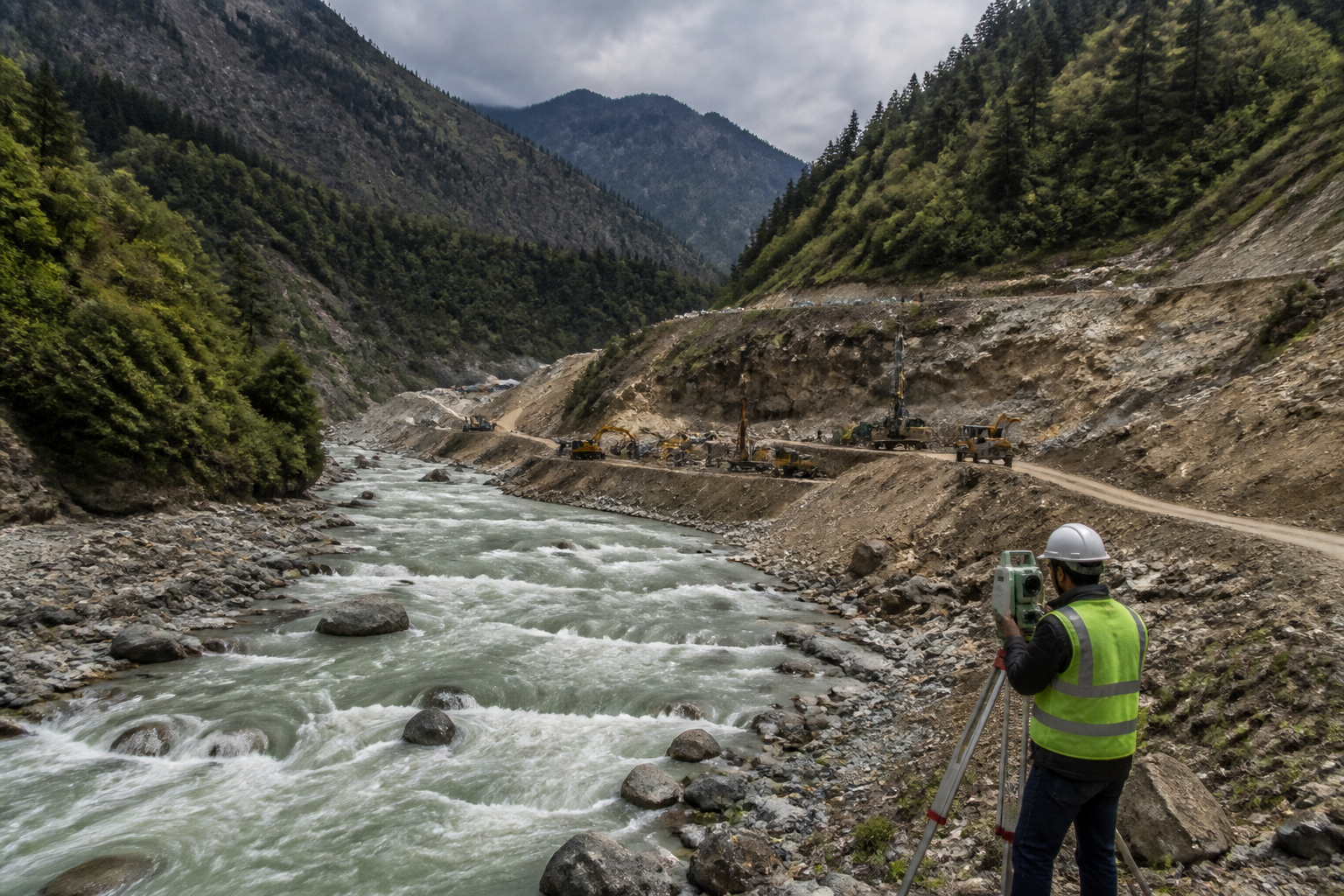
The Kishau Dam project has moved from an 86-year-old proposal to an inter-state agreement, but the signing of the pact is only the beginning of a complicated infrastructure process. The proposed dam on the Tons river is expected to generate 1,457 million units of electricity, irrigate 97,000 hectares and store 1,562 million cubic metres of water. It will also require around 2,500 hectares of forest land, resettlement of affected families and an estimated investment of ₹13,000 crore.
The agreement signed by Uttarakhand, Uttar Pradesh, Himachal Pradesh, Haryana, Rajasthan and Delhi, in the presence of Union Home Minister Amit Shah and Union Jal Shakti Minister C.R. Patil, resolves the political and administrative impasse around the multi-purpose project. The arrangement declares Kishau a national project, with approximately 90% of the financial burden to be borne by the Union government and the remaining 10% by the participating states.
That funding formula changes the project’s political economy. Large inter-state water infrastructure projects often remain stalled not only because of engineering complexity, but also because the states that bear local social and environmental costs may not be the same states that receive the most immediate benefits. In Kishau’s case, the agreement creates a central funding role while distributing benefits across the Yamuna basin. However, it does not remove the administrative tasks that must precede construction, including approval of the final detailed project report, Union Cabinet approval, forest-land transfer and rehabilitation planning.
The Kishau Dam project’s long history explains why the agreement is being presented as a breakthrough. The first proposal for a dam at the site reportedly came from the then Punjab government in 1940. The Uttar Pradesh irrigation department prepared a detailed project report in 1964. A further institutional step came in 2014, when Uttarakhand and Himachal Pradesh entered into an agreement and formed a joint venture. The corporation’s chairmanship is to rotate between the two states, with each chief secretary serving for two and a half years at a time.
The current agreement also follows earlier attempts to settle disputes in the Upper Yamuna basin. Amit Shah said a 12 May 1994 agreement established that individual storage projects in the basin would require separate agreements. The report links the renewed progress on Kishau to the resolution of disputes involving the Lakhwar and Renukaji projects in 2019. This sequence shows that the project was not held back by one isolated disagreement. Its progress depended on a wider basin-level framework in which water-sharing and storage projects had to be negotiated separately.
The proposed structure is substantial. The concrete gravity dam is planned to be 232.6 metres high and 680 metres long. The reservoir is expected to extend for around 32 kilometres and hold 1,562 million cubic metres of water. The project is expected to produce 1,457 million units of electricity, with the power divided between Uttarakhand and Himachal Pradesh. Uttarakhand’s stated share is 728 million units.
These figures place Kishau at the intersection of water storage, electricity generation and agricultural supply. The reported irrigation potential of 97,000 hectares gives the project a significance beyond the dam site and the two hill states where its infrastructure will be located. Uttar Pradesh, Haryana, Rajasthan and Delhi are among the states expected to benefit from the project in some form, according to the statements cited in the report. The project has also been linked by Uttarakhand Chief Minister Pushkar Singh Dhami to improved water availability, drinking water, irrigation, energy and the rejuvenation of the Yamuna.
That broad benefit-sharing narrative is important because the physical burden will be concentrated in Uttarakhand and the adjoining project area. Dhami has said that around 2,500 hectares of forest land will need to be transferred. For a forested and mountainous state, identifying land for compensatory afforestation is a major administrative challenge. The report does not provide the final compensatory-afforestation plan, the number of affected families or the precise area to be submerged. Those details will be central to judging how the project’s costs are distributed.
The rehabilitation question is therefore not a secondary component of the project. The Uttarakhand government has said that identifying land in affected areas and developing a rehabilitation model has begun. Dhami described the proper and respectful rehabilitation of affected families as the state government’s highest priority. The state has also requested ₹1,500 crore from the Union government as a soft loan to accelerate preparatory work.
The cost estimate of ₹13,000 crore includes around ₹2,000 crore for forest-land transfer and rehabilitation, ₹9,000 crore for civil works and approximately ₹1,500 crore for electrical and mechanical works. These figures show that the social and environmental elements are already recognised in the financial structure, but recognition in a cost estimate is not the same as implementation on the ground. The quality, timing and adequacy of rehabilitation will depend on decisions that have yet to be completed.
The project’s proposed completion date of 2035 also underlines the difference between political agreement and physical delivery. Construction is not expected to begin immediately. The final detailed project report still requires approval, followed by Union Cabinet approval. Forest-land transfer and rehabilitation-related matters must also be settled. Each stage creates the possibility of further delay, particularly where technical approval, inter-state coordination, environmental compliance and local rehabilitation overlap.
The institutional design may help address one recurring problem in large basin projects: fragmented responsibility. The Union government will carry most of the financial burden, while six states have formally committed to the project. The Uttarakhand-Himachal joint venture provides a dedicated institutional vehicle for the two states most directly associated with the dam and power generation. Yet the agreement will need to be translated into clear responsibility for land, rehabilitation, construction supervision, cost escalation and benefit allocation.
Kishau also illustrates the changing importance of storage infrastructure in the Yamuna basin. The project is being promoted not as a single-purpose power installation, but as a multi-purpose asset serving electricity, irrigation, drinking water and river-related objectives. That makes its eventual performance dependent on how competing uses are managed. The supplied material establishes the planned capacity and benefits, but it does not establish how water will be released across seasons, how shortages will be managed or how the stated Yamuna-rejuvenation objective will be measured.
The available numbers also reveal the scale of the implementation challenge. A 232.6-metre dam, a 32-kilometre reservoir, 1,562 million cubic metres of storage and 97,000 hectares of irrigation potential require coordination across engineering, land administration, forestry, agriculture and state water departments. The ₹13,000-crore estimate will have to be tested against the final detailed project report and future construction conditions. The 2035 target is therefore a declared timeline, not yet evidence of assured completion.
For cities, the project’s significance extends beyond the immediate dam area. Delhi and other downstream or basin-linked regions are included among the beneficiaries identified in the agreement. Urban water systems depend on decisions made far outside municipal boundaries, particularly where river basins cross state borders. A project negotiated among six states can alter the institutional context for water availability, but the supplied report does not quantify the additional drinking-water supply expected for Delhi or any other city.
The agreement confirms that the long-standing political barrier has been reduced. It does not yet confirm that the project has secured every approval, settled every rehabilitation issue or solved the environmental constraints associated with transferring forest land. The next decisive milestones are approval of the final detailed project report, Union Cabinet clearance, completion of land and rehabilitation arrangements, and the release of funds for preparatory work. Until those steps are completed, Kishau remains a formally advanced project rather than an operating water and energy asset.
