


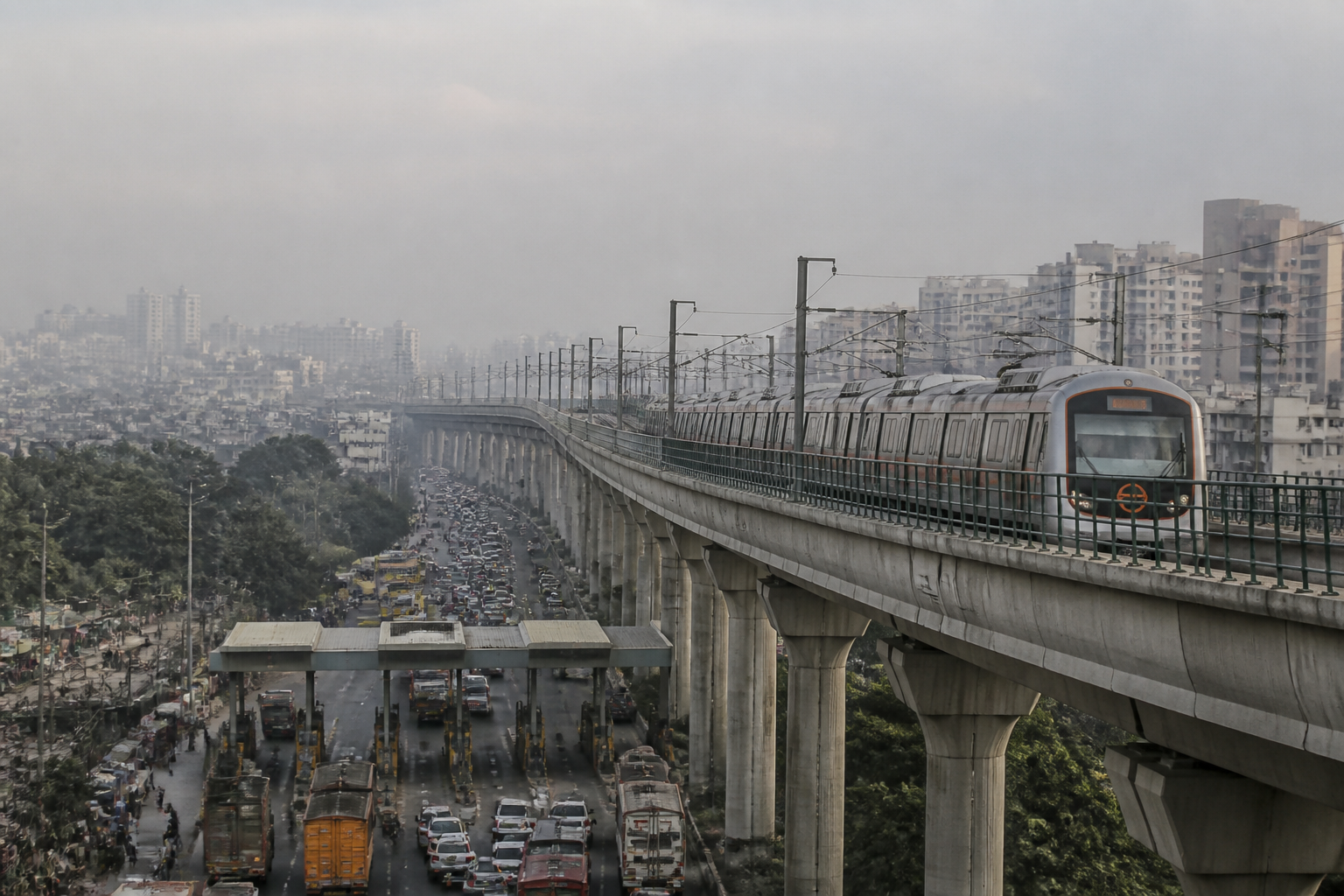
Delhi’s pollution fund has accumulated a large unspent balance even as almost all recorded expenditure has gone to a single regional transport project, according to figures obtained through the Right to Information Act. The data raises a central question about how money collected from commercial vehicles for pollution control is being prioritised, released and linked to measurable improvements in the capital’s air quality.
The Delhi government’s Transport Department received ₹1,935.44 crore in environmental compensation charges, or ECC, of which ₹781.51 crore had been spent and ₹1,153.93 crore remained available, the RTI response cited by Jagran – New Delhi showed. The unspent balance is about ₹372 crore higher than the total expenditure recorded so far.
The figures cover the period from the introduction of the charge in November 2015 to April 10, 2026. Separately, the Municipal Corporation of Delhi told the RTI applicant that it had collected ₹2,247.66 crore in ECC through toll plazas during the same broad period. The civic body said its role was limited to collecting the charge and depositing it with the Delhi government’s Transport Department. The difference between the amount collected by the MCD and the amount recorded as received by the Transport Department is not explained in the supplied material.
The ECC was introduced in compliance with a Supreme Court order. It was intended to discourage the entry of commercial vehicles into Delhi and support measures to control pollution. That purpose gives the fund a more specific policy character than a general transport budget: the charge is linked to an environmental externality, while its use is expected to support interventions connected with pollution reduction or cleaner urban mobility.
The spending pattern is heavily concentrated. Of the ₹781.51 crore recorded as expenditure, ₹765 crore—nearly 98%—was allocated to the Delhi-Meerut Regional Rapid Transit System project. The payments were made in two instalments: ₹265 crore on March 12, 2019, and ₹500 crore on May 3, 2023. The RTI document linked both payments to Supreme Court directions and identified the recipient as the National Capital Region Transport Corporation, also referred to in the report as NCRTC or NCRTC Ltd.
The remaining expenditure was distributed across an H-CNG project, an RFID system and works related to non-motorised vehicle lanes. The supplied RTI-based report does not provide a project-wise breakup of those amounts, nor does it establish the pollution reduction achieved by each intervention. It therefore shows where the money went, but not whether the spending delivered outcomes proportional to the environmental purpose for which the charge was imposed.
That distinction matters because the RRTS is a major regional mobility project, but its presence in the ECC expenditure account raises a question about the relationship between long-term transport infrastructure and immediate pollution-control needs. A rapid rail system can be associated with cleaner mobility if it shifts passengers from private vehicles or road-based transport. However, the figures supplied in the RTI report do not establish the basis on which the ₹765 crore allocation was assessed against the ECC’s stated pollution-control purpose.
The issue is not that transport infrastructure is unrelated to air quality. Delhi’s pollution burden is connected to how people and goods move through the city and the wider National Capital Region. Public transport capacity, commercial vehicle movement, road congestion and the availability of non-motorised transport infrastructure all belong to the same urban system. The institutional challenge is more precise: a charge created for a defined environmental objective needs a transparent framework showing how each expenditure contributes to that objective.
## A fund collected through one system and spent through another
The ECC arrangement separates collection from expenditure. The MCD collects the charge at toll plazas, while the money is deposited with the Transport Department. This division assigns the civic body a collection and transfer function, leaving the state government department responsible for holding and using the funds. Such an arrangement can support specialised implementation, but it also creates a need for clear public accounting across institutions.
The RTI figures illustrate why that accounting chain matters. The MCD’s reported collection of ₹2,247.66 crore is higher than the ₹1,935.44 crore received by the Transport Department in the figures cited by the report. The available material does not clarify whether the amounts relate to different accounting periods, deductions, transfers, revisions or another administrative distinction. Without that explanation, citizens can see the broad scale of collection and expenditure but cannot fully reconcile the fund’s flow from toll plaza to department to project.
The unspent amount presents a second accountability question. More than half of the ₹1,935.44 crore recorded as received by the Transport Department remained unused, even though the charge has been collected for almost 11 years. A balance can result from project approvals, legal restrictions, procurement timelines or the need to reserve funds for approved works. But the supplied response does not identify the reason for the ₹1,153.93 crore balance or specify a schedule for deploying it.
For an air-pollution fund, the timing of expenditure is particularly important. Pollution is a recurring urban problem, not a one-time infrastructure deficit. Measures such as cleaner commercial transport, enforcement systems, road-space changes, walking and cycling infrastructure, and alternative fuels may require sustained funding. A large idle balance may indicate that collection has outpaced the government’s ability to design, approve or implement eligible projects.
## What the allocation pattern reveals
The concentration of expenditure in the RRTS is the clearest finding in the data. The project received approximately 98% of the reported spending, leaving only a small share for H-CNG, RFID and non-motorised vehicle works. This is not merely a project-level detail. It indicates that the fund has functioned primarily as a financing source for one large regional transport investment rather than as a broad portfolio of pollution-control measures.
The distinction between a large capital project and distributed urban interventions is significant. A regional rail corridor requires substantial upfront funding and can absorb large allocations through a small number of sanctioned payments. By contrast, pollution-control measures across Delhi may involve many smaller projects, multiple agencies and continuing operating costs. The spending pattern may therefore reflect administrative convenience as much as environmental priority, although the supplied evidence does not establish the government’s reasoning.
The RRTS payments were connected in the RTI document to Supreme Court orders. That attribution is important because it indicates that the allocation was not presented simply as a discretionary departmental expenditure. At the same time, the available material does not reproduce the relevant court directions or explain the legal and financial basis in detail. The precise relationship between the court orders, the ECC’s purpose and the RRTS instalments remains an issue requiring fuller documentary examination.
The smaller allocations listed in the RTI response point to a wider set of possible interventions. H-CNG relates to cleaner fuel technology, RFID systems can support monitoring or regulatory enforcement, and non-motorised vehicle lanes affect how people move without motor vehicles. Yet the report does not provide locations, completion status, operational performance or air-quality outcomes for these works. That absence limits what can be concluded about their effectiveness.
## The larger urban governance question
Delhi’s pollution charges sit at the intersection of environmental regulation, transport planning and municipal administration. The charge is collected from commercial vehicles, but the benefits of spending are expected to extend across the metropolitan region. This creates a governance problem common to large cities: the institution that collects money, the department that holds it and the agencies that implement projects may not be the same.
A transparent fund framework would need to show at least four links: how much is collected, how much reaches the designated account, which projects are eligible, and what measurable environmental or mobility outcomes follow. The RTI disclosure provides important information on the first three elements, but only partially. It records collection and expenditure figures and names broad project categories, while leaving the performance and reconciliation questions unresolved.
The numbers also show that Delhi’s pollution-control finance is not constrained only by revenue. The fund collected thousands of crores over the period cited, yet a substantial amount remained unspent. That shifts attention from the ability to raise money to the ability to convert a dedicated charge into timely, demonstrable public action.
The evidence does not establish that the RRTS allocation was unlawful, ineffective or unrelated to pollution reduction. Nor does it show why the remaining balance has not been spent. It does establish a pronounced imbalance: ₹765 crore of ₹781.51 crore in recorded expenditure went to one project, while ₹1,153.93 crore remained unused in the Transport Department’s account as cited in the RTI response.
The next step for public accountability is therefore not simply to ask whether the fund was spent, but whether its collection, accounting, allocation and outcomes can be traced. The MCD’s collection figures, the Transport Department’s receipt figures and the project-wise expenditure records need to be reconciled. The government would also need to clarify the intended use and implementation timetable for the balance if the fund is to retain a direct connection with Delhi’s continuing pollution-control needs.
