


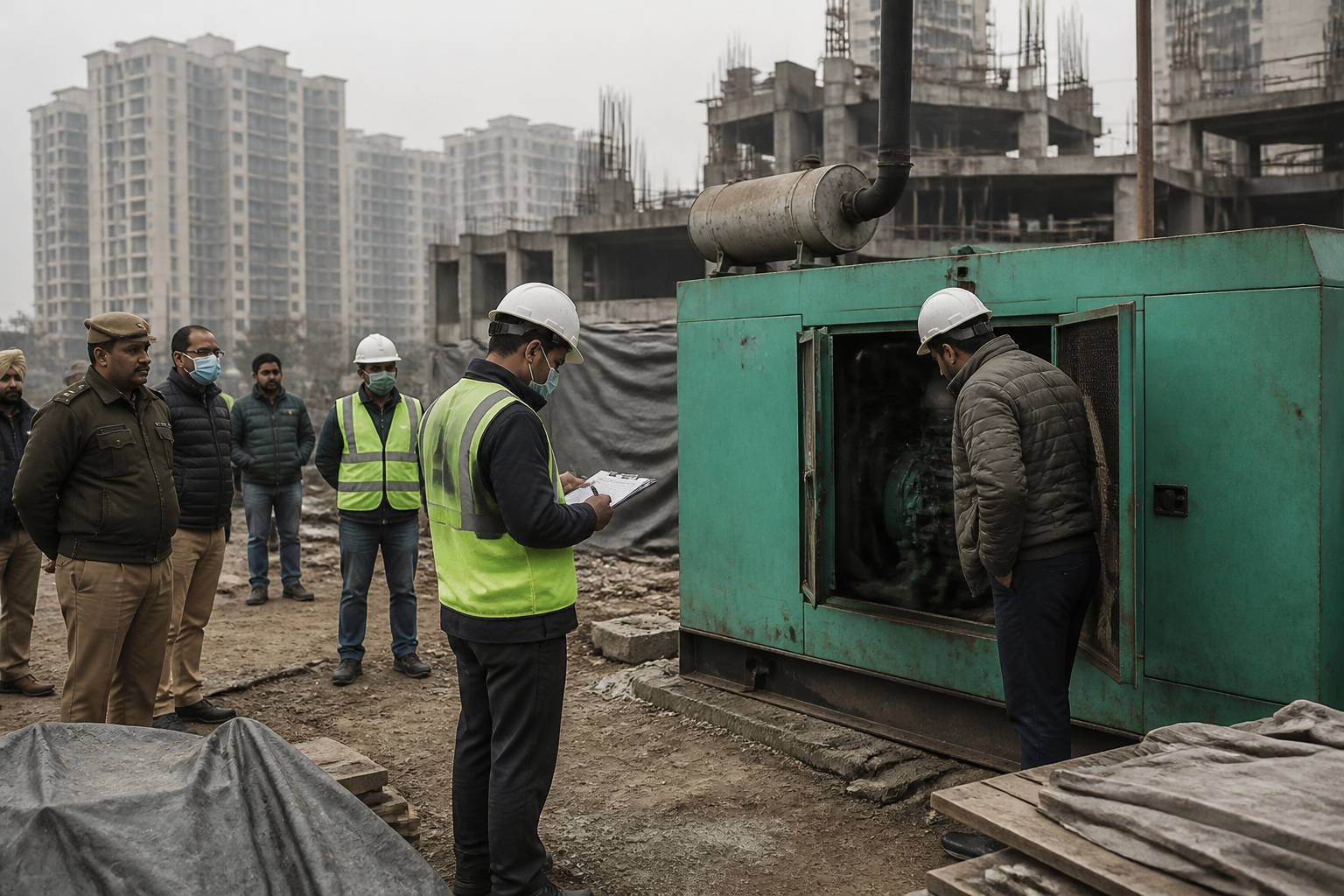
The latest Delhi-NCR pollution crackdown is not just a count of inspections. It is a record of how the region’s air-quality system is attempting to move from seasonal warnings to site-level enforcement before winter. The Commission for Air Quality Management’s Enforcement Task Force inspected 150 locations in 15 days, covering industrial units, diesel generator sets and construction and demolition sites. The exercise also produced proposed closures, equipment sealing and environmental compensation proceedings.
According to a report by Jagran – New Delhi, the inspections were conducted between 24 August and 7 September by the CAQM Enforcement Task Force. The 150 checks included 98 industrial units, 45 diesel generator sets and seven construction and demolition sites. The findings were reviewed at the task force’s 139th meeting, where action was proposed against units found violating applicable requirements.
The scale of the inspection drive matters because Delhi-NCR’s pollution challenge is distributed across many types of activity rather than being confined to one facility or one municipal boundary. Industrial operations, standby power generation and construction activity are governed by different institutions and occur across several states and urban jurisdictions. A regional enforcement mechanism therefore has to identify individual sources, record non-compliance and ensure that corrective action is actually completed.
The report says the proposed action includes closure of three construction and demolition projects and one industrial unit. The task force has also proposed sealing 25 DG sets installed at construction and demolition, industrial and other units. Environmental compensation has been recommended in two industrial cases. These are proposed enforcement outcomes reported after inspections, rather than a final account of completed action, making the next stage of the process important.
That distinction is central to understanding the region’s enforcement challenge. An inspection can identify a violation, but the effect on air quality depends on what follows: whether the closure order is implemented, whether sealed equipment remains out of use, whether a project meets the conditions for reopening and whether compensation proceedings are completed. The figures supplied in the report show that enforcement is a continuing administrative chain rather than a single event.
The report provides a larger cumulative picture. CAQM flying squads have so far inspected 28,547 units, projects and institutions across the National Capital Region. Of these, 1,829 were directed to close, while 1,479 were allowed to resume operations after compliance was confirmed. Another 224 cases were reportedly under examination for permission to restart operations.
These numbers reveal both the reach and the workload of the system. The inspection total indicates that the regional authority has been examining a large number of potential pollution sources. At the same time, the reopening figures show that enforcement does not end with a closure direction. Authorities must verify whether the identified shortcomings have been addressed before operations resume. The 224 cases still awaiting a decision represent an active administrative queue within that process.
The figures should not be read as a direct measure of the change in ambient air quality because the report does not provide pollution readings before and after inspections. Nor does it specify the individual violations recorded at every site, the amount of environmental compensation imposed or the duration of the proposed closures. What the available evidence establishes is the extent of inspection and the enforcement actions proposed or recorded by the task force.
The inclusion of DG sets is significant for urban infrastructure management. Diesel generator sets are used by several types of establishments when grid power is unavailable or inadequate, and they can also serve as backup systems at construction sites and industrial premises. The CAQM exercise treats them as identifiable equipment requiring inspection and, where violations are found, possible sealing. This creates a direct compliance point: instead of addressing pollution only at the level of a broad area, enforcement can target a specific machine at a specific site.
Construction and demolition sites present a different administrative challenge. They are temporary or changing locations, and their activities can shift rapidly as excavation, material handling, demolition and building work progress. The report records inspections at seven such sites and proposes closure of three projects. It does not provide details of the specific violations, but the action demonstrates that construction activity is part of the enforcement map rather than an issue addressed only through general advisories.
The industrial component is larger in volume in the latest drive, with 98 units inspected. One industrial unit faces a proposed closure, while environmental compensation has been recommended in two industrial cases. The report does not identify the units or quantify their emissions. It nevertheless shows how the enforcement framework is combining inspection, operational restrictions and financial liability within the same process.
The Nuh campaign offers a more localised view of this model. During a special drive in Nuh, Haryana, 35 premises were inspected. Thirteen were found compliant, while seven were closed at the time of inspection and are to be checked again. The task force also proposed sealing one DG set and initiating environmental compensation proceedings in six cases.
The Nuh figures also show why raw inspection totals require careful interpretation. A premise being closed when inspected is not the same as an authority ordering it to close, and a compliant finding is not equivalent to a measured improvement in regional air quality. These categories describe the status observed or action proposed during enforcement. They need to be followed by documented re-inspection and compliance confirmation to establish whether the intervention has had an operational effect.
The institutional role of CAQM is important because Delhi-NCR’s air basin extends beyond the boundaries of the National Capital Territory. The task force’s inspections cover units, projects and institutions across the region, while the reported special campaign was conducted in Haryana. This regional reach allows the authority to address pollution sources that may be outside Delhi but still form part of the wider air-quality problem affecting the metropolitan area.
At the same time, the enforcement figures point to the complexity of coordinating action across jurisdictions. A closure direction may involve a project operator, an industrial unit, a local administration and other agencies responsible for implementation. Permission to resume operations requires another level of verification. The cumulative figures of 1,479 units allowed to restart after compliance and 224 cases awaiting examination suggest that administrative capacity for follow-up is as important as the ability to conduct inspections.
The timing of the latest drive is also significant. The inspections took place before the winter pollution season, when the region typically faces heightened public attention on air quality. The report frames the action as preparation for winter, but it does not establish whether the enforcement effort is part of a permanent year-round system or a seasonal intensification. That distinction deserves monitoring because a pollution-control regime based mainly on pre-winter drives could leave gaps during the rest of the year.
The available evidence supports three conclusions. First, CAQM has expanded inspection activity across multiple urban and industrial sources, with 150 checks in a 15-day period and more than 28,000 cumulative inspections by flying squads. Second, the enforcement process is using several tools—closure proposals, sealing of DG sets, environmental compensation and post-compliance reopening. Third, the final impact cannot be judged from inspection numbers alone. It depends on implementation, re-inspection and the environmental results associated with each intervention.
The larger urban question is whether Delhi-NCR can convert enforcement activity into a reliable compliance system. The latest figures show that the authority is identifying sources and proposing action. They also show the continuing need to verify closures, manage reopening requests and track cases that remain under review. Until those stages are documented alongside ambient air-quality data, inspections should be understood as an important governance input, not as proof that the pollution problem has been solved.
For now, the next measurable steps are the proposed action against the identified construction, industrial and other units, the sealing of 25 DG sets where approved, re-inspection of closed premises in Nuh and decisions on the 224 cases awaiting permission to resume operations. These follow-up actions will determine whether the latest Delhi-NCR pollution crackdown remains an inspection exercise or becomes a sustained compliance mechanism.
