


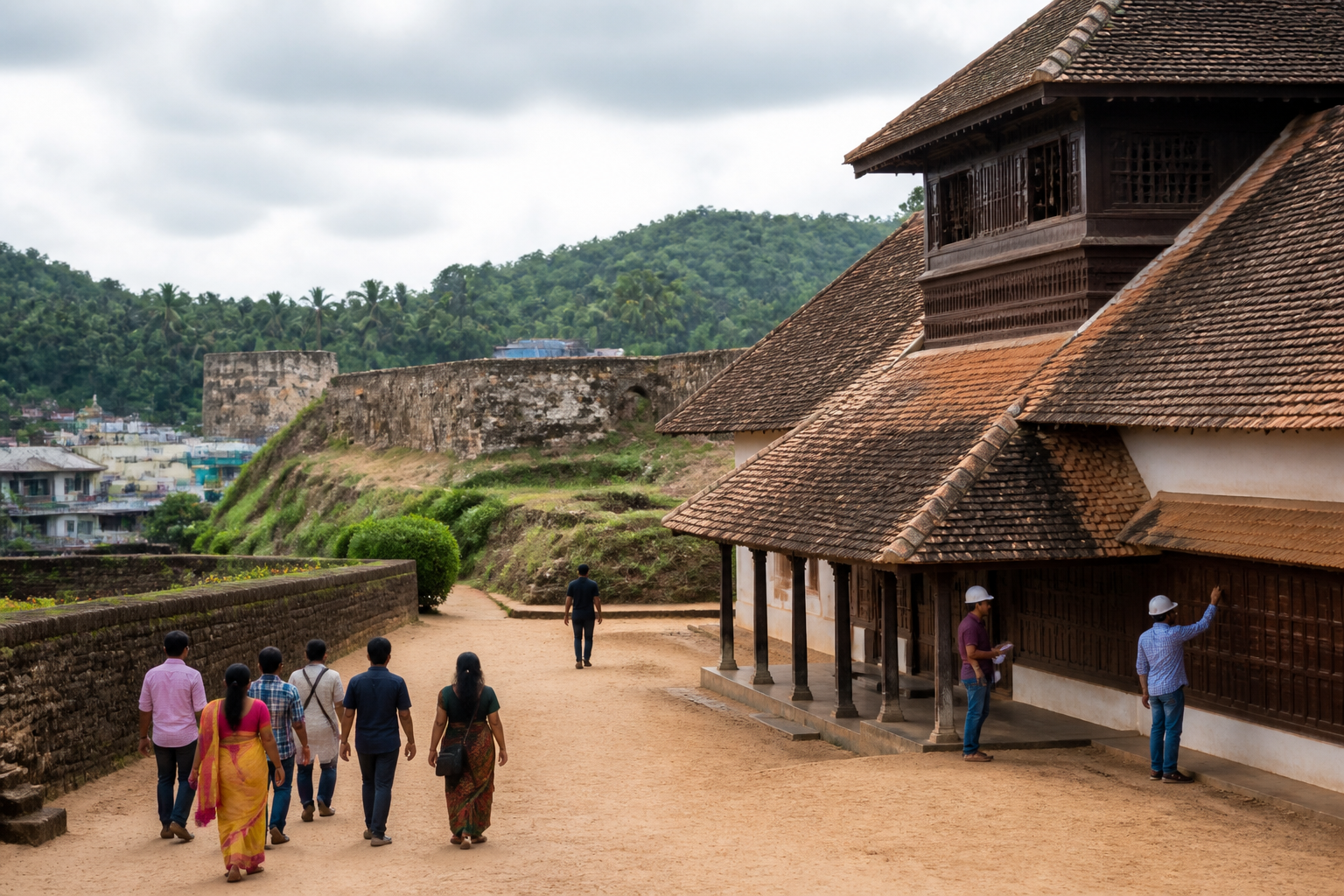
Padmanabhapuram Palace is confronting two pressures that often arrive together at India’s heritage sites: rising visitor numbers inside a fragile monument and fragmented administration outside it. Kerala is considering online, slot-based ticketing to manage the palace’s annual footfall, while the adjoining Kalkulam Fort and other Travancore-era assets under Tamil Nadu jurisdiction remain exposed to decay, encroachment and weak institutional coordination.
The contrast is visible within the same historic landscape. The 17th-century palace in Padmanabhapuram, near Thuckalay in Kanyakumari district, is protected and maintained by the Keralam department of archaeology. The department has carried out restoration work worth Rs 2.3 crore over the past two years, including a museum revamp. It is now considering a system that would limit the number of visitors entering at particular times.
The proposal is not simply a ticketing upgrade. It reflects a conservation problem created by the palace’s popularity. The monument receives about six lakh visitors a year, with daily footfall crossing 1,000 during peak seasons. Almost all areas of the palace have been opened to the public, apart from the Uppirikka Malika, which contains a mural pagoda and served as the royals’ prayer chamber.
E Dinesan, director of the Keralam department of archaeology, said the carrying capacity of a heritage structure diminishes over time. He pointed to the palace’s original ability to accommodate around 150 royals, attendants and civilians, compared with the daily pressure created by hundreds of visitors today. The distinction is important: a building designed for historic occupation is not automatically equipped to absorb continuous modern tourism.
Padmanabhapuram Palace is particularly vulnerable because its construction depends on materials and techniques that require specialised care. The structure used locally available materials such as lime mortar, while its floors were made with a mixture of herbs and guarded ingredients. The palace comprises more than 15 distinct structures, making conservation a continuing programme rather than a one-time repair project.
The financial record shows the scale of that responsibility. Over the past decade, the archaeology department has spent an average of Rs 1 crore annually on conservation, security, surveillance and visitor amenities. Ticket sales generate about Rs 2 crore annually. That revenue provides an important stream for maintaining the monument, but it also creates a structural tension: the site’s popularity supports its finances while the same popularity accelerates physical stress.
Recent restoration work illustrates how the expenditure is distributed across the complex. The first phase of restoration at the homappura, a single-storey, double-courtyard building where homams were performed, was completed at a cost of Rs 60 lakh. The department has also received administrative sanction of Rs 68 lakh for the ongoing restoration of Puthen Kottaram, while Rs 60 lakh has been earmarked for Thekkae Kottaram, a residential complex to the south of the palace. A proposal for the latter is awaiting administrative sanction from the Keralam government.
The proposed slot-based system would therefore serve two functions. It could reduce congestion inside the palace and make visitor flows more predictable for conservation teams. It could also help the department manage the relationship between ticket income and physical access. The supplied report does not establish the proposed capacity, ticketing software, implementation date or whether the system will be seasonal. Those details will determine whether the measure becomes a conservation tool or only a booking change.
The wider governance problem begins at the palace boundary. Under the 1956 state reorganisation settlement, the Keralam government retained custodianship of 6.5 acres of the palace complex. The archaeology department’s jurisdiction ends with those grounds. The land outside the walls, including shops, eateries and other commercial establishments, falls under the Tamil Nadu government. The arrangement separates the management of the principal monument from the management of the setting through which visitors approach it.
That division is especially consequential because Padmanabhapuram Palace was constructed within the ancient Kalkulam fortifications. The fort, established around 1600 CE and later rebuilt under Marthanda Varma around 1750, originally formed part of the same political and administrative landscape. Today, the remains of the 284-year-old Kalkulam Fort adjoining the palace are described as being in a precarious condition.
D Dayalan, a former director of the Archaeological Survey of India and archaeological adviser to Tamil Nadu’s archaeology department, said the fort had earlier been entrusted to the Tamil Nadu public works department. He said it is no longer protected by either the state or the Central government, with portions demolished and others lost to encroachments. Roads and settlements close to the fort wall have also created a risk of collapse.
This produces an uneven heritage landscape. Inside the palace grounds, a dedicated department is funding restoration, improving surveillance and considering regulated entry. Immediately outside, a historic fort spread across 186 acres faces unclear protection and maintenance arrangements. The two assets share history, visitors and physical proximity, but not a unified conservation authority.
The problem extends beyond these two monuments. Kanyakumari district contains forts, temples, churches and other structures associated with the Travancore era and the Dutch presence in the region. About 6.5 kilometres from Padmanabhapuram, the ruins of Eraniel Palace remain neglected under Tamil Nadu government control. At Udayagiri Fort in Puliyoorkurichi, different components are divided between departments: the biodiversity park falls under the Tamil Nadu forest department, while the historic structures, including a chapel containing the tomb of Dutch lieutenant Eustachius De Lannoy, are protected by the Tamil Nadu archaeology department.
The fragmentation is not only administrative; it affects how the sites can be presented and maintained as a visitor circuit. A visitor entering through a well-managed palace may encounter commercial growth, damaged fortifications or inaccessible ruins immediately beyond it. Conservation spending at one site cannot compensate for the loss of the historic setting around it. Nor can visitor regulation inside the palace address construction, land use or encroachment outside its boundary.
The palace’s earlier attempt to seek international recognition also points to the difficulty of managing the wider zone. More than a decade ago, the Keralam government approached Unesco to nominate the palace as a potential World Heritage Site. The government was informed that such a nomination would involve zoning regulations, including buffer-zone rules concerning construction, land use and resource extraction. Because the palace’s formal jurisdiction covers only 6.5 acres, the requirements would necessarily involve authorities beyond the department currently responsible for the monument.
This is the institutional gap at the centre of the story. Heritage protection is often organised around ownership or departmental boundaries, while historic landscapes function across those boundaries. The palace, fortifications, roads, shops, settlements and related monuments form a connected system for visitors and for the physical survival of the structures. A conservation plan that covers only the monument but not its surroundings cannot fully manage tourism pressure or development risk.
Dayalan has suggested that the two state governments work together to bring neglected sites under a unified heritage zone and promote their shared histories. He also pointed to the National Culture Fund and private funding models used for restoration elsewhere in Tamil Nadu. These are proposals rather than an announced joint programme, and the supplied report does not establish whether either state has begun formal negotiations.
What is established is that Padmanabhapuram Palace has an active conservation system, significant visitor demand and identifiable financial commitments, but the broader historic landscape lacks comparable institutional coherence. The palace earns around Rs 2 crore annually from tickets against average annual expenditure of Rs 1 crore on conservation and related visitor services, while adjoining assets face uncertain protection. That imbalance makes the proposed ticketing reform necessary but insufficient as a heritage-management response.
The next test will be whether visitor regulation is linked to a larger plan for the entire historic zone. That would require clarity on carrying capacity, access to the palace, the treatment of commercial activity outside the walls, protection of Kalkulam Fort, and the responsibilities of Kerala and Tamil Nadu departments. Until those questions are addressed, Padmanabhapuram will remain a well-maintained monument surrounded by a deteriorating and administratively divided heritage landscape.
